


Home / Magic Mushroom Spores / Psilocybe Cubensis Spores for Microscopy
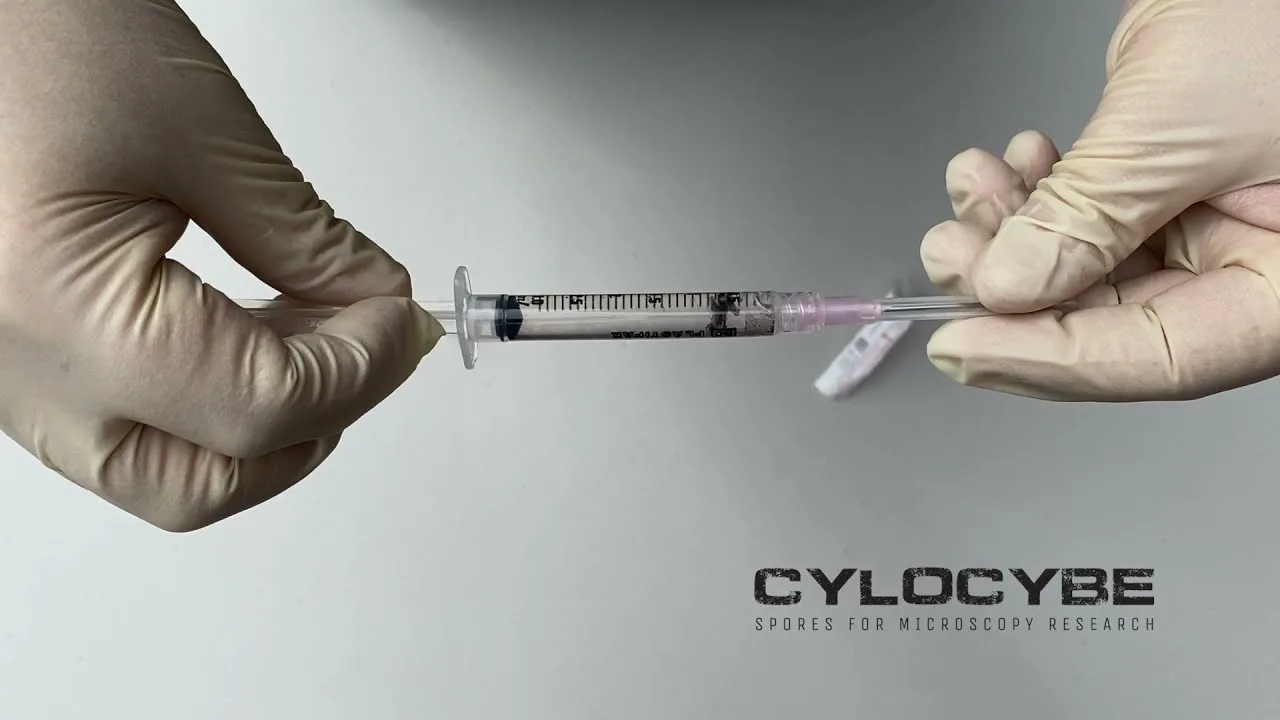
Playing it here streams from YouTube, they then see you're on our site. Click "Watch on YouTube" if you don't want that.
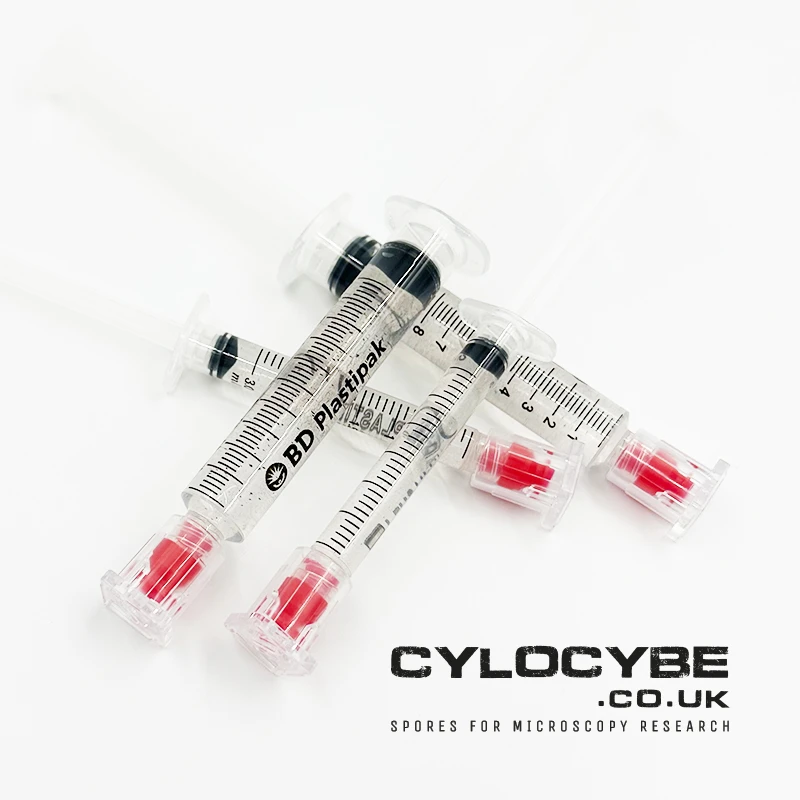
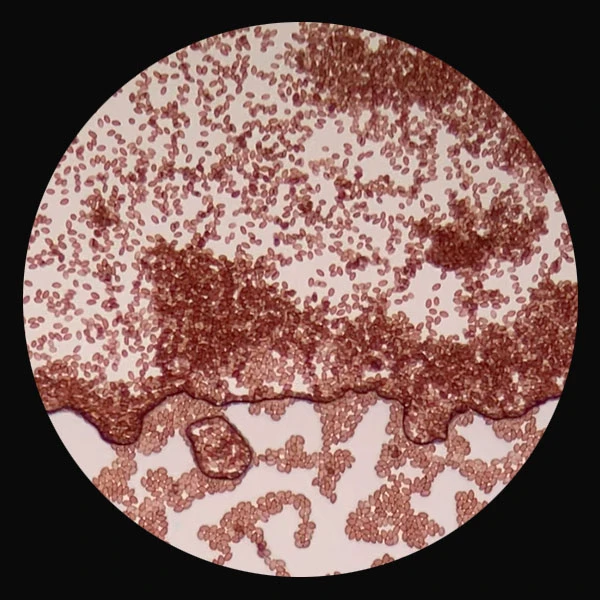
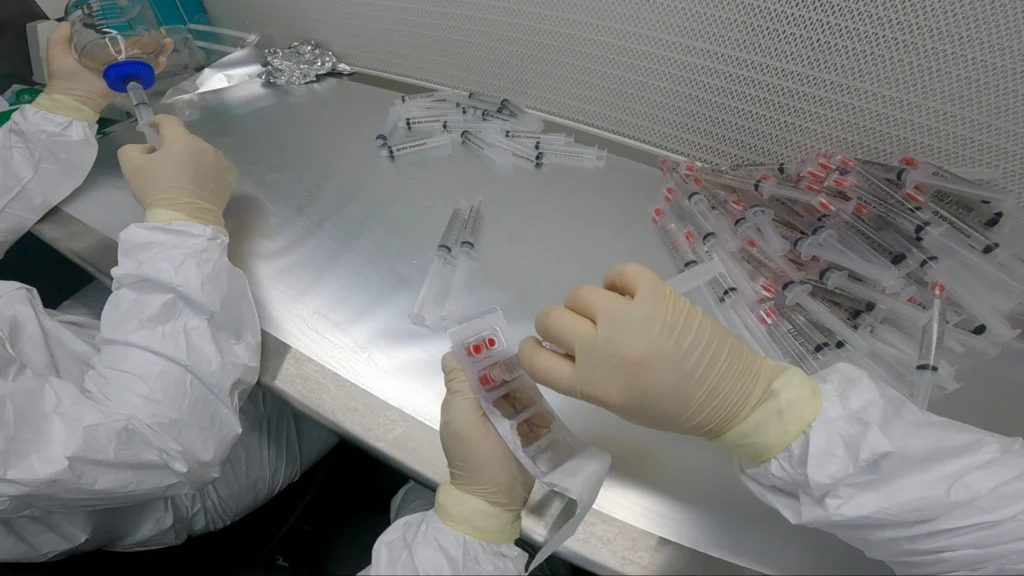
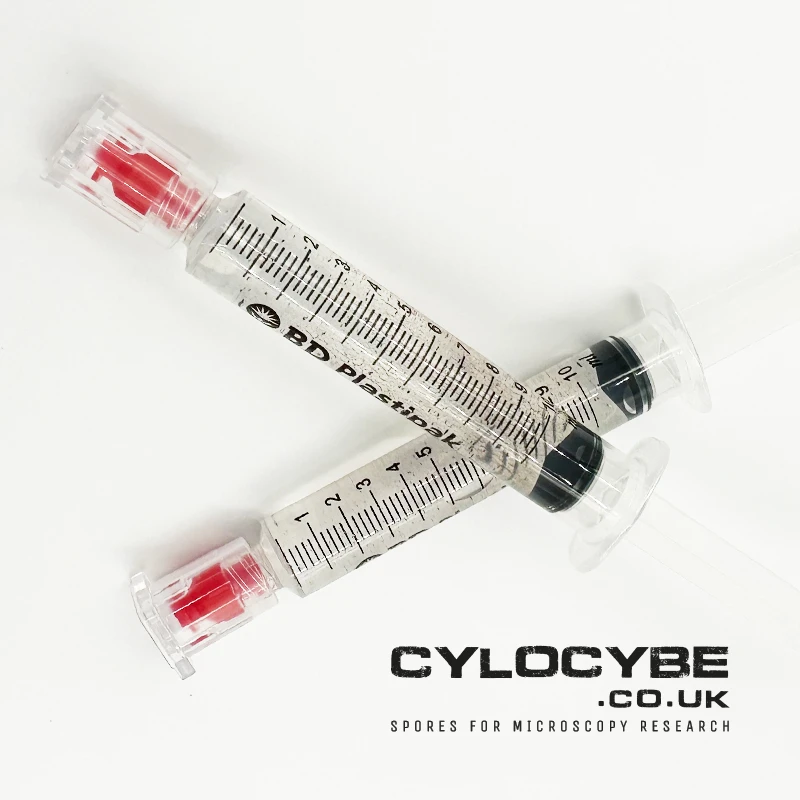
Not demo'd in the video: The plastic break-off component doubles as a screwdriver so you can remove the red cap without getting your grubby fingers anywhere near the exposed syringe opening!
Psilocybe Cubensis Spores for Microscopy
Choose your format
Our prices might seem "cheap", they aren't - these are just ethically priced spores.
Genuine, viable, lab-produced spore syringes and prints sourced from Jamaica, USA and Austria (where it's legal to cultivate magic mushrooms).
Looking to become an ethically priced spore vendor? Drop us an email and we'll help you get started. We can provide prints suitable for running a spore vending business (large, ultra-clean, fresh, dense) - with bulk tiered pricing. If you don't have a lab, we can also provide bulk syringes labelled or unlabelled, bagged or unbagged.
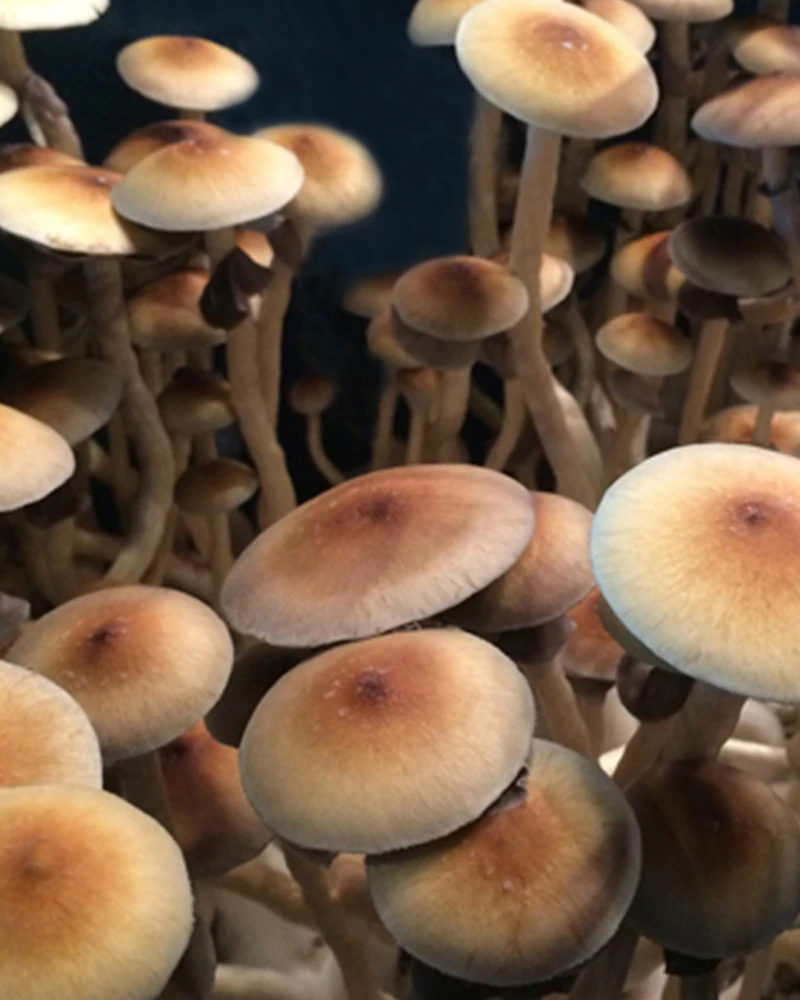
Psilocybe cubensis spores for microscopy
Spore Syringe: 12 ml
- Spores suspended in sterile distilled water in a BD Luer-Lok syringe
- Sealed with a sterile, tamper-evident luer-locking cap
- One sterile wrapped 21G (0.9 mm) × 40 mm luer-locking needle
- One sterile 70% isopropyl alcohol / 2% chlorhexidine wipe, for cleaning your slides before dropping spores on to
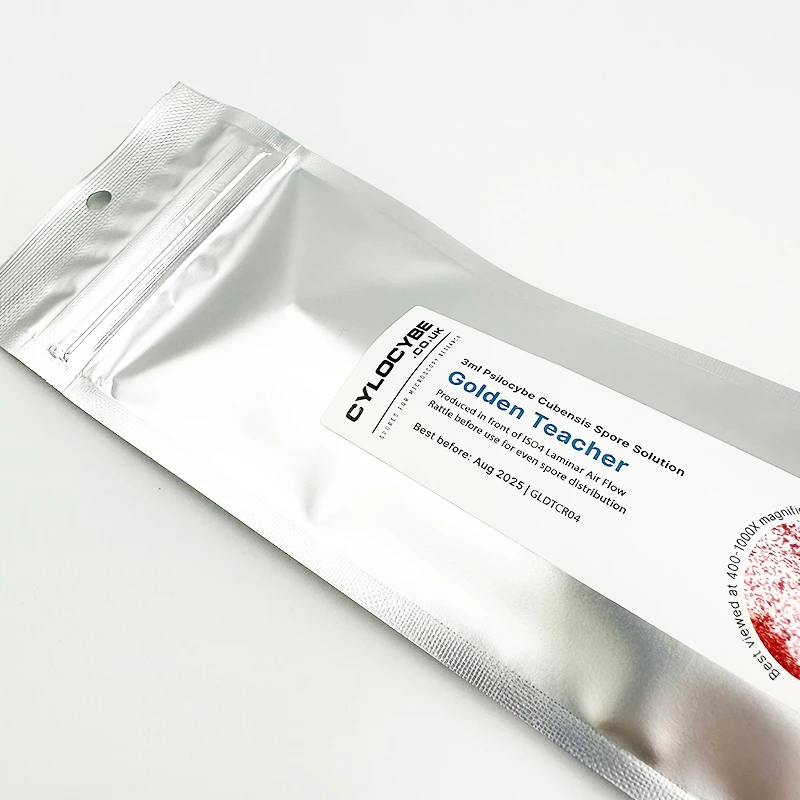
- Sealed in a light-blocking mylar foil bag, labelled on the outside of the bag
OR Spore Print
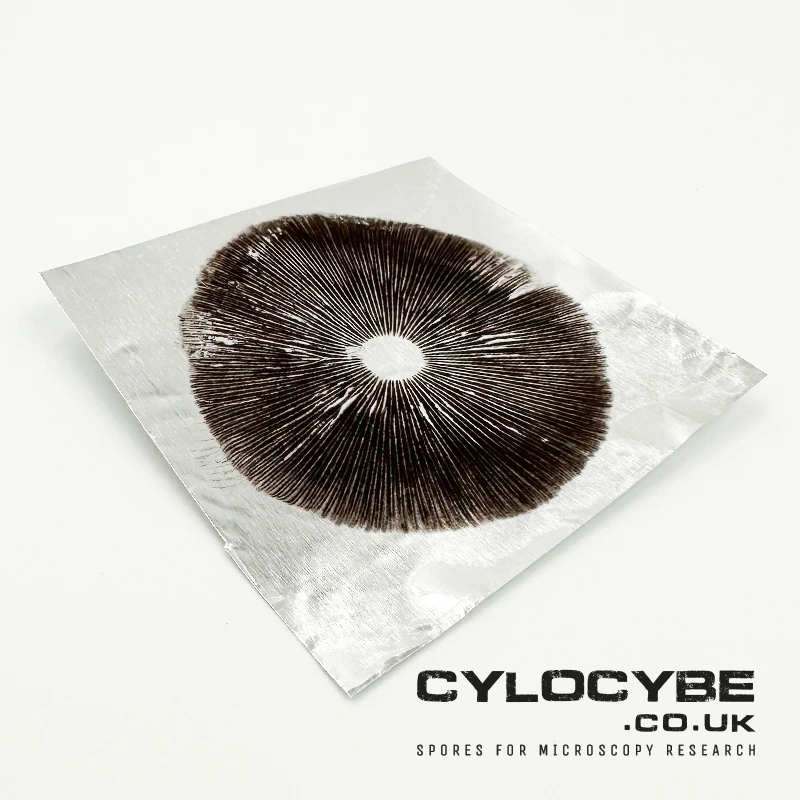
- Spores dropped onto sterile foil. Prints vary: some big, some small, some light, some dense.
- One sterile 70% isopropyl alcohol / 2% chlorhexidine wipe, for cleaning your slides before dropping spores on to
- Sealed in a mylar foil bag. Some are fully light-blocking, some have a window so you can see the print.
How Clean
All spore syringes, vials and swabs are produced right here by us at Cylocybe using spore prints sourced from professional cultivation labs throughout the world. While there is no such thing as a sterile spore syringe (that would be silly), our spore products should contain everything you want without any nasty surprises like trichoderma or bacteria from a staff member watching the clock and picking their nose at the same time. The only person trusted with this job at Cylocybe is Nick, the co-founder who treats every single spore product with the same high level of precision.
Useful
- Syringe is made of polypropylene. Pressure-cooker safe (if you want to re-use).
A cube is a cube
Spores contain an almost infinite mix of genetics. If a customer in a country where it is legal to cultivate this strain did so, then the spores wouldn't necessarily produce the same-looking mushroom they dropped from, or share its exact characteristics. But, sometimes they can - their are always exceptions to the rule when it comes to mycology (especially when expert cultivators are involved).
This is why cultivators in countries where it's legal to cultivate this species share live liquid cultures (which are of course banned in most countries, including here in the UK) and do not start from spores. Even gourmet mushroom farms never start from spores because it'd be a genetic lottery.
There are a few small exceptions to this, for example Leucistic and Albino strains, whose spores will generally all produce whitish mushrooms - but even this exception wouldn't mean all the other traits of the mushroom the spores dropped from would be the same.
This is why the saying "A cube is a cube" exists.
We're telling you this not because we think you'd dare try to cultivate them, but because it's interesting to know.
Does this mean it even matters what spores you buy because they all look the same under the scope. Well, not quite, some of the spores we have can be red, golden, black, and we've even had white translucent cube spores too. This is all getting rather confusing, isn't it... We love it.
The About Strain Tab
Finding the history and background for every cube strain is a massive job with basically no return and the reason why shops don't even bother trying. We thought we'd ask Claude Fable to dig through old forums and web archives to hunt down the first times these strains were ever mentioned on the web and track down anything else it could find about them - what we got after lots of work cutting out gibberish was a really good result that we ourselves are happy with. We're not investigators - we sell products. And just like your local corner shop who don't know the story behind every product on their shelves, neither do we. That's your responsibility if you want to know. Our AI research is a brilliant launching point to learn more.
Legal Disclaimer
Do not attempt the cultivation of this species as even the mycelium would contain Psilocybin - a hallucinogenic chemical banned in the UK since 2005.
What customers say
801 reviews for Psilocybe Cubensis Spores for Microscopy
These reviews are verified CusRev reviews. You will likely see large gaps in the years, these were either due to being on an extended break from Cylocybe due to life events or that we had gaps where we kind of stopped paying the CusRev contract. We unfortunately lost all of our Trustpilot reviews. If you want to leave a review, feel free to. We never pester for them, but only a teeny tiny number of people write them and it would mean a lot to us and our potential customers if you did when you get sent a review invite in a few months. If you order more than one product here, please don’t review every one of them - we had a customer buy 40 syringes and leave top reviews for each - we appreciate them but we have to remove them because they look manufactured. And for the love of mushrooms, don’t buy 40 products and leave 40 bad reviews without getting in touch first :)
Only logged in customers who have purchased this product may leave a review.
Psilocybe cubensis
Australian Gold Cap.
An Aussie pasture classic: golden caps the colour that gave the whole country its slang for these mushrooms, plus a heavy dark purple-brown print that makes it a satisfying one to study.
What's known
Here's what's meant to be true and not.
What we actually know
- Australian Gold Cap is a plain Psilocybe cubensis. Not a hybrid, not a separate species, and not low-pigment.
- In Australia, gold top, golden top and gold cap are everyday common names for wild P. cubensis itself, which is where this strain's name comes from.
- P. cubensis is not native to Australia. By most accounts it arrived with imported cattle (around 1,800 head were on the mainland by 1803) and now grows wild from northern Queensland down to southern New South Wales.
- Like other healthy normally coloured cubes it drops a heavy, dark purple-brown spore print and shows the classic blue bruising of the species when the flesh is handled.
What the community says
- The strain is said to have been isolated from a single wild fruit somewhere in southern Australia, but no collector, place or date is documented. Treat that as hearsay.
- It is described as having been passed around the Australian spore-trading scene for decades before it apparently slipped across borders to overseas vendors fairly recently.
- Vendor blurbs love to call it a high-potency, tough, mold-resistant Aussie. Remember a cube is a cube, and strength claims like that are largely cultivation talk rather than anything about the spores.
- Because it shares the Australian-pasture origin story, it sometimes gets lumped in with other Aussie strains like Blue Meanies or Wollongong. They are separate community names, not the same isolate.
Where it came from
In Australia you do not say Psilocybe cubensis at the pub. You say gold top, and everyone knows exactly what you mean. The golden-brown cap is so much a part of the local landscape that the colour became the name, and "Australian Gold Cap" is really just that same slang dressed up as a strain. So the first thing to say is that the name describes a look, not a documented pedigree.
The species itself is a relative newcomer to the continent. By most accounts it is not native at all, and rode in with the cattle that colonial shippers landed from the late 1700s onward. Give a dung-loving, warm-climate fungus that many fresh paddocks of cow pats and it does what it does best, and within a couple of centuries gold tops were a fixture of Queensland and New South Wales pasture from late spring into autumn.
As a named collector's strain the history is thin: it is said to come from a wild southern-Australian fruit, but no name, no paddock and no date survive. Take the origin as a story.
What to expect at the scope
What you can say plainly is what it is under the lens. This is normally coloured, ordinary cubensis, the kind that gives a generous dark purple-brown print and clean, thick-walled, subellipsoid spores with the usual flattened germ pore at one end. There is no albino or leucistic twist here, no famous quirk, just a good-looking pasture cube with a great Aussie nickname and a habit of catching its own falling spores on a persistent white ring.
Magic mushroom spores
Psilocybe cubensis.
The name
The formal record, from Index Fungorum:
Psilocybe cubensis (Earle) Singer, Sydowia 2(1-6): 37 (1948). Basionym: Stropharia cubensis Earle 1906.
Index Fungorum, record 290107
What that line means: Earle named this mushroom first, in 1906, but filed it under a different genus, Stropharia. Singer moved it into Psilocybe in 1948, and published that move in a journal called Sydowia, volume 2, page 37. Earle keeps the brackets because the first name was his. A basionym is simply the original name a later one was built on.
The genus itself:
Psilocybe (Fr.) P. Kumm., Führ. Pilzk. (Zerbst): 21 (1871).
Index Fungorum, genus record 18418
What that line means: the same idea one level up. Fries used the name first; Paul Kummer raised it to a full genus in 1871, in a German field guide printed in Zerbst. Fries in the brackets, Kummer outside them.
“Psilocybe cubensis was first described in 1906 as Stropharia cubensis by American mycologist Franklin Sumner Earle in Cuba.”
Wikipedia, Psilocybe cubensis
“The name Psilocybe is derived from the Ancient Greek roots psilos (ψιλος) and kubê (κυβη), and translates as ‘bare head’.”
Wikipedia, Psilocybe cubensis
“It belongs to the fungus family Hymenogastraceae.”
Wikipedia, Psilocybe cubensis
What a family is: the rank above genus. Older books file Psilocybe under Strophariaceae; DNA work moved it to Hymenogastraceae, so you will see both depending on how old the book is.
What it looks like
The cap:
“The cap is 1.6–8 cm, conic to convex with a central papilla when young, becoming broadly convex to plane with age, retaining a slight umbo sometimes surrounded by a ring-shaped depression. The cap surface is smooth and sticky, sometimes with white universal veil remnants attached.”
Wikipedia, Psilocybe cubensis
In plain English: the cap is roughly 1.5 to 8 cm across. Young ones are cone-shaped or domed with a small raised bump in the middle — that bump is the papilla. Older ones open out flat and usually keep it, sometimes with a shallow ring-shaped dip around it. The surface is smooth and sticky to the touch, and can carry white flecks, which are what is left of the veil that covered the mushroom when it was young.
The stem:
“The hollow white stipe is 4–15 cm high by 0.4–1.4 cm thick, becoming yellowish in age.”
Wikipedia, Psilocybe cubensis
In plain English: the stem. 40 to 150 mm tall, 4 to 14 mm thick, hollow down the middle, white to start with and yellowing as it ages.
The gills:
“The narrow grey gills are adnate to adnexed, sometimes seceding attachment, and darken to purplish-black and somewhat mottled with age.”
Wikipedia, Psilocybe cubensis
In plain English: the gills reach the stem and join it (adnate), or meet it only narrowly (adnexed), and sometimes pull away from it altogether as the cap opens out (seceding). They start grey and turn purple-black in uneven patches as the spores ripen — that patchiness is what mottled means.
And the reaction the genus is known for:
“When bruised, all parts of the mushroom stain blue.”
Wikipedia, Psilocybe cubensis
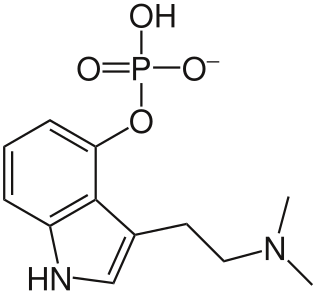
The blue is not psilocybin. It is what psilocybin becomes. Two enzymes taken from this species were described in 2020:
“We report two enzymes from Psilocybe cubensis that carry out a two-step cascade to prepare psilocybin for oxidative oligomerization that leads to blue products. The phosphatase PsiP removes the 4-O-phosphate group to yield psilocin, while PsiL oxidizes its 4-hydroxy group.”
Lenz, Wick, Braga, García-Altares, Lackner, Hertweck, Gressler & Hoffmeister, Angew. Chem. Int. Ed. 59(4): 1450–1454 (2020) · PubMed 31725937 · doi:10.1002/anie.201910175
In plain English: break the mushroom and two enzymes go to work in sequence. The first, PsiP, snips the phosphate group off psilocybin, which leaves psilocin. The second, PsiL, then oxidises that psilocin. The oxidised pieces link up with each other into short chains, and those chains are the blue you can see.
“MS and IR spectroscopy indicated the formation of a heterogeneous mixture of preferentially psilocyl 3- to 13-mers and suggest multiple oligomerization routes, depending on oxidative power and substrate concentration. The results also imply that phosphate ester of psilocybin serves a reversible protective function.”
Lenz et al. (2020) · PubMed 31725937
In plain English: the blue is not one compound but a mixture — chains of roughly three to thirteen linked units, in varying proportions depending on how much oxygen and how much starting material there is. That is why the colour varies from a faint blue-green to a deep ink stain. The last sentence is the neat part: the phosphate group that PsiP removes acts as a cap that keeps psilocybin stable while the mushroom is intact. Damage the mushroom and the cap comes off, which is why bruising is what triggers the colour.
Under the microscope
“The spores are 11.5–17.3 x 8–11.5 µm, sub-ellipsoid, basidia 4-spored but sometimes 2- or 3-, pleurocystidia and cheilocystidia present.”
Wikipedia, Psilocybe cubensis
In plain English: a µm is a micrometre, a thousandth of a millimetre, so the spores are about 12 to 17 thousandths of a millimetre long. Sub-ellipsoid means slightly oval. Basidia are the cells on the gills that make the spores, normally four at a time. Pleurocystidia and cheilocystidia are sterile cells that sit on the face and the edge of the gill; they make no spores, and which ones a mushroom has helps tell species apart under the scope.
Where it grows
“Psilocybe cubensis is found on cow (and occasionally horse) dung, sugar cane mulch or rich pasture soil.”
Wikipedia, Psilocybe cubensis
“Psilocybe cubensis is a pan-tropical species, occurring in the Gulf Coast states and southeastern United States, Mexico, in the Central American countries of Belize, Costa Rica, Panamá, El Salvador and Guatemala, the Caribbean countries Cuba, the Dominican Republic, Puerto Rico, Guadalupe, Martinique, and Trinidad, in the South American countries of Argentina, Bolivia, Brazil, Colombia, French Guiana, Paraguay, Uruguay and Peru, Southeast Asia, including Thailand, Vietnam, Cambodia and Malaysia, India, Australia, Fiji, and possibly Nepal and Hawaii.”
Wikipedia, Psilocybe cubensis
Where it came from
A paper published in Proceedings of the Royal Society B in March 2026 named the species' closest wild relative, Psilocybe ochraceocentrata, from grassland in South Africa and Zimbabwe. The two last shared an ancestor around 1.5 million years ago — far earlier than the long-held assumption that P. cubensis reached the Americas with cattle in the 1500s.
“Discovery of the closest free-living relative of the domesticated ‘magic mushroom’ Psilocybe cubensis in Africa”. Proc. R. Soc. B 293(2066): 20252270.
Bradshaw, Sharp, Van Der Merwe, Tremble & Dentinger, 11 March 2026 · doi:10.1098/rspb.2025.2270 · registry record
Psilocybin
“Psilocybin… is a naturally occurring tryptamine alkaloid and investigational drug found in more than 200 species of mushrooms, with hallucinogenic and serotonergic effects.”
Wikipedia, Psilocybin
In plain English: an alkaloid is a nitrogen-containing compound made by a plant or fungus. Tryptamine describes its chemical skeleton, which is the same one serotonin is built on. Serotonergic means it acts on the body's serotonin receptors. Investigational drug means it is going through formal medical trials.
“Psilocybin itself is biologically inactive but quickly converted by the body to psilocin.” “Psilocybin is transformed into psilocin by dephosphorylation mediated via phosphatase enzymes.”
Wikipedia, Psilocybin
In plain English: psilocybin does nothing on its own. Enzymes called phosphatases strip a phosphate group off it — that is dephosphorylation — and what is left behind is psilocin, which is the active compound.
“In 1958, the Swiss chemist Albert Hofmann isolated psilocybin and psilocin from the mushroom Psilocybe mexicana.”
Wikipedia, Psilocybin
The law in the UK
“Fresh mushrooms had previously been widely available, even in shops.”
Wikipedia, Legal status of psilocybin mushrooms
“Section 21 of the Drugs Act 2005 made fresh psychedelic mushrooms (‘fungi containing psilocybin’) a Class A drug.” “From 18 July 2005 both fresh and ‘prepared’ (that is, dried, cooked or made into a tea) psilocybin mushrooms became illegal.”
Wikipedia, Legal status of psilocybin mushrooms
In plain English: before that date fresh mushrooms sat in a gap in the law and were sold openly, including in shops. Section 21 of the Drugs Act 2005 closed the gap. Since 18 July 2005 fresh and dried both count as Class A, the most serious category under the Misuse of Drugs Act 1971.
Why spores are different
“Mushroom spores, which do not contain psilocybin, are not regulated.”
Wikipedia, Legal status of psilocybin mushrooms
In plain English: the law controls psilocybin and psilocin. A spore contains neither, so it is not a controlled substance. That is the basis on which spores can be sold and studied here, and it is why growing is a different matter entirely.
Everything we sell is sold for microscopy, research and collecting.
Q & A
 Psilocybe Cubensis Spores for Microscopy
Strains with * are the most popular ones (essentially a top 5).
We will when we can, it’s unfortunately quite a bit more difficult to get our hands on those species than it used to be since switching away from our old supplier who was causing us some issues in regards to quality.
Apologies, I don't understand the question. These are microscopy spores if that answers it for you.
Regardless of our own personal opinions; cultivating this species has been illegal in the UK since 2005.
Magic mushrooms aren’t illegal like Cannabis is - they are class A restricted and sit beside heroin and cocaine on that list.
...Some people may find that fact more mind bending than the chemical itself, but that’s the law. If we sold this product for anything other than it’s intended purpose (viewing under the microscope) then we’d have our business and our freedoms taken away in a heartbeat.
Please use our products responsibly and legally.
1ml exists on the site. We are trying to source exotics, but it’s a nightmare right now getting ahold of them.
Preparing Cylocybe Spore Syringes
Playing it here streams from YouTube, they then see you're on our site. Click "Watch on YouTube" if you don't want that.
Same day dispatch on spores when you order and pay before 1pm Monday to Friday (UK-only pledge). If we run late, Tracked 24 orders get an extra freebie in the parcel, and Tracked 48 orders are bumped up to Tracked 24 so they still arrive by the same date. Free UK Postage is different - we hold those back a few working days to help with our workload, which is the trade for it being free.
If your parcel does not arrive
Contact us, not Royal Mail. Royal Mail only deal with the sender, which is us:
“If you're the recipient please contact the sender. They will contact us to make enquiries on your behalf.”
Royal Mail: what to do if your item doesn't arrive
When Royal Mail treat an item as missing
Royal Mail will not look at a claim until this much time has passed after the date your item was due. They also say early claims cannot be processed.
- Tracked 24 and Tracked 48: due date plus 7 working days
- Standard and Tracked to Europe: due date plus 20 working days
- Tracked outside Europe: due date plus 25 working days
- Standard outside Europe: due date plus 25 working days
What Royal Mail pay for a lost item
- International Standard and International Economy: the lower of market value or £20
- International Tracked: the lower of market value or £50
Royal Mail: international compensation
That is what Royal Mail pay us. What you get from us is covered by our replacements policy, which does not depend on Royal Mail paying out.
Stopped at customs
In the 9 years we have been running, we have only had a couple of issues with parcels being stopped at customs - if this is the fault of us (USA seized a parcel once because we put a Cadbury's chocolate bar into a parcel as a treat ) then of course we will sort it out and take the hit. But if it's not our fault, then we will not cover any replacement cost. Luckily, this situation has probably happened a few times in all of these years.
Full shipping and dispatch details, including every international price
Graham F. (verified owner) –
These look ace under the microscope.!
Anonymous (verified owner) –
Looking beautiful under the Microscope. Thank you and keep up the grate work
Simone (verified owner) –
Took a bit to understand how to put on the needle, but everything good so far!
Nick –
There's a video on the product page, scroll down 🙂
Richard (verified owner) –
Thomas L. (verified owner) –
Matthew M. (verified owner) –
C Davies (verified owner) –
I have to say that the syringe is well-packed in foil and appears to have spores (very tiny). I have not yet put them on a slide to view under a microscope, but I can see something in the media.
Tom (verified owner) –
A service to the nation
P (verified owner) –
Excellent quality, clean spores for microscopy.
Eddie (verified owner) –
Excellent