Skip to content

Home / Magic Mushroom Spores / Rare & Exotic Species / Psilocybe Mexicana

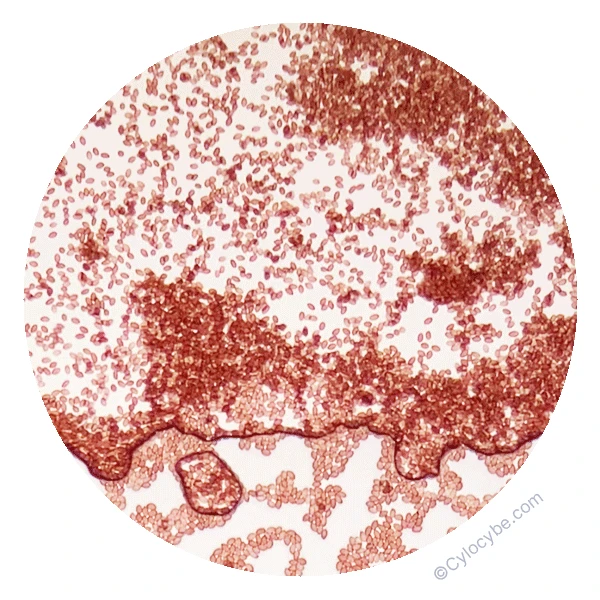
Microscopy spores Psilocybe Mexicana

Psilocybe Mexicana

The first psilocybin mushroom

The mushroom modern psilocybin science actually began with. Roger Heim named it in 1957, grew it in his Paris lab, and from that cultivated material Albert Hofmann isolated the first pure psilocybin.

£15.00£30.00

Choose your format

Some formats are out of stock

Want to know the moment it returns?

Sold for microscopy, taxonomy and collecting only. Not for cultivation.

UK lab-made
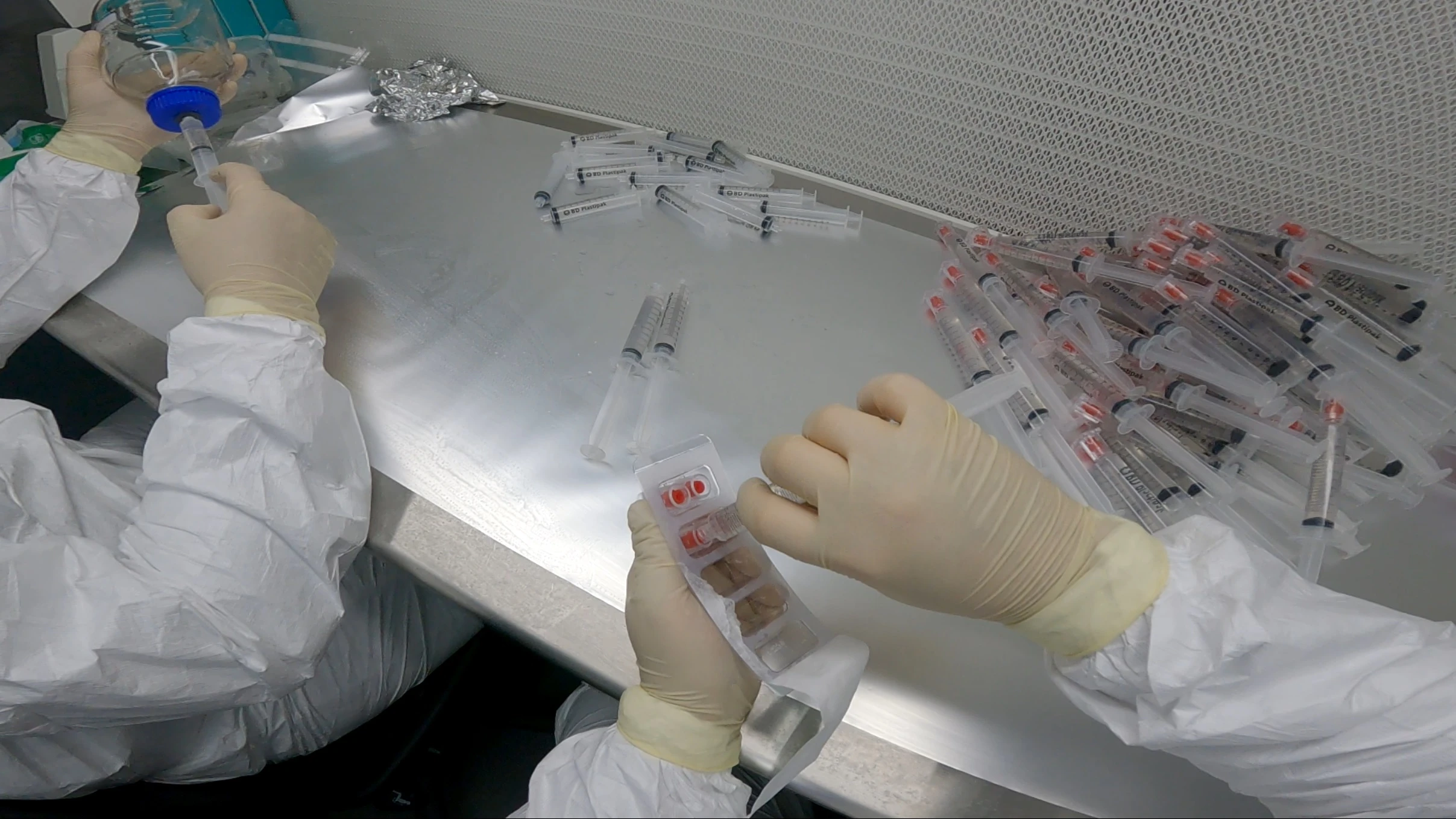
filled under laminar flow
Discreet post
plain packaging, tracked

The short version

Psilocybe mexicana is a small, fragile, ochre-brown grassland mushroom from the Mexican and Central American highlands, described by Roger Heim in 1957. It is the species Albert Hofmann's Sandoz lab first isolated psilocybin and psilocin from, and one of the few psilocybes that forms sclerotia (the "magic truffles"). Not a cubensis: smaller spores, smaller fruitbodies, meadow not dung. Sold here for spore microscopy only.

Straight talk

Fact vs. legend

There is a lot of folklore around this strain. Here is which bits are real, side by side.

What we actually know

  • Psilocybe mexicana was described and named by the French mycologist Roger Heim in 1957 (Revue de Mycologie, Paris). The authority "R. Heim" after the binomial records exactly this.
  • Heim cultivated the species in his Paris laboratory, and it grew well in artificial culture. That cultivability is the reason it, rather than a harder-to-grow ceremonial species, became the chemistry workhorse.
  • Working from roughly 100 g of Heim's lab-cultivated dried material, Albert Hofmann's group at Sandoz in Basel isolated and named psilocybin and psilocin, publishing in 1958. This is the species the field of psilocybin science was launched from.
  • It is one of the few psilocybes that forms sclerotia: hardened, dormant masses of mycelium that, by most accounts, give the organism some protection from wildfire and drought.
  • The spore print is dark purple-brown. Under the scope the spores run roughly 8 to 12 by 5 to 8 micrometres, smooth, subellipsoid to ovoid, with the distinct germ pore characteristic of the genus.
  • It is a grassland and meadow species, not a dung mushroom. It grows among moss along roadsides and trails, in humid meadows and cornfields, and at the grassy margins of forest in Mexico and parts of Central America.
  • In Gaston Guzman's classification it is the namesake of section Mexicanae, a group diagnosed partly by spores longer than about 8 micrometres, which also contains its sclerotia twin Psilocybe tampanensis.

What the community says

  • Teonanacatl is often translated "flesh of the gods", but the word (teotl "god" plus nanacatl "mushroom") reads more literally as "god's mushroom", and by most accounts it was a collective term for several sacred species, not a label for P. mexicana specifically.
  • It is widely repeated that Maria Sabina's velada centred on this species. By most accounts her ceremonies chiefly used Psilocybe caerulescens; mexicana is the one that carried the laboratory story, not her ceremony night.
  • A frequent claim is that Hofmann discovered or named the mushroom. He did not. Heim named the mushroom; Hofmann named the molecules.
  • Many shop sources state the sclerotia are stronger than the fruitbodies. Hofmann's own analytical figures point the other way, with sclerotia-bearing mycelium reportedly equal to or lower than the dried mushrooms. We do not assert the sclerotia are more potent.
  • The vendor "Jalisco" strain is sometimes said to be "the original 1956 Heim and Hofmann strain". That conflates a commercial label with the original Oaxaca material and is not supported by any scholarly source; treat it as marketing.

The story

The mushroom that wrote the science

Most magic mushrooms have a story. This one has a footnote in every textbook. Psilocybe mexicana is the species from which the active molecules of the whole genre were first pulled out, named and drawn as a structure, and it got there by a quiet route nobody would have guessed.

The Nahua name teonanacatl, often rendered "flesh of the gods" (though it reads more literally as "god's mushroom"), was recorded by sixteenth-century chroniclers such as Sahagun. It was, by most accounts, a collective name for several sacred mushrooms, not a precise label for any one species. For a long stretch the record went sideways: in 1915 the botanist William Safford argued teonanacatl was not a mushroom at all but dried peyote, and that error stood for roughly two decades until Richard Evans Schultes, working with Blas Pablo Reko, confirmed in the late 1930s that the ceremonial intoxicant was, in fact, mushrooms. The type material of P. mexicana traces to springy meadows near Huautla de Jimenez, Oaxaca, in the rainy season of 1938.

The popular ignition came later. In the mid 1950s the American banker and amateur ethnomycologist R. Gordon Wasson reached Huautla and, on the night of 29 to 30 June 1955, took part in a velada led by the Mazatec curandera Maria Sabina. His photo-essay "Seeking the Magic Mushroom" ran in Life on 13 May 1957 and is widely credited with introducing the Western public to these mushrooms. A note belongs here: Wasson popularised what Schultes, Reko and Robert Weitlaner had already documented, and the mushroom most associated with Sabina's ceremonies is reported to be P. caerulescens, not this one. The exposure, by her own later account, fell hard on Sabina and on Huautla.

Heim named the mushroom, Hofmann named the molecule, and neither was the species Maria Sabina chiefly used. Mexicana earned its place in history for a quieter reason: it was the one that grew in the lab.

The French mycologist Roger Heim, then director of the Museum national d'Histoire naturelle in Paris, identified the mushrooms Wasson collected and described P. mexicana in 1957. Crucially, he got it to grow under glass in his Paris laboratory, and it took to culture better than the showier ceremonial species. That single practical fact is why this modest meadow mushroom, and not a more famous one, became the doorway into the chemistry.

The landmark

Where psilocybin came from

This is the species the modern study of psilocybin literally started from. The molecule the whole field is built on came out of cultivated Psilocybe mexicana grown by Heim in Paris and analysed by Hofmann in Basel.

Heim grew it, then posted it to Basel

Roger Heim cultivated P. mexicana in his Paris lab and, by Hofmann's own account, sent roughly 100 g of dried, lab-grown fruitbodies to Albert Hofmann at the Sandoz works in Basel. This was the literal hand-off from ethnomycology to pharmacology, and it worked because the species cultured well.

Psilocybin and psilocin isolated (1958)

Hofmann's group, with assistant Hans Tscherter, isolated two new crystalline compounds from the cultivated material and named them psilocybin and psilocin. The isolation was published in 1958 (Hofmann, Heim, Brack and Kobel, Experientia 14). The structure work and total synthesis followed shortly after, so the active principle gained a name, a structure and a reproducible synthesis.

Tracked down by self-experiment

Because the effect is subjective and human, animal assays gave unreliable readouts, so the team could only locate the active fraction in people. Hofmann reported eating 32 dried specimens himself to confirm the cultivated material was still active. We note this strictly as how the molecule was tracked down, documented science history and not guidance of any kind.

Why it matters

Sandoz later supplied synthesised psilocybin (under the name Indocybin) to researchers, and every later study traces back to this isolation. Psilocybin is essentially a prodrugAn inactive compound the body converts into the active one; psilocybin converts to psilocin., both tryptamine alkaloids structurally related to serotonin. For a mushroom this slight, that is a remarkable place in the record.

The truffle question

Sclerotia, the "magic truffle"

Sclerotium cross-section

Alongside its sister species Psilocybe tampanensis, P. mexicana is one of the few psilocybes that lays down sclerotiaHardened, dormant lumps of fungal tissue, a survival store the fungus can revive from later.. This is a piece of biology worth getting right, because the trade name for it is a bit of a fib.

What a sclerotium actually is

A sclerotium is a hardened, compact mass of myceliumThe thread-like body of a fungus, the network a mushroom grows from., a dormant survival body the fungus forms to ride out adverse conditions (it runs roughly 30 percent dry matter). By most accounts it affords some protection from wildfire and drought, which is the documented ecological reason this meadow species evolved one.

Not a real truffle

In the trade these underground bodies are sold as "magic truffles", a popular misnomer. A true truffle is the fruiting body of an ascomycete; a sclerotium is a storage and dormancy structure of the mycelium. They look superficially alike and behave completely differently, and a keen reader should know the difference.

Light or dark decides which form

The clean teaching point: documented accounts agree sclerotia formation is favoured by dark, nutrient-rich conditions, while above-ground mushroom formation is favoured by exposure to daylight. That light-versus-dark switch is exactly why the "truffle" lineages are grown in the dark.

A potency note

Many shop pages claim the sclerotia are stronger than the mushrooms. Hofmann's own figures point the other way, with sclerotia-bearing mycelium reportedly equal to or lower than the dried fruitbodies, and encyclopaedic sources agree the sclerotia carry lower active content. We frame the sclerotium as a documented survival structure, not as a strength pitch.

In cultivation

Grown for its sclerotia

The same cultivability that once handed Hofmann his material has kept this species a fixture of the live-growing world ever since. We document that biology and history in the third person, as mycology, not as a how-to.

A note before we get into it.

What follows documents how Psilocybe mexicana is grown and kept, as mycology and history. It is legally cultivated, and its sclerotia legally sold, in places like the Netherlands and Jamaica; here in the UK we sell these spores strictly for microscopy and study. We keep this to documented behaviour and history, never instruction: no recipe, no parameters.

Documented substrate families

Community write-ups document grain and grass-type substrates for this species, consistent with its wild grassland ecology, rather than the heavily dung-based media used for coprophilic mushrooms. Whole-grain and grass-seed type substrates are the documented class; flour-and-vermiculite cake media are reportedly unsuitable. We keep this at the substrate-family level only.

Prized as a sclerotia-former, not an easy fruiter

The Shroomery cultivator known as stonesun reportedly rated the "A" strain of P. mexicana his top sclerotia producer by yield, writing that for sclerotia his "ultimate favorite is P. mexicana/A", with galindoi/ATL no.7 a close second that is easier to fruit. Treat this as a reported community account about sclerotia yield, not an absolute "best strain" claim; a second forum source paraphrases the order a little differently.

Why the Dutch truffle trade exists

When the Netherlands added psilocybin mushrooms to List II of the Opium Law (in force 1 December 2008), the wording covered the fruitbodies but, reportedly on the view that they were weaker, not the sclerotia. That left the sclerotia (the "magic truffles") legal to grow and sell in Dutch smart shops, and Mexicana sits in that trade alongside Tampanensis, Atlantis and "Hollandia". We note this as documented legal and commercial history.

Sources: Heim 1957; Hofmann, Heim, Brack & Kobel 1958 (Experientia 14); Guzmán 1983; Wikipedia; GBIF; and Shroomery threads by stonesun.

The species

Meet Psilocybe mexicana

Its closest relative is Psilocybe tampanensis, its sclerotia twin: whole-genome work reports their ITSA standard stretch of fungal DNA (the internal transcribed spacer) used as a species barcode. sequences are around 99 percent identical, though current phylogenomics still keeps them as distinct, closely related species. Psilocybe galindoi (Guzman 1978) is now treated as a synonym of P. mexicana.

Family
Hymenogastraceae (historically Strophariaceae; placement repeatedly revised)
Genus
Psilocybe (Fr.) P. Kumm., 1871
Species
Psilocybe mexicana R. Heim, 1957
Section
Mexicanae (Guzman), the section it gives its name to
Etymology
mexicana, simply "of Mexico" (not, despite the muddle, "teonanacatl")
Type locality
Meadows near Huautla de Jimenez, Oaxaca, Mexico (1938)

On the old "Jalisco" name: it is a commercial label, not a scientific taxon, pointing loosely to Jalisco state, the type locality of P. galindoi (now folded into mexicana). The geographic root is real, but the "original 1956 Heim strain" claims around it are vendor lore, so we simply list this as Psilocybe mexicana.

How you'd know it

Field marks

A delicate little grassland mushroom, nothing like the stout cubensis habit. These describe the mature organism for reference.

Slender and small

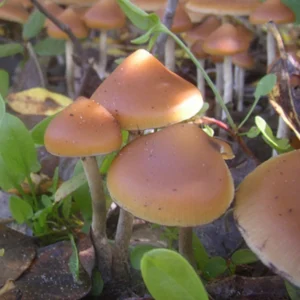
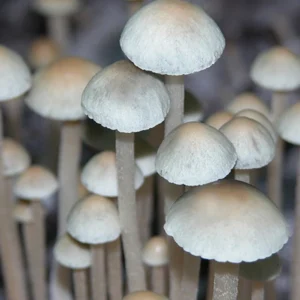
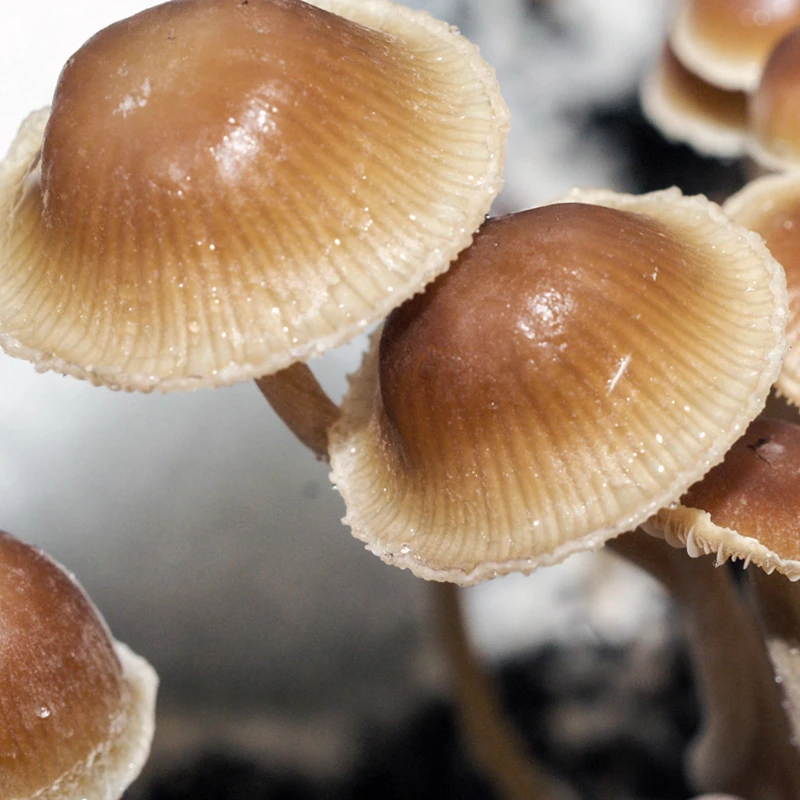
Almost Mycena-like. The cap is roughly 1 to 2 cm, conic to campanulateBell-shaped. and often subumbonate (a small raised central point), on a threadlike stem about 4 to 10 cm tall by only 1 to 2 mm thick.

Hygrophanous and bluing

The cap is hygrophanousChanges colour as it loses moisture, a common identification clue., ochre to brown to straw and fading to yellowish, sometimes with bluish-green tones with age. Like other active psilocybes it bruises blue where handled.

Hollow stem, no real ring

The stem is equal or tapering slightly to the base, hollow, straw to reddish-brown, darkening where injured. There is no persistent annulusA ring on the stem left by the veil; this species does not keep one., though young specimens can show a thin fibrillose veil remnant.

Pale-edged purple gills

Gills are adnateJoined to the stem along their width. to adnexed, pale grey maturing to purplish-brown as the spores ripen, typically with whitish edges. That pale margin is the cheilocystidia-lined gill edge, a tidy field cue.

Where it comes from

A highland grassland mushroom, not a dung-lover

Psilocybe mexicana grows alone or in small groups among moss along roadsides and trails, in humid meadows and cornfields, and especially in the grassy strips bordering deciduous forest, often in rich meadow soil rather than directly on dung. This is the opposite of the coprophilicDung-loving: grows on the droppings of grazing animals. habit of P. cubensis, and it is one of the cleaner ways to keep the two species straight.

Altitude is a genuine point of source disagreement: some references give a low band around 300 to 550 m, while most field accounts repeat a mid-altitude highland figure of roughly 1,000 to 1,800 m. The core documented range is Mexico (notably Oaxaca) and parts of Central America (Guatemala, Costa Rica and El Salvador). It is moisture-loving and fruits in the warm wet months, often given as May to October.

The main event

Under the microscope

This is what you actually bought the spores for. Put a print or a drop from a syringe on a slide, and here is what shows up, and how it differs from its cousins.

  • Small, smooth, oval. SubellipsoidRoughly oval, like a slightly squashed egg. to ovoid, smooth-walled spores about 8 to 12 µm long by 5 to 8 wide, each with a flattened paler germ poreA thin spot at one end of a spore where a new fungus can emerge. at the apex.
  • Dark only in a crowd. The print is dark purple-brown, but that alone will not separate it from cubensis or tampanensis, which all print in the same register. You need the scope.
  • The cystidia. Four-spored basidiaThe club-shaped cells on the gills that grow and release the spores.; the gill edge carries cheilocystidiaSterile cells along the gill EDGE, used to tell species apart. (roughly 13 to 34 µm, fusoid to sublageniform, sometimes with a forked neck), while pleurocystidiaSterile cells on the gill FACE. on the gill face are sublageniform or simply absent. A drop of KOHPotassium hydroxide, used to clear and mount a sample under the microscope. is the routine mounting reagent.
  • The size tell. Mexicana and tampanensis spores overlap heavily (both roughly 8 to 12 µm, both section Mexicanae), so you cannot reliably split those two on size alone. Cubensis is clearly bigger (around 11.5 to 17 µm and thick-walled), so a cubensis field reads visibly chunkier.
  • The legal bit, and why it's true. These spores contain no psilocybin and no psilocin; that chemistry only appears later in living tissue. That is exactly why a syringe or print is a study specimen and not a controlled substance in the UK.

Choose your format

Print, syringe, vial or swab?

Same lab-grade genetics in every option. The difference is shelf life versus how soon you are at the scope.

Spore print

Keeps longest

Spores dropped onto sterile foil. Stored cool and dry it outlasts everything else here, so it is the one to reach for if you are building a reference collection to keep for years.

Spore syringe

Ready tonight

Spores suspended in sterile water, ready to go straight onto a slide. The quickest way to be at the microscope this evening. Comes in 3 mL and 12 mL.

Vial & swab

Compact

A sealed glass vial is a tidy middle ground; a sterile swab is the most travel-friendly little format for adding a rare species to your set.

At a glance

The spec sheet

Species
Psilocybe mexicana R. Heim, 1957
Common names
Mexican mushroom; "Mexicana" truffle (the sclerotia); loosely teonanacatl
Family
Hymenogastraceae (hist. Strophariaceae)
Section
Mexicanae (Guzman), spores over ~8 µm
Type locality
Meadows near Huautla de Jimenez, Oaxaca, Mexico, 1938
Spore print
Dark purple-brown
Spore size
~8 to 12 × 5 to 8 µm, smooth, subellipsoid, with a germ pore
Cap
1 to 2 cm, conic to campanulate, hygrophanous
Stem
4 to 10 cm × 1 to 2 mm, hollow, no real ring
Habitat
Moss, meadows, cornfields, forest margins (not dung)
Range
Mexico and parts of Central America (Guatemala, Costa Rica, El Salvador)
Sclerotia
Yes, a documented sclerotia-former (the "magic truffle")
Intended use
Microscopy, taxonomy & collecting only

Dig deeper

Further reading

Independent, non-commercial sources, no shops, just good information.

Common questions

Frequently asked

No, and it is worth being clear about. It is its own species (Psilocybe mexicana R. Heim 1957) in section Mexicanae, with smaller fruitbodies, smaller spores (around 8 to 12 microns versus roughly 11.5 to 17 for cubensis) and a meadow rather than dung habit. The shared dark purple-brown print and the bluing reaction are genus traits, not evidence they are the same thing.

Partly chance, partly biology. Of the sacred mushrooms Roger Heim worked with, mexicana grew best in lab culture in Paris. That cultivability let Heim produce enough dried material to send about 100 g to Albert Hofmann at Sandoz, who isolated and named psilocybin and psilocin from it in 1958. A harder-to-grow species would not have made such a convenient source.

No. Heim named the mushroom (1957); Hofmann named the molecules (1958). That clean split, the mushroom from a French mycologist and the chemistry from a Swiss chemist in Basel, is the most commonly muddled part of the story.

By most accounts, no. Sabina's veladas are documented to have chiefly used Psilocybe caerulescens. Mexicana got tangled into her story because Wasson collected it among the material taken to Heim, but its starring role is the cultivation-and-chemistry chapter, not the ceremony night of 29 to 30 June 1955.

Sclerotia are hardened, dormant masses of mycelium the species forms as a survival structure, sold in some markets as "magic truffles" (a misnomer, since a real truffle is an ascomycete fruitbody). On strength, we do not make the common "sclerotia are more potent" claim: Hofmann's own figures and encyclopaedic sources put the sclerotia equal to or lower than the dried mushrooms.

"Jalisco" is a commercial label for P. mexicana that points to Jalisco state, the Mexican region tied to Guzman's 1970s galindoi collections (galindoi is now a synonym of mexicana). The name and the geographic link are real; the specific "rediscovered by Heim" and yield claims around it are vendor lore. Since it is simply Psilocybe mexicana, we list it under the species name.

We sell P. mexicana spores (syringes and prints) as microscopy and study specimens. Spores contain no psilocybin or psilocin, which is the basis on which they are handled here as collector and microscopy items. They are for the scope, not the substrate. We sell them for spore microscopy only, not for cultivation.

Ask the community

Questions and answers

No questions yet. Yours could be the first.