
Home / Magic Mushroom Spores / Psilocybe Cubensis / Amazonian
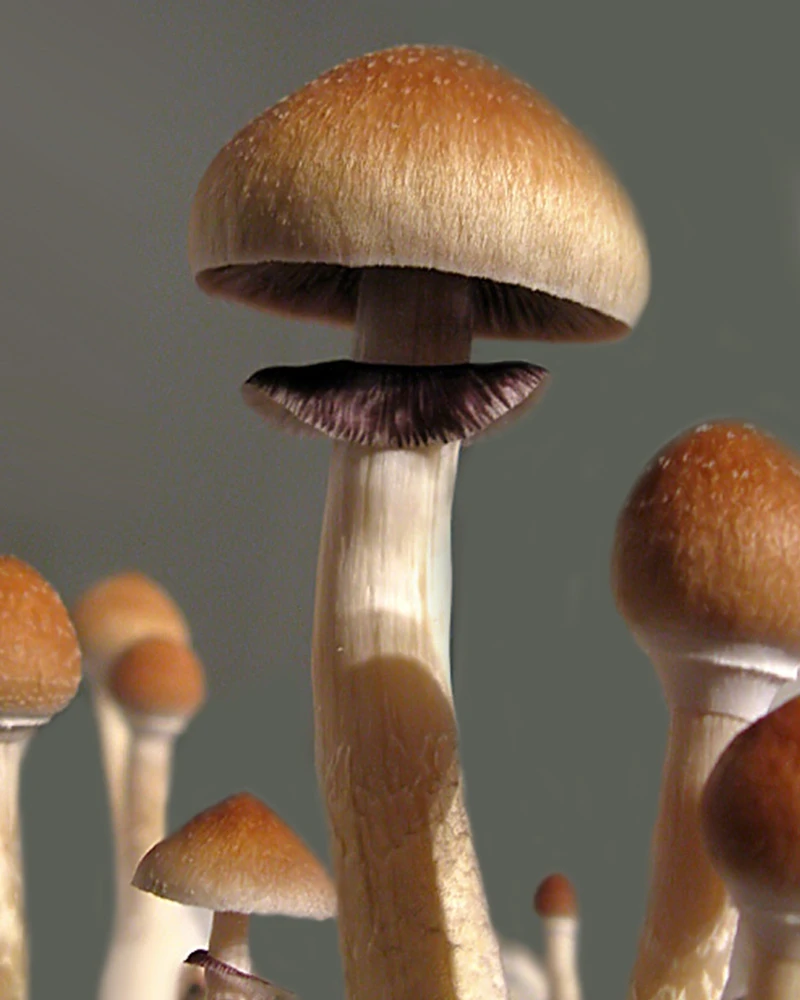
Psilocybe cubensis
Amazonian
A big, old-school rainforest line carried out of the Amazon by a long-gone Hawaiian spore house. Tall fruitbodies and a dark, heavy, dependable purple-brown print made for the microscope.
★★★★★ 4.8 · 23 reviewsChoose your format
Some formats are out of stock
Want to know the moment it returns?
Sold for microscopy, taxonomy and collecting only. Not for cultivation.
filled under laminar flow
plain packaging, tracked
The short version
Amazonian, properly PES Amazonian, is one of the classic 1990s cubensis lines, named for Pacifica Exotica Spora, the Honolulu spore vendor that put it into circulation. It is a plain Psilocybe cubensis: large golden-to-caramel caps, rope-like rhizomorphic growth, and a dark, heavy, easy-to-read purple-brown print. The Amazon collection story is repeated everywhere but documented almost nowhere, so treat the origin as lore.
Straight talk
Fact vs. legend
There is a lot of folklore around this strain. Here is which bits are real, side by side.
What we actually know
- The name traces to Pacifica Exotica Spora (PES), a Honolulu spore vendor active from roughly the 1990s into the early 2000s, now defunct, which also put out PES Hawaiian.
- Naming a strain after the company that distributed it was common practice at the time, which is why the PES prefix stuck.
- Genetically it is a plain Psilocybe cubensis, not a hybrid, not a separate species, and not an albino or leucistic line.
- It drops a dark purple-brown to near-black spore print and deposits heavily, which makes it a clean, high-contrast subject under the microscope.
- It is widely reported to throw large fruitbodies on rope-like rhizomorphic growth, a look collectors recognise on sight.
- As with every cube, lab data shows strain-to-strain strength differences are mostly cultivation-driven. A cube is a cube.
What the community says
- The story goes that it was collected in the Amazon, variously placed in Brazil, Colombia or Peru, from dung in the rainforest before PES preserved and distributed it. The collection itself is undocumented, so treat it as lore.
- One colourful version has it found in a dung patty left by a tapir, already bruised blue. A good tale, and exactly the kind of detail nobody can verify.
- It often gets tangled up with the famous McKenna Amazon collection story, the one usually told about Penis Envy. They are separate threads of folklore and should not be assumed to be the same line.
- The trade can't even agree whether Amazonian and the shorthand PESA are one strain or two. Some old hands say identical, others swear PESA fruits smaller. The question has been open on the forums for years.
- The PES in the name is sometimes wrongly read as a place. It is just the old vendor's initials, Pacifica Exotica Spora.
The story
A rainforest name from a vanished spore house
Most cubensis strains are named after a person, a place, or a quirk of shape. Amazonian is named after a shop. Its full handle is PES Amazonian, and the PES is Pacifica Exotica Spora, a Honolulu spore vendor that by most accounts ran from the 1990s into the early 2000s and helped put cubensis spores into mail-order circulation before quietly closing. The same outfit gave the hobby PES Hawaiian. Sticking the distributor's initials on the front of a strain was just how things were done back then, which is why two unrelated lines can both wear the PES badge.
The Amazon part of the story is where the documentation thins out fast. It is said to have been collected somewhere in the Amazon basin, with vendors variously naming Brazil, Colombia or Peru, from dung on the rainforest floor before PES isolated and shared it. None of that collection trip is recorded anywhere you can actually check. Psilocybe cubensis genuinely is a pan-tropical dung-lover, so a wild Amazon origin is entirely plausible, but plausible is not the same as proven.
The version is short: a real old vendor, a real widely-shared line, and an origin story that has been repeated far more often than it has been verified.
The Amazon mix-up worth knowing
Because the word Amazonian is so loaded, this line keeps getting cross-wired with the other famous Amazon tale, the McKenna brothers and the collection that hobbyists usually credit as the ancestor of Penis Envy. Those are different strands of folklore, and even that PE story is now reckoned to be heavily embroidered. The cleaner read is to treat PES Amazonian as its own thing, a sturdy old commercial cubensis, and to keep the legends labelled as legends.
The species
Meet Psilocybe cubensis
Amazonian is a collector’s line of a single, well-travelled species. Psilocybe cubensis was first written up in 1906 by the American mycologist Franklin Sumner Earle, from a specimen found in a cattle field in Cuba, which is where the name comes from. He originally called it Stropharia cubensis; Rolf Singer moved it into the genus Psilocybe in 1948.
The genus name is a tidy bit of Greek: psilos (“bare”) plus kubē (“head”), for the smooth, peelable skin of the cap, so the full name reads roughly as “the bare-headed mushroom from Cuba.”
- Family
- Hymenogastraceae (older books say Strophariaceae)
- Genus
- Psilocybe (Fr.) P. Kumm., 1871
- Species
- Psilocybe cubensis (Earle) Singer, 1948
- Basionym
- Stropharia cubensis Earle, 1906
- This product
- Amazonian, a collector’s cultivar of the species
- Type locality
- Cuba (where it was first named)
How you’d know it
Field marks
These describe the mature mushroom for reference and identification.
Big golden cap
Reportedly one of the larger cubes, the cap golden to caramel and often reddish when young, conical at first and opening to convex or flat with age. A small central bump is commonly noted.
Tall fibrous stem
White to pale yellow, thick and fibrous and frequently long. A leftover partial veil leaves a persistent ring (annulus) part way up, usually dusted purple-brown once the spores drop.
Darkening gills
Crowded and pale when young, deepening through dark brown to purplish-black as the spores ripen, packing the print with pigment.
Blue bruising
Handle or cut the flesh and it bruises blue-green, the classic Psilocybe reaction as enzymes convert psilocybin to psilocin, which then oxidises to blue pigments. Old lore even claims the wild collection was found already bruised.
Where it comes from
A dung-lover with a wanderer’s history
Psilocybe cubensis is coprophilic, a fancy word for dung-loving. In the wild it lives on the droppings of big grazing animals, classically cattle and water buffalo, fruiting from warm, humid pasture. It does not grow on wood and it does not partner with tree roots.
You’ll find it across the warm parts of the world: the Gulf Coast of the United States, Mexico, Central and South America, Southeast Asia and Australia. It was named from Cuba, but where the lineage truly began is an open question. A 2026 study describing its closest wild relative in southern Africa suggests the deep roots are Old-World, the mushroom having apparently travelled with grazing herds long before anyone gave it a Latin name.
The main event
Under the microscope
This is what you actually bought the spores for. Put a print or a drop from a syringe on a slide and here’s what shows up.
- Shape & size. Smooth, thick-walled and subellipsoid, like a slightly squashed rugby ball, roughly 11.5–17 µm long by 8–11 µm wide (the figures Paul Stamets settled on).
- The germ pore. Look for a single pale, flattened dot at one end. That’s the one thin spot in the wall where, in nature, a mushroom would begin, and a real cubensis hallmark.
- Pale alone, dark in a crowd. A single spore looks honey-amber with the light behind it; only in a mass do they read deep purple-brown to black. So a near-black print but pale spores on the slide is normal optics, not a dud.
- What you’ll need. Find the field at 100×, study shape and the germ pore at 400×, and get the wall crisp at 1000× under oil. A touch of methylene blue or KOH lifts the contrast.
- The legal bit, and why it’s true. A dormant spore carries no psilocybin or psilocin at all; that chemistry only appears later in living tissue. That is exactly why the spores are legal to own and study in the UK.
Choose your format
Print, syringe, vial or swab?
Same lab-grade genetics in every option. The honest difference is shelf life versus how soon you’re at the scope.
Spore print
Keeps longest
Spores dropped straight onto sterile foil. Stored cool and dry it outlasts everything else here, so it’s the one to reach for if you’re building a collection to keep for years.
Spore syringe
Ready tonight
Spores suspended in sterile water, ready to go straight onto a slide. The quickest way to be looking down the microscope this evening. Comes in 3 mL and 12 mL.
Vial & swab
Compact
A sealed glass vial is a tidy middle ground; a sterile swab is the most travel-friendly, robust little format for adding a strain to your reference set.
At a glance
The spec sheet
- Species
- Psilocybe cubensis
- Strain
- Amazonian (collector’s cultivar)
- Spore print
- Dark purple-brown to near-black, heavy depositor
- Spore shape
- Subellipsoid, smooth, thick-walled, with a germ pore
- Spore size
- ~11.5–17 × 8–11 µm
- Basidia
- Mostly 4-spored, ~20–30 × 7–10 µm
- Wild habitat
- Coprophilic, on herbivore dung & warm pasture
- Climate
- Subtropical to tropical
- Intended use
- Microscopy, research & collecting only
Dig deeper
Further reading
Independent, non-commercial sources, no shops, just good information.
- Psilocybe cubensis on Wikipedia: the species overview.
- The genus Psilocybe: taxonomy and the family reshuffle.
- Index Fungorum: the formal nomenclature record.
- Proc. Royal Society B (2026): the African wild-relative study.
Common questions
Frequently asked
Yes, for microscopy and research. A dormant spore contains no psilocybin or psilocin, so the spores themselves are not a controlled substance in the UK. We sell them strictly for microscopy, taxonomy and collecting, never for cultivation.
Amazonian almost always means PES Amazonian, after the old Pacifica Exotica Spora vendor. PESA is a common shorthand for the same name. Whether PESA and PES Amazonian are genuinely one line or two has been argued on the forums for years without a settled answer, so we describe what is verifiable and flag the rest as lore.
That is the standard story, usually placed in Brazil, Colombia or Peru, but the actual collection is not documented anywhere you can verify. Psilocybe cubensis really is a tropical dung-lover, so a wild origin is plausible. We just won't state it as fact.
Smooth, subellipsoid, thick-walled spores, pale amber individually and dark purple-brown in a mass, each with a small germ pore at one end. Find them at 100x, study at 400x, and get the wall sharp at 1000x under oil. The heavy print gives you plenty to work with.
If you want something that keeps for years on a shelf, take the print, and Amazonian is a generous depositor so prints tend to be dark and dense. If you want to be at the microscope sooner, take the syringe. The vial and swab sit in between on convenience.
Cool, dark and dry. A fridge (not freezer) suits syringes and vials; prints keep happily in a sealed bag somewhere cool. Stored well, a print stays viable for study for years.
What customers say
Reviews
Don’t waste your time!
Reply from Cylocybe
Hey Hussein, if you are having issues with any of our products get in touch and give us time to reply :) This is our busiest time of the year for us but we’ll do our best to help !
Arrived well packed and looks good 👍
Perfect
Great deal and a quality product as always.
Excellent
Again high quality, will definitely reorder from you guys again!
Ask the community
Questions and answers
No questions yet. Yours could be the first.
For microscopy, taxonomy and collecting only.Sold for legal research. Not for cultivation. Spores contain no controlled substances. We trust you to be responsible.