
Home / Magic Mushroom Spores / Psilocybe Cubensis / Escondido
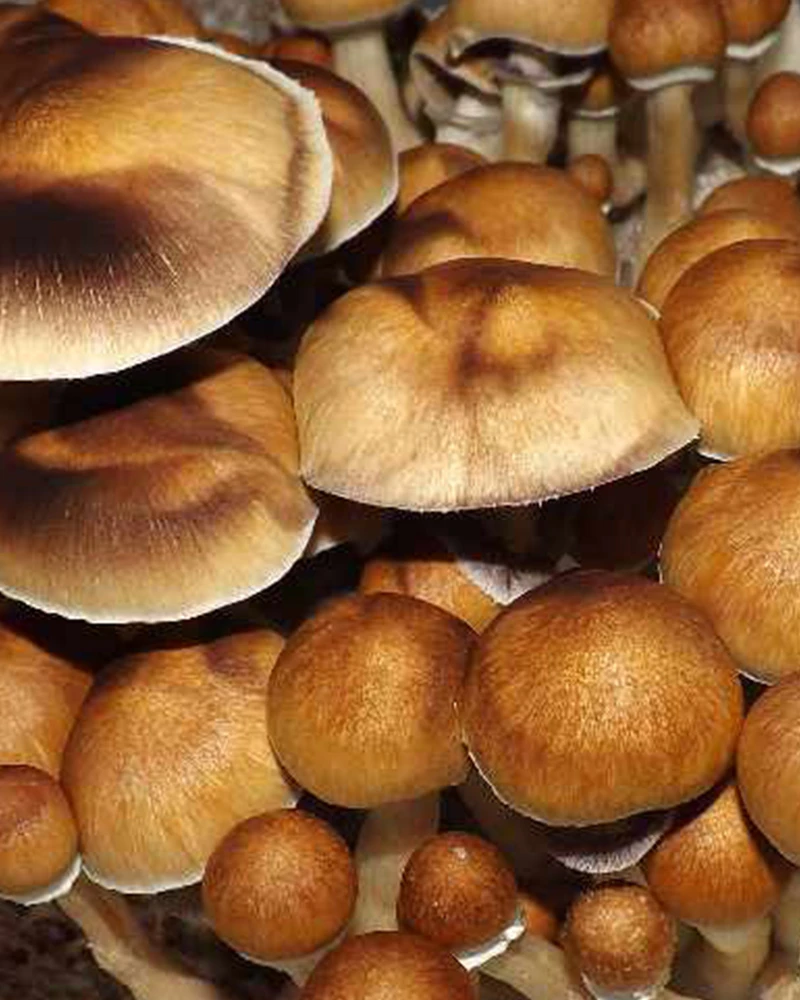
Psilocybe cubensis
Escondido
A Mexican cube named for a "hidden" corner of Oaxaca, throwing classic caramel caps and a dependable dark spore drop. Plenty of romance in the name, a little argument over exactly which place it points to.
★★★★★ 5.0 · 11 reviewsChoose your format
Some formats are out of stock
Want to know the moment it returns?
Sold for microscopy, taxonomy and collecting only. Not for cultivation.
filled under laminar flow
plain packaging, tracked
The short version
Escondido is a Psilocybe cubensis line said to trace back to a wild collection in Oaxaca, Mexico, the region at the heart of Mexico's sacred-mushroom history. Its name is Spanish for "hidden." It looks like a textbook cube, caramel caps and a thick white stem, and it is a generous, dark-spored depositor, which makes it an easy and rewarding strain to study under glass.
Straight talk
Fact vs. legend
There is a lot of folklore around this strain. Here is which bits are real, side by side.
What we actually know
- Genetically it is a plain Psilocybe cubensis, not a hybrid and not a separate species. A Shroomery moderator put it bluntly: Escondido is a variety, a name made by humans.
- Its name is Spanish for hidden, and every account agrees the name points to a place in the southern Mexican state of Oaxaca.
- It is described across sources as a vigorous line with large fruitbodies and heavy sporulation, dropping a dark purplish-brown to near-black print that is easy to work with and archive.
- Oaxaca is genuinely one of the most important regions on earth for psilocybin mushrooms, the home of Mazatec and Mixtec ceremonial use, so the geographic backdrop is real even where the strain's own paperwork is thin.
- Lab data for Psilocybe cubensis as a whole spreads its strength across a wide band regardless of variety name. As the hobby saying goes, a cube is a cube.
What the community says
- The story goes that Escondido was collected from the wild in Oaxaca around the late 1990s, but no firm collector, date or herbarium record travels with the name, so treat the timeline as community lore.
- Sources cannot agree which Oaxacan place it honours. Some say Puerto Escondido, the Pacific surf town on the coast. Others point inland to the San Jose del Pacifico and Rio Escondido area in the mountains. Both share the word hidden, which is half the appeal of the name.
- Vendors lean hard on the sacred-mushroom heritage of the Mazatec and Mixtec curanderos, yet several of those same write-ups quietly admit Escondido itself has no documented ceremonial use. The connection is geographic romance, not provenance.
- It is occasionally billed as one of the oldest cubensis strains going. That is a nice flourish with nothing solid behind it.
The story
Named for somewhere hidden, and nobody quite agrees where
Escondido is Spanish for hidden, and that is fitting twice over. The name is said to honour a corner of Oaxaca, in southern Mexico, the region more bound up with sacred mushroom history than anywhere else on the planet. It is also fitting because the strain's own origin is, frankly, a little hidden too. By most accounts the line was collected from the wild somewhere around the late 1990s, but no named collector, no firm date and no herbarium voucher travel along with it. Treat that timeline as community lore rather than documented history.
The fun part is that the sources cannot even agree which place the name points to. Some say Puerto Escondido, the Pacific surf town down on the Oaxacan coast, where warm humid pastureland suits a dung-loving cube perfectly. Others point inland and uphill to the San Jose del Pacifico and Rio Escondido area in the mountains. Both readings share that one word, hidden, which is most of the charm.
The answer to "where exactly is Escondido from?" is that the name is real, the region is real, but the precise spot is still an argument the vendors are having amongst themselves.
Real region, thin paperwork
What is not in doubt is the backdrop. Oaxaca is the heartland of Mazatec and Mixtec ceremonial mushroom use, the tradition that ran through curanderas like Maria Sabina and the velada healing nights. Several write-ups borrow that heritage to dress the strain up, then quietly concede in the same breath that Escondido itself has no documented ceremonial history. So the romance is geographic association, not provenance. Underneath it all, by every description, Escondido is simply a good, vigorous Mexican Psilocybe cubensis, which is plenty.
The species
Meet Psilocybe cubensis
Escondido is a collector’s line of a single, well-travelled species. Psilocybe cubensis was first written up in 1906 by the American mycologist Franklin Sumner Earle, from a specimen found in a cattle field in Cuba, which is where the name comes from. He originally called it Stropharia cubensis; Rolf Singer moved it into the genus Psilocybe in 1948.
The genus name is a tidy bit of Greek: psilos (“bare”) plus kubē (“head”), for the smooth, peelable skin of the cap, so the full name reads roughly as “the bare-headed mushroom from Cuba.”
- Family
- Hymenogastraceae (older books say Strophariaceae)
- Genus
- Psilocybe (Fr.) P. Kumm., 1871
- Species
- Psilocybe cubensis (Earle) Singer, 1948
- Basionym
- Stropharia cubensis Earle, 1906
- This product
- Escondido, a collector’s cultivar of the species
- Type locality
- Cuba (where it was first named)
How you’d know it
Field marks
These describe the mature mushroom for reference and identification.
Caramel-golden cap
Rich caramel to golden-brown, starting subconical and bell-shaped when young and opening to wavy and plane with age. Often a touch reddish-brown in the centre. A textbook Mexican cube cap with nothing exotic about it, which is exactly the point.
Thick white stipe
Stem is white, thick and fleshy, bruising blue-green where it is handled or ages. A leftover partial veil tends to leave a ring, or annulus, dusted darker as the spores rain onto it.
Gills going near-black
Attachment adnate to adnexed. Pale grey in young fruitbodies, deepening to nearly black as the spores ripen in mass. The deepening colour is the print arriving before your eyes.
Heavy dark deposit
This is a generous depositor. Reports agree on dense, clearly defined prints in dark purplish-brown to near-black, the kind that store well and give you plenty to work with on the slide.
Where it comes from
A dung-lover with a wanderer’s history
Psilocybe cubensis is coprophilic, a fancy word for dung-loving. In the wild it lives on the droppings of big grazing animals, classically cattle and water buffalo, fruiting from warm, humid pasture. It does not grow on wood and it does not partner with tree roots.
You’ll find it across the warm parts of the world: the Gulf Coast of the United States, Mexico, Central and South America, Southeast Asia and Australia. It was named from Cuba, but where the lineage truly began is an open question. A 2026 study describing its closest wild relative in southern Africa suggests the deep roots are Old-World, the mushroom having apparently travelled with grazing herds long before anyone gave it a Latin name.
The main event
Under the microscope
This is what you actually bought the spores for. Put a print or a drop from a syringe on a slide and here’s what shows up.
- Shape & size. Smooth, thick-walled and subellipsoid, like a slightly squashed rugby ball, roughly 11.5–17 µm long by 8–11 µm wide (the figures Paul Stamets settled on).
- The germ pore. Look for a single pale, flattened dot at one end. That’s the one thin spot in the wall where, in nature, a mushroom would begin, and a real cubensis hallmark.
- Pale alone, dark in a crowd. A single spore looks honey-amber with the light behind it; only in a mass do they read deep purple-brown to black. So a near-black print but pale spores on the slide is normal optics, not a dud.
- What you’ll need. Find the field at 100×, study shape and the germ pore at 400×, and get the wall crisp at 1000× under oil. A touch of methylene blue or KOH lifts the contrast.
- The legal bit, and why it’s true. A dormant spore carries no psilocybin or psilocin at all; that chemistry only appears later in living tissue. That is exactly why the spores are legal to own and study in the UK.
Choose your format
Print, syringe, vial or swab?
Same lab-grade genetics in every option. The honest difference is shelf life versus how soon you’re at the scope.
Spore print
Keeps longest
Spores dropped straight onto sterile foil. Stored cool and dry it outlasts everything else here, so it’s the one to reach for if you’re building a collection to keep for years.
Spore syringe
Ready tonight
Spores suspended in sterile water, ready to go straight onto a slide. The quickest way to be looking down the microscope this evening. Comes in 3 mL and 12 mL.
Vial & swab
Compact
A sealed glass vial is a tidy middle ground; a sterile swab is the most travel-friendly, robust little format for adding a strain to your reference set.
At a glance
The spec sheet
- Species
- Psilocybe cubensis
- Strain
- Escondido (collector’s cultivar)
- Spore print
- Dark purple-brown to near-black, heavy depositor
- Spore shape
- Subellipsoid, smooth, thick-walled, with a germ pore
- Spore size
- ~11.5–17 × 8–11 µm
- Basidia
- Mostly 4-spored, ~20–30 × 7–10 µm
- Wild habitat
- Coprophilic, on herbivore dung & warm pasture
- Climate
- Subtropical to tropical
- Intended use
- Microscopy, research & collecting only
Dig deeper
Further reading
Independent, non-commercial sources, no shops, just good information.
- Psilocybe cubensis on Wikipedia: the species overview.
- The genus Psilocybe: taxonomy and the family reshuffle.
- Index Fungorum: the formal nomenclature record.
- Proc. Royal Society B (2026): the African wild-relative study.
Common questions
Frequently asked
Yes, for microscopy and research. A dormant spore contains no psilocybin or psilocin, so the spores themselves are not a controlled substance in the UK. We sell them strictly for microscopy, taxonomy and collecting, never for cultivation.
It is named for a place in Oaxaca, Mexico, and that much everyone agrees on. The exact spot is contested: some sources say the coastal town of Puerto Escondido, others the inland San Jose del Pacifico and Rio Escondido area. There is no firm collector or date on record, so take the precise origin as lore.
Not really. Oaxaca genuinely is the heartland of Mazatec and Mixtec mushroom traditions, but several write-ups that invoke that heritage admit Escondido itself has no documented ceremonial use. It is a geographic association, not a provenance.
Smooth, thick-walled, subellipsoid spores, pale amber on their own and dark purple-brown in a mass, each with a small flattened germ pore at one end, formed on four-spored basidia. Find them at 100x, study at 400x, and get the wall sharp at 1000x under oil.
By all accounts yes. Escondido is described as a vigorous, heavy sporulator that lays down dense, well-defined dark prints, which is a large part of why it is an easy and satisfying line to study and archive.
If you want something that keeps for years on a shelf, take the print. If you want to be at the microscope tonight, take the syringe. The vial and swab sit in between on convenience.
What customers say
Reviews
Too early to say but looking very good so far. Oh yes!!!! Happy days. ❤ 🙏
Quality product
Never had a bad product and the spore syringes do a great job every time.
Spores are now healthy mushroom pins..👍🏻
Good product
Ask the community
Questions and answers
No questions yet. Yours could be the first.
For microscopy, taxonomy and collecting only.Sold for legal research. Not for cultivation. Spores contain no controlled substances. We trust you to be responsible.