


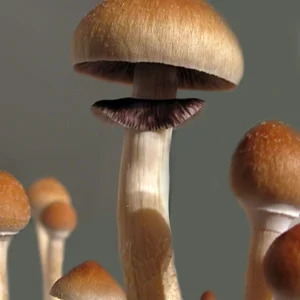
 B+
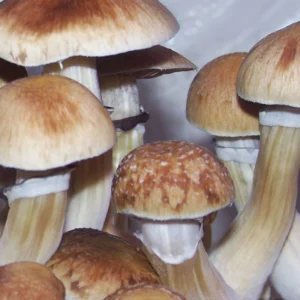
B+
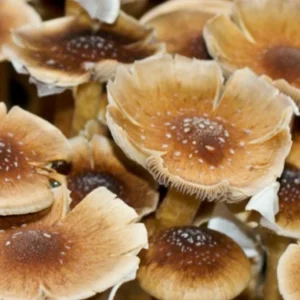 Ban Hua Thai
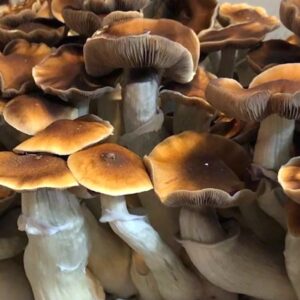 Blue Magnolia
 Cambodian
 E4K
E4K
 MIB
MIB
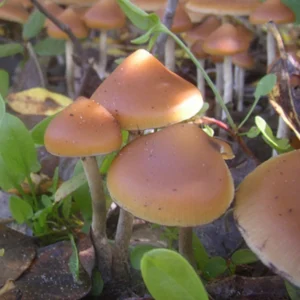 Psilocybe Azurescens
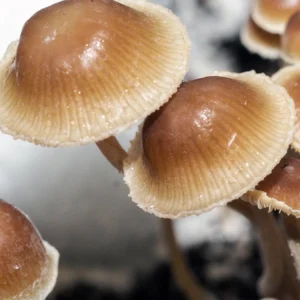 Psilocybe Mexicana
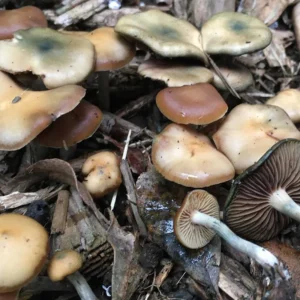 Psilocybe Subaeruginosa
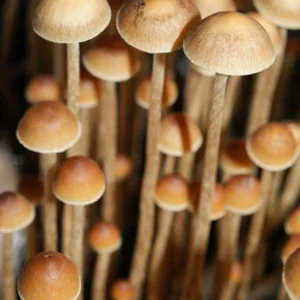 Psilocybe Tampanensis
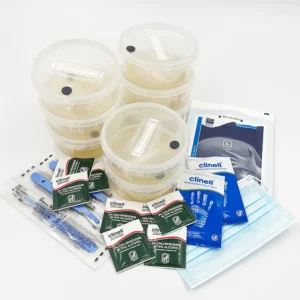
 MycoBox Grow Kit
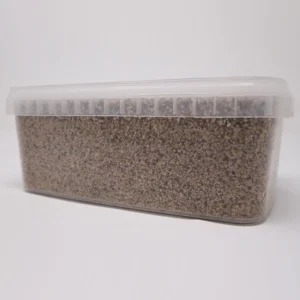 PF-Tek MycoBox Grow Kit
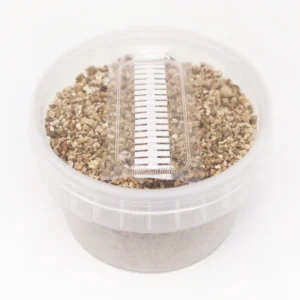 PF-Tek MycoPot Grow Kit (DIY)
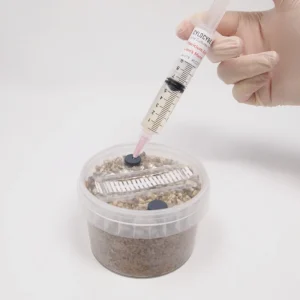 PF-Tek MycoPots Grow Kit
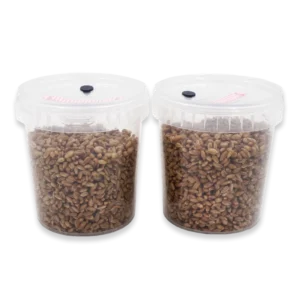 SpawnTubs™
 Brown Rice Flour
 Chicken Manure Pellets (1kg)
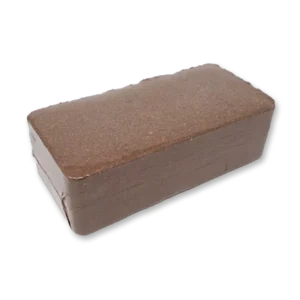 Coco Coir (650g)
 Gypsum (Calcium Sulphate) 3kg
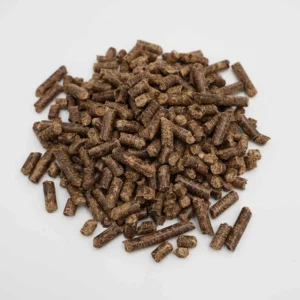 Hardwood Pellets (3kg)
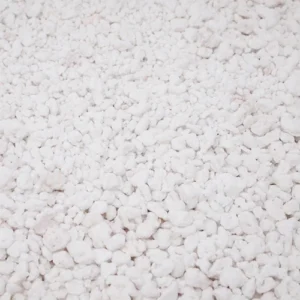 Perlite (5L)
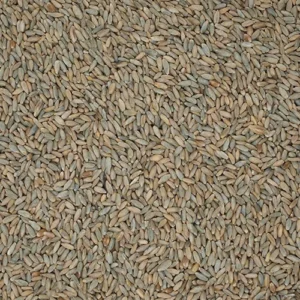 Rye Grain (3kg)
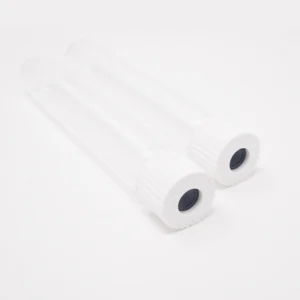
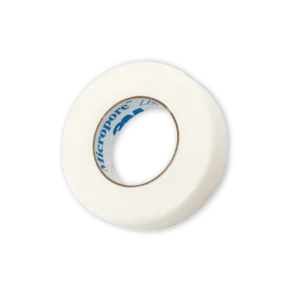 3M Breathable Micropore Tape
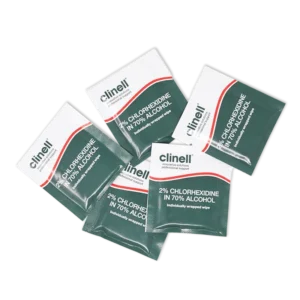 70% IPA Clinell Alcohol Wipes (5)
 CyLab
CyLab
 Kilner 1L Mason Jars (12)
 Sabla™ / Still-air Box (S/M/L/XL)
 Self-Healing Injection Ports (10)
 SporeKit™ Syringe

 Dextrose (100g)
 Light Malt Extract (LME 100g)
 Urea Granules (1kg)
Home / Magic Mushroom Spores / Psilocybe Cubensis / Leucistic Ecuador
 1 / 6
1 / 6

Psilocybe cubensis
Leucistic Ecuador
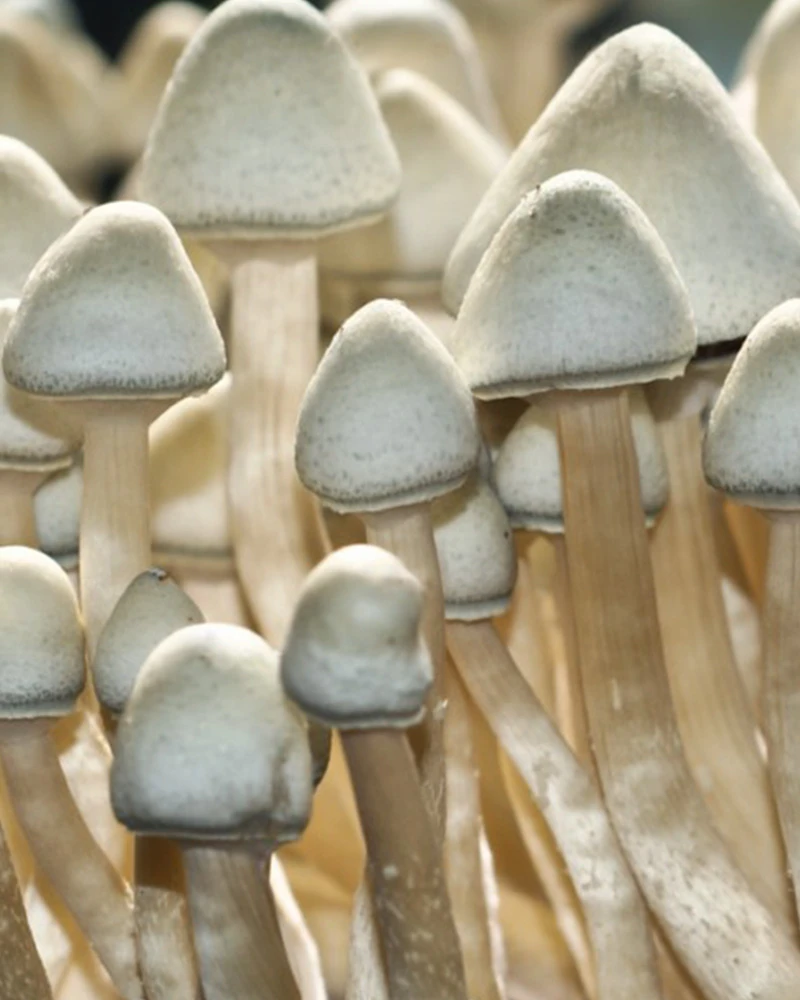
A pale, frost-pretty version of a hardy Andean highland cube. White-to-cream caps with golden flecks, yet it still drops a proper dark purple-brown print, so it studies like a classic Ecuador.
Choose your format
Some formats are out of stock
Want to know the moment it returns?
Usually dispatched same day if paid by 1pm.
Sold for microscopy, taxonomy and collecting only. Not for cultivation.
filled under laminar flow
plain packaging, tracked
Straight talk
Fact vs. legend
There is a lot of folklore around this strain. Here is which bits are real, side by side.
What we actually know
- Leucistic Ecuador is a plain Psilocybe cubensis, the same species as every other cube. The Ecuador name points to a highland landrace, and leucistic describes a pigment trait, not a separate species or a hybrid.
- Leucistic means a partial loss of body pigment, so caps and stems come out pale white to cream, often keeping a few golden flecks rather than going fully bare.
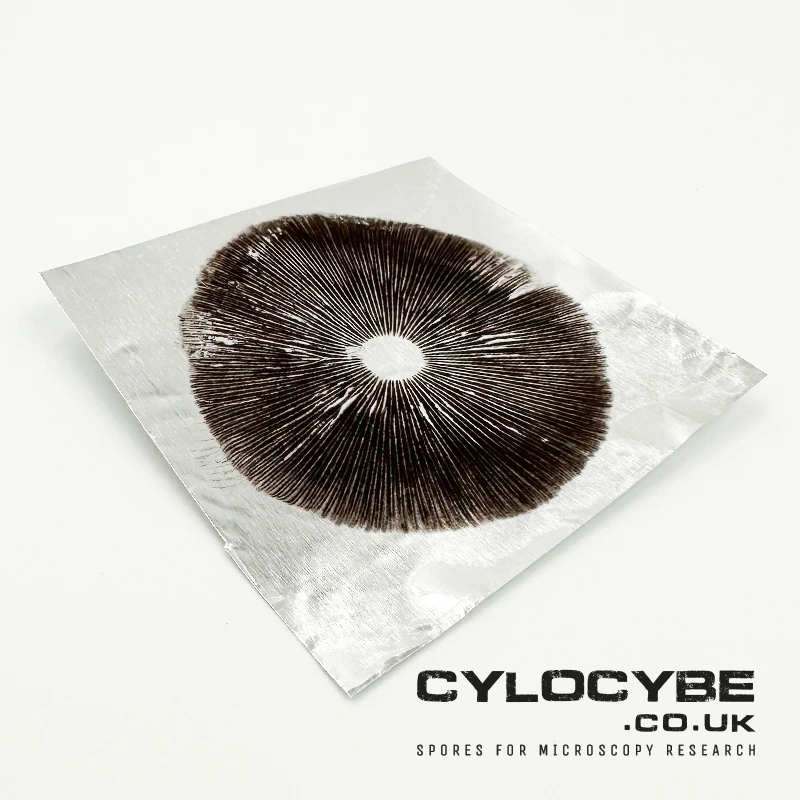
- Crucially it is leucistic and not albino: the spores still carry pigment, so it drops a heavy, dark purple-brown print just like a standard cube.
- The leucistic trait is recessive, which is why hobbyists keep selecting the palest specimens generation after generation to hold the look. A line like this is maintained by selection, not found wild.
- The parent Ecuador line is reportedly a hardy, heavy-fruiting landrace with thick stems and broad caps, traits this pale version is said to inherit.
What the community says
- The Ecuador parent strain is, by most accounts, said to have been collected around the year 2000 by a Shroomery member remembered only as BIO, reportedly near Otavalo in the northern Ecuadorian highlands at altitude. Treat the specifics as community lore rather than documented record.
- Because it apparently came from high, thin-air country, the Ecuador line picked up a reputation as an unusually tough, resilient cube. A nice story, though hardiness claims are easy to repeat and hard to verify.
- The leucistic version itself has almost no documented backstory. Nobody seems to credit a particular person or date with isolating it, so the answer is that it is a hobbyist selection of unclear authorship.
- Vendors sometimes blur leucistic and albino together, but they are not the same thing, and calling this one albino would be wrong because its spores are clearly pigmented.
- It is occasionally tied to old Andean ritual traditions in sales copy. Indigenous mushroom use in the region is real history, but linking it to one modern vendor isolate is a stretch.
The story
A ghost-pale cube from thin-air country
Leucistic Ecuador is really two stories stacked on top of each other. The first is the Ecuador landrace underneath it, a stocky highland cube that, by most accounts, came out of the northern Ecuadorian mountains. The lore that gets repeated most often credits a collector remembered only as BIO, who is said to have printed it around the turn of the millennium somewhere near Otavalo, up where the air is thin. How much of that is documented and how much is forum folklore is genuinely hard to say, so take the names and dates as community memory rather than gospel.
The second story is the leucistic part, and here it gets easier because there is almost nothing to dress up. Leucism is a recessive pigment trait, and a pale line like this is something a patient hobbyist selects into being by picking the whitest mushroom out of each flush, over and over, until the colour mostly drops out. Who first did that with the Ecuador line, and when, nobody seems to record. So the fair description is a low-pigment isolation of a known landrace, of unclear authorship.
The single most useful thing to know about this one: leucistic is not albino. The body loses its colour, but the spores keep theirs.
Why the print still comes out dark
That distinction is the whole reason this strain is fun under a microscope. A true albino loses pigment everywhere, spores included, and gives you a faint, frustrating print. Leucistic Ecuador only loses it from the flesh, so you get the best of both: a pale, frost-white fruitbody with the odd golden fleck still showing, sitting over gills that still ripen dark and a print that lands a proper heavy purple-brown. Apparently it inherits the parent line's generous spore drop, which means plenty of material to look at. The pale body is the novelty, but the spores are pure, ordinary, well-behaved cubensis.
The species
Meet Psilocybe cubensis
Leucistic Ecuador is a collector's line of a single, well-travelled species. Psilocybe cubensis was first written up in 1906 by the American mycologist Franklin Sumner Earle, from a specimen found in a cattle field in Cuba, which is where the name comes from. He originally called it Stropharia cubensis; Rolf Singer moved it into the genus Psilocybe in 1948.
The genus name is a tidy bit of Greek: psilos ("bare") plus kubē ("head"), for the smooth, peelable skin of the cap, so the full name reads roughly as "the bare-headed mushroom from Cuba."
- Family
- Hymenogastraceae (older books say Strophariaceae)
- Genus
- Psilocybe (Fr.) P. Kumm., 1871
- Species
- Psilocybe cubensis (Earle) Singer, 1948
- Basionym
- Stropharia cubensis Earle, 1906
- This product
- Leucistic Ecuador, a collector's cultivar of the species
- Type locality
- Cuba (where it was first named)
How you'd know it
Field marks
These describe the mature mushroom for reference and identification.
Pale, flecked cap
Comes out white to cream rather than the usual caramel, the leucistic pigment loss at work. It often keeps a scatter of faint golden flecks, especially toward the centre, and tends to broaden out from a bell to a fairly flat disc as it matures.
Thick, stocky stem
White and dense, on the chunky, muscular side that the Ecuador parent line is known for. A leftover partial veil usually leaves a ring (annulus) around the upper stipe, which often catches falling spores and ends up dusted purple-brown.
Gills that ripen dark
Pale and crowded when young, then darkening steadily to a dusky purple-grey and near-black as the spores mature. The pale body never stops the gills from colouring up, which is the giveaway that this is leucistic and not albino.
Blue bruising on the pale flesh
Handle or nick the flesh and it bruises blue-green, the usual Psilocybe enzyme reaction. The bruise reads especially clearly against the white cap and stem, so this strain shows it off better than darker cubes.
Where it comes from
A dung-lover with a wanderer's history
Psilocybe cubensis is coprophilic, a fancy word for dung-loving. In the wild it lives on the droppings of big grazing animals, classically cattle and water buffalo, fruiting from warm, humid pasture. It does not grow on wood and it does not partner with tree roots.
You'll find it across the warm parts of the world: the Gulf Coast of the United States, Mexico, Central and South America, Southeast Asia and Australia. It was named from Cuba, but where the lineage truly began is an open question. A 2026 study describing its closest wild relative in southern Africa suggests the deep roots are Old-World, the mushroom having apparently travelled with grazing herds long before anyone gave it a Latin name.
The main event
Under the microscope
This is what you actually bought the spores for. Put a print or a drop from a syringe on a slide and here's what shows up.
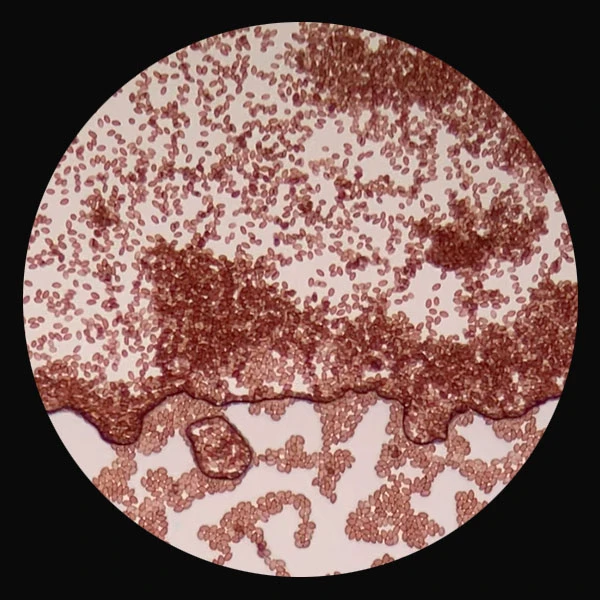
- Shape & size. Smooth, thick-walled and subellipsoid, like a slightly squashed rugby ball, roughly 11.5–17 µm long by 8–11 µm wide (the figures Paul Stamets settled on).
- The germ pore. Look for a single pale, flattened dot at one end. That's the one thin spot in the wall where, in nature, a mushroom would begin, and a real cubensis hallmark.
- Pale alone, dark in a crowd. A single spore looks honey-amber with the light behind it; only in a mass do they read deep purple-brown to black. So a near-black print but pale spores on the slide is normal optics, not a dud.
- Leucistic, not albino, so the spores stay dark. The pigment loss in this line is confined to the cap and stem, which means the gills still ripen and the print deposits a normal heavy purple-brown. That is the opposite of a true albino, which loses pigment from the spores too and gives a faint, hard-to-read deposit. Expect ordinary, well-pigmented cubensis material on the slide, just from a frost-white mushroom.
- What you'll need. Find the field at 100×, study shape and the germ pore at 400×, and get the wall crisp at 1000× under oil. A touch of methylene blue or KOH lifts the contrast.
- The legal bit, and why it's true. A dormant spore carries no psilocybin or psilocin at all; that chemistry only appears later in living tissue. That is exactly why the spores are legal to own and study in the UK.
Choose your format
Print, syringe, vial or swab?
Same lab-grade genetics in every option. The honest difference is shelf life versus how soon you're at the scope.
Spore print
Keeps longest
Spores dropped straight onto sterile foil. Stored cool and dry it outlasts everything else here, so it's the one to reach for if you're building a collection to keep for years.
Spore syringe
Ready tonight
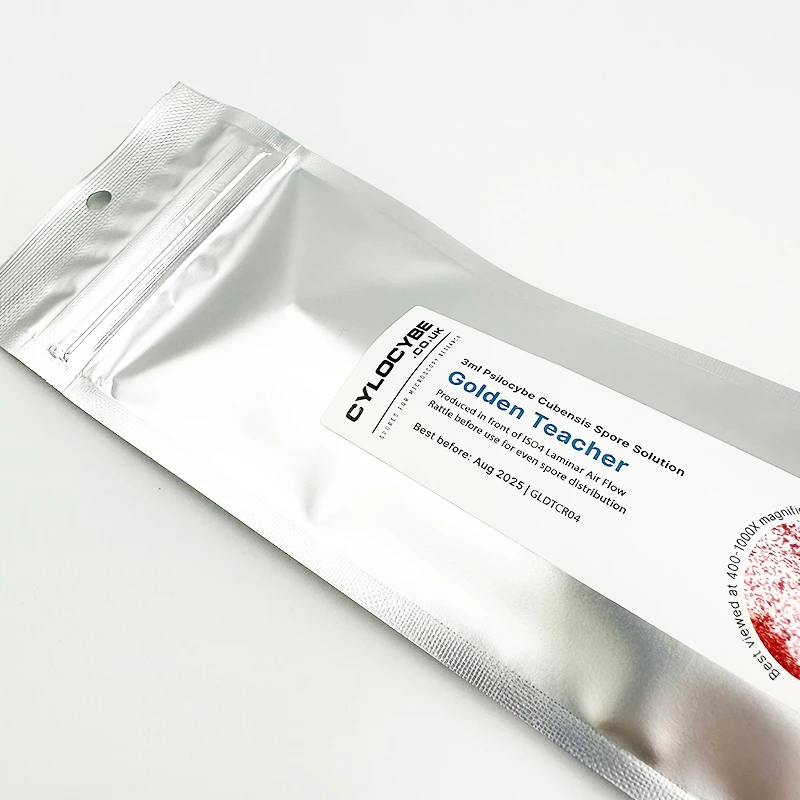
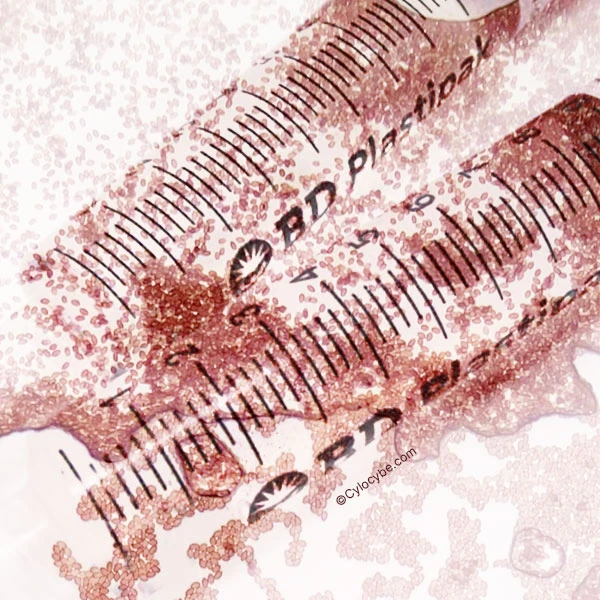
Spores suspended in sterile water, ready to go straight onto a slide. The quickest way to be looking down the microscope this evening. Comes in 3 mL and 12 mL.
Vial & swab
Compact
A sealed glass vial is a tidy middle ground; a sterile swab is the most travel-friendly, robust little format for adding a strain to your reference set.
At a glance
The spec sheet
- Species
- Psilocybe cubensis
- Strain
- Leucistic Ecuador (collector's cultivar)
- Spore print
- Dark purple-brown to near-black, heavy depositor
- Spore shape
- Subellipsoid, smooth, thick-walled, with a germ pore
- Spore size
- ~11.5–17 × 8–11 µm
- Basidia
- Mostly 4-spored, ~20–30 × 7–10 µm
- Wild habitat
- Coprophilic, on herbivore dung & warm pasture
- Climate
- Subtropical to tropical
- Intended use
- Microscopy, research & collecting only
Dig deeper
Further reading
Independent, non-commercial sources, no shops, just good information.
- Psilocybe cubensis on Wikipedia: the species overview.
- The genus Psilocybe: taxonomy and the family reshuffle.
- Index Fungorum: the formal nomenclature record.
- Proc. Royal Society B (2026): the African wild-relative study.
For microscopy, taxonomy and collecting only.Sold for legal research. Not for cultivation. Spores contain no controlled substances. We trust you to be responsible.