Home / Magic Mushroom Spores / Rare & Exotic Species / Psilocybe Cyanescens
Psilocybe cyanescens
Wavy Caps
The caramel wood-chip Psilocybe with the undulating cap margin and a purple-brown print, scientifically born in Britain at Kew. A landmark wood-loving species and a rewarding microscopy subject. Sold strictly as a spore specimen for microscopy, taxonomy and collecting.
Choose your format
Some formats are out of stock
Want to know the moment it returns?
Sold for microscopy, taxonomy and collecting only. Not for cultivation.
filled under laminar flow
plain packaging, tracked
The short version
Psilocybe cyanescens, the "Wavy Cap", is the wood-loving member of the bluing Psilocybe group and one of the most distinctive species a collector can put under a scope. Where a cubensis is a smooth-capped, dung-and-grassland tropical species, cyanescens is a cool-weather wood-chip and mulch decomposer whose mature cap margin goes literally wavy, fading from caramel to buff as it dries. It carries a purple-brown to blackish-purple-brown spore print, which is exactly what separates it from the unrelated Panaeolus cyanescens (jet-black print, dung) that this shop also sells under a confusingly similar name. It was first described from mulch beds at Kew Gardens in London, so this is, in a real sense, a British type species. Listed here only as a spore specimen for microscopy, taxonomy and collecting, never for cultivation or consumption.
Straight talk
Fact vs. legend
There is a lot of folklore around this strain. Here is which bits are real, side by side.
What we actually know
- Formally described in 1946 by British mycologist Elsie Maud Wakefield, from mulch beds at the Royal Botanic Gardens, Kew, in London; she had been collecting it there since as early as 1910.
- It is a wood/lignin saprotroph living on wood chips and woody mulch, classically around landscaped plant beds, and is not a dung or pasture-grass species.
- Its spore print is dark purple-brown to blackish-purple-brown, the decisive separator from the jet-black-printed dung species Panaeolus cyanescens and from the rust-printed deadly Galerina marginata.
- The mature cap margin becomes distinctly wavy and undulating, the trait that gives Wavy Cap its name; the cap is hygrophanous, fading from caramel to buff as it dries.
- Fruiting is triggered by a DROP in temperature, so it is an autumn-into-winter species, the opposite of warm-loving cubensis.
- Its range is expanding fast because the mycelium colonises commercial wood-chip and mulch distribution networks and is carried at scale as landscaping material.
What the community says
- A mass-fruiting of roughly 100,000 fruit bodies is said to have appeared on a racetrack in southern England, often cited as the species' best-known UK story; the precise count is anecdotal lore, not a published census.
- The native range is contested. First described from Britain, it is by many accounts probably a non-native North American (Pacific Northwest) species introduced via mulch or botanical imports, while other sources say the wild origin simply remains unknown. It is best treated as an open question.
- Cyanescens is widely reputed to be among the more potent Psilocybe species and is often grouped as several times the strength of cubensis, with North American specimens reportedly testing higher than European ones. We note this only as documented chemical variation, not a product claim; potency varies enormously by lineage, locality, age and handling.
- Wood-lover paralysis, a delayed muscle-weakness syndrome, is anecdotally associated with consuming wood-loving Psilocybes; the leading idea that aeruginascin is responsible is an unproven hypothesis, with no confirmed causative compound and no controlled studies.
- The exact sectional name (commonly cited as section or stirps Cyanescens) is widely repeated, but we could not verify it verbatim against Index Fungorum or MycoBank, so treat it as reported.
- One secondary source dates the description to 1942; this is an error repeated in some write-ups. The verified taxonomic year is 1946.
The story
The mushroom that was born at Kew
Most of the famous Psilocybe species were first written up somewhere warm and far away. Wavy Cap is different. It was scientifically born in Britain, in the mulch beds of the Royal Botanic Gardens at Kew, where the mycologist Elsie Maud Wakefield had been quietly collecting a small caramel-capped, blue-bruising mushroom since around 1910. She finally gave it a name in 1946, in the Transactions of the British Mycological Society, and called it cyanescens for the indigo colour that bloomed wherever the flesh was handled.
That detail, a type collected from cultivated garden mulch rather than a wild forest, is the reason one of the oldest arguments about this species has never been resolved. Nobody is sure where it actually comes from. It is abundant in temperate Europe and just as abundant in the North American Pacific Northwest, and a popular reading holds it is really a North American species that hitched a ride into Kew on imported plants. The answer is that the wild origin is unknown, and the more we move wood chips around the planet the harder it becomes to ever trace it back.
It is the mushroom that learned to travel by mulch, turning up in parks and cemeteries and ordinary back gardens, wherever there is rotting wood and a cold snap to wake it.
A wood mushroom, not a dung mushroom
Everything about Wavy Cap is keyed to two things: wood and cold. It is a lignin eater, so it lives on wood chips and woody debris, binding the substrate with tough white rhizomorphs and fruiting in troops when autumn temperatures fall. That ecology is also why it gets confused with two very different organisms. The deadly Galerina marginata can share the same rotting wood, but it has a ringed stem, a rust-brown print and no blue bruising. And then there is the namesake trap: Panaeolus cyanescens, the dung-loving species this same shop also stocks, carries the identical epithet because it too bruises blue, yet it is a different genus entirely with a jet-black print. The clean way to keep them straight is the spore print and the substrate, which is exactly the kind of thing a print under a microscope is for.
The signature
The cap that actually goes wavy
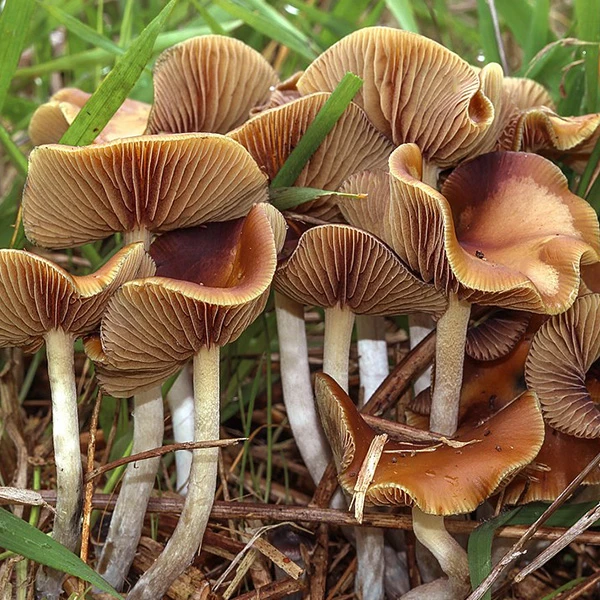
A cubensis page can talk about big spores and a tan-to-golden cap, but it cannot claim the one thing that names this species: the cap margin of a mature Psilocybe cyanescens becomes distinctly undulating, sinusoidal, wavy. That, plus a few collector-grade structural details, is the hook here.
The wavy margin is the diagnosis, not just a nickname
The cap starts convex and flattens out, but at maturity the margin develops a rippling, undulating edge that gives the species its English name. A cubensis cap stays smooth and convex-to-flat and never does this. Confident identification still wants the full set of characters (no single feature is ever enough), but the wavy margin is the one you notice first. The closest wavy-capped relative, the Australasian P. subaeruginosa, is separated mainly by geography.
A peelable gelatinous pellicle
The cap surface carries a thin gelatinous pellicleA thin skin over the cap that can be peeled., a slimy skin you can reportedly peel by pinching the moist cap. Cubensis does not show this prominently. Treat it as a supporting separator rather than a sole ID.
White rhizomorphs at the base
The stem base is bound into the substrate by conspicuous white rhizomorphsThick cords of fungal threads, like fungal roots., root-like cords of matted mycelium reportedly strong enough to lift chunks of wood chip. This is the wood-decomposer's anchoring habit made visible, and it is not a feature of cubensis.
Cold triggers it, not heat
Fruiting is cued by a drop in temperature, typically when the air falls to roughly the low-to-mid teens Celsius, so it is an autumn-into-winter species. Cubensis is the opposite, a warm tropical dung mushroom. The autumn-frost behaviour is one of the cleanest biological lines between the two.
The species
Meet Psilocybe cyanescens
It sits in the bluing, wood-loving core of Psilocybe (Greek psilos, "bare", plus kybē, "head"), and the epithet cyanescens means "becoming blue", after the blue-green bruising. Its family placement is genuinely unsettled: the prevailing modern view is Hymenogastraceae (GBIF and most current references), older books say Strophariaceae, and the live Index Fungorum record currently lists the newer concept Agrocybaceae. We note the disagreement rather than pick a winner. The UK vernacular "Blueleg Brownie" records the blue-bruising white stem.
It belongs to the wood-loving cyanescens complex. P. azurescens (the coastal Flying Saucer) is larger with a pronounced umbo, a much longer stem and longer, more elongate spores; P. subaeruginosa (Australia and New Zealand) is the Southern Hemisphere counterpart, often also wavy-capped, separated mainly by range plus its more conic, umbonate cap and its longer, narrower subellipsoid spores; P. allenii overlaps heavily and is best split by its non-wavy cap plus DNA. The one separation that matters for safety is from the deadly Galerina marginata (Funeral Bell): rust-brown print, a membranous ring, no blue bruising. And critically, this is Psilocybe cyanescens, not Panaeolus cyanescens: same epithet, different genus and family, jet-black print, dung habitat.
- Family
- Hymenogastraceae (modern) (Strophariaceae in older books; Agrocybaceae per current Index Fungorum)
- Genus
- Psilocybe (Fr.) P. Kumm., 1871
- Species
- Psilocybe cyanescens Wakef., 1946
- First described
- By Elsie Maud Wakefield, from Kew mulch beds, in Trans. Brit. Mycol. Soc. 29(3): 141 (1946); no basionym
- Etymology
- cyanescens, "becoming blue", for the bruising; "Wavy Cap" for the undulating margin
- Type locality
- Royal Botanic Gardens, Kew, London (cultivated mulch)
How you'd know it
Field marks
A small, caramel, blue-bruising wood mushroom with a tell-tale rippling edge. These describe the mature wild organism for reference and identification.
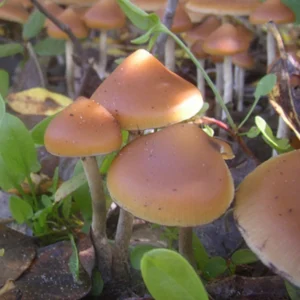
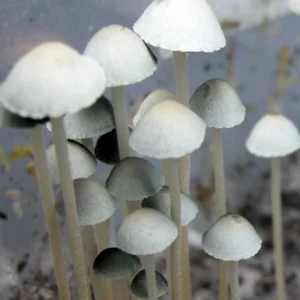
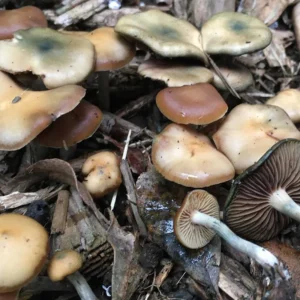
Cap: caramel, hygrophanous, going wavy
Roughly 1.5 to 5 cm across, convex then flattening with a low umbo, caramel to chestnut-brown when moist and fading to buff as it dries (hygrophanousChanges colour as it loses moisture.). The margin is striate and becomes distinctly wavy at maturity, the trait that names the species. Surface smooth, slightly viscid when moist, with a peelable gelatinous pellicle.
Gills and bruising
Gills adnateBroadly attached to the stem., close becoming subdistant, pale cinnamon-tan when young and darkening to dark purple-brown as the spores mature, with noticeably paler edges. Cap, gills, stem and flesh bruise greenish-blue where handled, cut or aged. The blue is shared with other bluing wood Psilocybes, so it is not by itself diagnostic between them.
Stem and rhizomorphs
Stem roughly 3 to 9 cm long and 2.5 to 8 mm wide, white, smooth to silky-fibrillose, often slightly swollen at the base, which carries conspicuous white rhizomorphsThick cords of fungal threads, like fungal roots. binding the wood chips. There is no true ring; young specimens show only a cobwebby cortinaA cobwebby partial veil that soon disappears.-like veil leaving at most a faint, fleeting fibrillose zone.
Habitat, season and odour
A wood/lignin saprotrophFeeds on dead matter; here, wood. on wood chips and woody debris, classically around the perimeter of mulched plant beds in parks and gardens, occasionally leaf litter, rarely lawns; reportedly not favouring pure bark mulch and not a dung or pasture-grass species. Fruits in autumn into winter, triggered by cooling temperatures. Odour and taste reportedly farinaceous (fresh flour).
Where it comes from
A wood mushroom that travels by mulch
Psilocybe cyanescens is a saprotrophFeeds on dead organic matter rather than a living host. that feeds on lignin, so it lives on wood. In practice that means wood chips and woody debris, classically the mulched beds of parks, gardens, cemeteries and roadsides, and it favours lignin-rich material (hardwood chips, conifer debris, sawdust) over pure bark mulch. It is not a dung species and not a pasture-grass species, which is precisely how its ecology separates it from Panaeolus cyanescens (dung) and from the Liberty Cap (dead grass roots). The stem base is anchored by tough white rhizomorphs, and it can fruit in dense troops, occasionally in spectacular numbers on freshly mulched ground.
It is abundant in temperate western and central Europe (including increasingly across southern Britain and apparently spreading northwards), the North American Pacific Northwest down to the San Francisco Bay Area, New Zealand and parts of West Asia. The range is expanding fast, largely because the mycelium hitchhikes through the commercial wood-chip and mulch trade. Fruiting is cued by a drop in temperature, so it is an autumn-into-winter species, halted by hard frost. Its true native range is genuinely unresolved, because the type came from cultivated Kew mulch rather than a wild habitat.
The main event
Under the microscope
This is what you actually bought the spores for. Put a print or a drop from a syringe on a slide, and here is what shows up, and how it differs from a cube.
- Plump ellipsoids with a germ pore. Smooth, thick-walled ellipsoidOval, like a rugby ball. to broadly ellipsoid spores, about 10 to 12.5 by 7 to 7.5 µm in peer-reviewed KOH measurements (popular sources cite ~9 to 12.5 by 5 to 8), each with a distinct truncate apical germ poreA thin spot at one end of a spore where a new fungus can emerge..
- Purple-brown, but that won't split it from a cube. The print is dark purple-brown to blackish-purple-brown. That colour is the decisive separator from the rust-printed deadly Galerina marginata and the jet-black Panaeolus cyanescens, but cubensis prints the same purple-brown, so colour does not separate those two.
- The cystidia tell. Abundant pleurocystidiaSterile cells on the gill FACE. (clavate-mucronate to broadly fusiform) on the gill faces, plus short-necked lageniform cheilocystidiaSterile cells along the gill EDGE. on the edges. That combination points specifically to cyanescens within the wood-lover complex. (An old claim that the Kew type lacks pleurocystidia was an artefact of a collapsed hymenium; Borovicka showed they are present.)
- Against a cube, and the look-alikes. Spore size is the primary tell: cubensis spores are markedly larger (~11.5 to 17 by 8 to 11.5 µm), so a spore over about 14 µm long is cubensis, not cyanescens. Within the wood-lovers, cyanescens has the shortest, broadest spores; azurescens spores are longer and more elongate; subaeruginosa spores are longer and narrower (subellipsoid).
- The legal bit, and why it's true. A dormant spore carries no psilocybin and no psilocin; that chemistry only appears later in living tissue. That is exactly why a syringe or print is a study specimen and legal to own in the UK.
How it behaves
Keyed to wood and to cold
What makes cyanescens interesting biologically is how unlike a cubensis it is. Everything about it is keyed to wood and to cold, and the documentary record describes substrate and trigger TYPES rather than any procedure.
Documentary ecology only. The UK basis for selling these spores is that a dormant spore contains no psilocybin or psilocin and is not a controlled substance, so it is legal here for microscopy and study. Cultivating the fungus is illegal in the UK, and these descriptions of how the organism behaves where it is studied or grown legally are not instructions and carry no recipe, parameters or dosing.
It is a lignin specialist
Where it is studied or grown legally, it is associated with lignin-rich material: wood chips, woody mulch, hardwood such as alder, sawdust and decaying woody debris. It is reported to dislike substrate that is not lignin-rich and to do poorly on pure bark mulch. This wood preference is the whole story of how it spreads through landscaping.
Cold is the switch
Unlike warm-loving cubensis, fruiting is triggered by a drop in temperature, so it is an autumn-into-winter fruiter in cool maritime climates and is halted by frost. The mycelium is described as easier to establish than the fruit bodies are to coax out.
Easy to colonise, hard to fruit
The documentary record reports that in a suitable cool, damp, shaded maritime climate the mycelium establishes readily on outdoor wood-chip beds and can even be transplanted, but the yield per unit of substrate is comparatively low and getting it to fruit, rather than just run mycelium, is the difficult step.
Why it is a study specimen, not a food
A real, cautiously documented safety note attaches to the wood-loving Psilocybe group: an anecdotally reported delayed muscle-weakness syndrome (wood-lover paralysis) is associated with consuming these species. No causative compound is proven and there are no controlled studies, only surveys and emerging case reports. It is one more reason these are sold as microscopy specimens, never as food.
Sources: Wakefield 1946 (Trans. Brit. Mycol. Soc.); Borovicka 2008 (Czech Mycology); the Wikipedia, First Nature and GBIF species records; and Windsor et al. 2025 (J. AOAC Int.).
Choose your format
Print, syringe, vial or swab?
Same lab-grade genetics in every option. The difference is shelf life versus how soon you are at the scope.
Spore print
Keeps longest
Spores dropped onto sterile foil. Stored cool and dry it outlasts everything else here, so it is the one to reach for if you are building a reference collection to keep for years.
Spore syringe
Ready tonight
Spores suspended in sterile water, ready to go straight onto a slide. The quickest way to be at the microscope this evening. Comes in 3 mL and 12 mL.
Vial & swab
Compact
A sealed glass vial is a tidy middle ground; a sterile swab is the most travel-friendly little format for adding a rare species to your set.
At a glance
The spec sheet
- Species
- Psilocybe cyanescens Wakef., 1946
- Common names
- Wavy Cap, Blueleg Brownie (UK)
- Family
- Hymenogastraceae (modern); Strophariaceae (older); Agrocybaceae (current Index Fungorum)
- Spore print
- Dark purple-brown to blackish-purple-brown
- Spore size
- ~10 to 12.5 × 7 to 7.5 µm (KOH); popular sources ~9 to 12.5 × 5 to 8 µm
- Spore shape
- Ellipsoid to broadly ellipsoid, smooth, with an apical germ pore
- Basidia
- 4-spored (sometimes 2-spored), clavate, hyaline
- Cystidia
- Pleurocystidia abundant (clavate-mucronate / fusiform); cheilocystidia short-necked lageniform
- Cap
- 1.5 to 5 cm, caramel, hygrophanous, wavy margin at maturity
- Stem
- 3 to 9 cm, white, bruising blue, white basal rhizomorphs; no true ring
- Bruising
- Blue-green where handled, cut or aged
- Habitat
- Wood chips and lignin-rich mulch; not dung, not grass
- Season
- Autumn into winter, triggered by cooling temperatures
- Intended use
- Microscopy, taxonomy & collecting only
Dig deeper
Further reading
Independent, non-commercial sources, no shops, just good information.
- Psilocybe cyanescens on Wikipedia: broad overview: description, habitat, range, season, the native-range debate, the mulch-distribution spread and the ~100,000 racetrack mass-fruiting story.
- Borovicka 2008, Czech Mycology 60(2):173-192: the peer-reviewed microscopy reference: KOH spore measurements, the cystidia characters, and the holotype correction.
- First Nature, Psilocybe cyanescens (Pat O'Reilly): standard UK field reference; source of the Blueleg Brownie name.
- Index Fungorum record 290108: the authoritative name record (Wakef., 1946), showing the current family placement and that there is no basionym to cite.
- Windsor et al. 2025, J. AOAC International: reference-material spore measurements for cyanescens and the wood-loving look-alikes.
Common questions
Frequently asked
This page is Psilocybe cyanescens, the wood-loving Wavy Cap with a purple-brown to blackish-purple-brown spore print. Panaeolus cyanescens (Blue Meanies) is a completely different genus and family, a dung species with a jet-black print. They share only the epithet cyanescens because both bruise blue. The decisive separators are print colour (purple-brown versus jet-black) and habitat (wood chips versus dung). Always read the full genus name on the label, never just "cyanescens".
Yes. A dormant spore contains no psilocybin or psilocin, so under UK law spores are not a controlled substance and are legal to possess, sell and study for microscopy, taxonomy and education. We sell them strictly on that basis. Cultivating the fungus is a separate matter and is illegal in the UK; nothing on this page is a cultivation or consumption guide.
Mainly spore size. Cubensis spores are markedly larger (about 11.5 to 17 by 8 to 11.5 micrometres), while cyanescens spores are plumper ellipsoids of roughly 10 to 12.5 by 7 to 7.5 micrometres. Both share a truncate germ pore, four-spored basidia and present cystidia, and both give a purple-brown print, so size is the primary microscopic discriminator. Macroscopically the wavy cap and wood-chip habitat also set it apart.
Because the cap margin genuinely becomes undulating and sinusoidal at maturity, a trait a cubensis cap does not show. The cap is also hygrophanous, fading from caramel-brown when moist to buff as it dries. The UK common name Blueleg Brownie refers to the blue-bruising white stem.
That is unsettled. The prevailing modern view is Hymenogastraceae (GBIF and most current references), older treatments use Strophariaceae, and the live Index Fungorum record currently lists the newer family Agrocybaceae. The order Agaricales is agreed in every scheme. We report the disagreement rather than pretend one answer is final.
It is abundant in temperate Europe (including increasingly across southern Britain), the North American Pacific Northwest down to the San Francisco Bay Area, New Zealand and parts of West Asia. Its native range is genuinely debated, partly because the type came from cultivated Kew mulch. The range is expanding fast because the mycelium travels through the commercial wood-chip and mulch trade.
It has that reputation, often grouped with azurescens and subaeruginosa, but measured psilocybin and psilocin content is highly variable across studies and populations, from near-zero up to roughly 1.8 percent dry weight, depending on substrate, region, flush and specimen. We treat potency only as documented chemical variation, never as a product claim, and we sell these spores for microscopy only.
Yes, which is one reason a spore print is so useful. The lethally toxic Galerina marginata (Funeral Bell) can grow on the same wood, but it has a rust-brown spore print, a distinct membranous stem ring and does not bruise blue, versus cyanescens' purple-brown print, blue bruising and ringless cobwebby veil remnants. Within-complex separation from allenii, azurescens and subaeruginosa is not reliable from photos alone and leans on range plus microscopy or DNA.
Ask the community
Questions and answers
No questions yet. Yours could be the first.
For microscopy, taxonomy and collecting only.Sold for legal research. Not for cultivation. Spores contain no controlled substances. We trust you to be responsible.