Home / Magic Mushroom Spores / Rare & Exotic Species / Psilocybe Azurescens
Psilocybe azurescens
The Flying Saucer
The Pacific Northwest's cold-fruiting coastal wood-lover, reputedly one of the most potent Psilocybe species ever measured. Sold here strictly as a spore specimen for microscopy, taxonomy and collecting.
Choose your format
Some formats are out of stock
Want to know the moment it returns?
Sold for microscopy, taxonomy and collecting only. Not for cultivation.
filled under laminar flow
plain packaging, tracked
The short version
Psilocybe azurescens is the famous "Flying Saucer" of the Oregon and Washington coast, a tall, caramel-capped wood-lover that fruits into the cold of late autumn and winter on buried wood debris and among the roots of dune grasses. It is known for two things: the reputation, by most accounts, of being among the most potent psilocybin mushrooms ever assayed, and a violent blue-black bruising reaction that gave it its name. It is the opposite of a tropical, dung-loving P. cubensis: cold not warm, wood not dung, a narrow native range not a global one. It also forms no sclerotia, so there is no truffle stage to it, unlike P. tampanensis or P. mexicana. Sold here as a spore deposit for microscopy only. A dormant spore contains no psilocybin or psilocin, which is what makes it a legal study specimen in the UK.
Straight talk
Fact vs. legend
There is a lot of folklore around this strain. Here is which bits are real, side by side.
What we actually know
- Described by Paul Stamets and biochemist Jochen Gartz in 1995, in the journal Integration, with the type collected near Hammond, Oregon, at the mouth of the Columbia River.
- It is a lignicolous wood-lover that grows on woody debris in sandy coastal soils with an affinity for the dune grass Ammophila, and it forms no sclerotia.
- It is a cold-fruiter, coming up from late September into late December and early January, the opposite season to most cultivated Psilocybe.
- Its native range is a narrow Pacific Northwest coastal band from Depoe Bay, Oregon to Grays Harbor County, Washington; it is not a native British or European species.
- On the slide: spores 12 to 13.5 by 6.5 to 8.0 micrometres, ellipsoid with an apical germ pore; a dark purplish-brown to purplish-black print; abundant pleurocystidia and clamp connections.
- All tissues bruise intense blue to blue-black, among the strongest bluing of any Psilocybe, which is what the epithet azurescens ("becoming blue") describes.
What the community says
- By most accounts it is the most potent psilocybin mushroom known, the famous "up to ~1.8 percent psilocybin / ~2.5 percent total tryptamines" figure. These are author-era numbers from limited assays; lab work on its close relatives shows the alkaloid load varying more than fivefold between specimens, so "one of the most potent" is defensible while "the most potent" is contested. None of it applies to a dormant spore.
- The widely quoted exact "1.78 percent psilocybin / 0.38 percent psilocin" figure traces to the original Stamets and Gartz (1995) description of azurescens itself, from a small number of early assays, and has not been reproduced in a modern peer-reviewed survey, so treat the exact percentage as historical and single-origin rather than a current measurement.
- It is said to have been first noticed in 1979 by a Boy Scout troop camping near the Columbia River estuary. This is repeated everywhere as fact but traces only to Stamets' own retelling, with no independent citation, so treat it as founding anecdote.
- An informal name, "Psilocybe astoriensis", reportedly circulated among Astoria-area foragers for the local population before 1995. It was never validly published (a nomen nudum) and is discovery lore, not a true synonym.
- The story that Stamets named the species in connection with his son Azureus is well attested and attributed to Stamets himself, but it is anecdote layered on the hard Latin derivation rather than a primary taxonomic statement.
- Community "antihistamine cures" for wood-lover paralysis are forum lore; the 2025 Toxicon authors call the excess-histamine theory an unlikely explanation and warn of placebo and expectation bias.
The story
The mushroom at the mouth of the river
There is a thin, wind-scoured strip of coast where the Columbia River empties into the Pacific, all sand, drift logs and stiff dune grass, and that is more or less the whole world of Psilocybe azurescens. It is not a global tramp like the dung-loving cubensis. It is a local, a specialist, a thing that learned to make its living off wood the river dragged down and buried, and off the roots of the marram grass that holds the dunes in place.
The story everyone tells starts in 1979, with a Boy Scout troop said to have stumbled on a big, strongly bluing mushroom near Astoria. That tale traces only to Stamets' own retelling, so hold it loosely. What is firm is what came after: foragers passed around an unofficial name, "Psilocybe astoriensis", for the Astoria population, and that name never got a proper Latin description, so it never counted. It took until 1995 for Paul Stamets and the German biochemist Jochen Gartz to write it up properly, in a small journal called Integration, as Psilocybe azurescens.
Get the authorship right: it is Stamets and Gartz, 1995, not the "Stamets and Pollock, 1996" that vendors keep copying off each other.
The name is the best part. Azurescens means "becoming blue", because the flesh does exactly that, fast and hard, the moment you touch it, bruising a deep oxidised blue-black at the margin and the stem base. Stamets has said he tied the name to his son Azureus, who was himself named for the colour. Whether you take the family story or just the Latin, the point is the same: this is the mushroom that turns the colour of its own chemistry when you handle it.
The reputation, and the version of it
What made azurescens famous is the claim that it is the most potent of all the magic mushrooms, carrying something like double the tryptamine load of a cubensis. The numbers behind that headline are real but old and thin, a handful of assays from the Stamets and Gartz era, and modern work on its close relatives shows the alkaloid content swinging wildly from one specimen to the next. So the version is "reputed, by most accounts, to be among the most potent", with the variability said out loud. The single most-quoted exact percentage comes from those same early assays and has never been reproduced in a modern peer-reviewed survey, so it is best read as historical rather than a current measurement.
For our purposes none of that chemistry is in the box anyway. A dormant spore carries no psilocybin and no psilocin; it carries the genetics, the germ pore, the print colour and the shape, which is exactly what makes it a legal and genuinely rewarding specimen to put under a microscope. The flying saucer comes to you as a deposit on a slide, the way a serious collector wants it.
The signature
Why this is not just another purple-brown print
A cubensis page can talk about a big, forgiving, dung-loving mushroom. An azurescens page gets to talk about the one that sits at the top of nearly every potency ranking of the genus, fruits when everything else has died back, and binds the beach together with its own roots. Three things set it apart, on the slide and in the story.
The reputed potency crown
By most accounts azurescens carries the highest total tryptamine load of any Psilocybe measured. The widely circulated Stamets and Gartz era figures put it at up to roughly 1.8 percent psilocybin by dry weight, well above a typical cubensis, with psilocin and baeocystin on top. We say reputed and by most accounts deliberately: those are author-era numbers from limited assays, and lab work on its close relatives shows the alkaloid load swinging more than fivefold between individual specimens. So it is genuinely high and genuinely variable, never a fixed figure. None of that is relevant to a dormant spore, which contains none of these compounds, but it is the headline a cube page can never claim.
A cold coastal wood-lover, not a dung mushroom
Cubensis is a warm-weather dung and pasture species. Azurescens is its opposite on every axis: it decomposes lignin-rich wood in sandy coastal soils, leans on the dune grass Ammophila (marram), and fruits as the temperature drops, from late September into December and early January. This cold, wood-debris, coastal niche is the true differentiator, not a microscopic detail.
No sclerotia, no truffle
Unlike the truffle-formers (P. tampanensis, P. mexicana) there is no sclerotium here to examine. Azurescens overwinters as a tenacious white mycelial mat on buried wood, not as a hardened underground body. The examinable material is the spore deposit itself, so there is no "Philosopher's Stone" framing to mistake this for.
The species
Meet Psilocybe azurescens
It belongs to the bluing, psilocybin-bearing core of Psilocybe, the genus whose name comes from the Greek psilos ("bare" or "smooth") and kybē ("head"). Current databases (GBIF, MycoBank, Index Fungorum) place the genus in the family Hymenogastraceae, nested near Hypholoma by multigene work; older books and some vendor pages still say Strophariaceae, and we note that disagreement. The epithet azurescens is Latin for "becoming blue", after the violent bruising.
Two relatives must be ruled out. P. cyanescens ("Wavy Caps") is smaller, with a distinctly wavy cap margin, no persistent umboA raised bump in the centre of the cap. and clearly smaller spores; azurescens is taller, keeps a pronounced broad umbo and runs larger spores. P. subaeruginosa is the Australasian counterpart, so close in form and chemistry that geography, not the slide, is the practical separator. Keep brown-spored impostors in mind too: the deadly Galerina, plus Pholiotina and the non-active Hypholoma fasciculare (sulphur tuft) share similar wood-and-grass ground.
- Family
- Hymenogastraceae (older books say Strophariaceae)
- Genus
- Psilocybe (Fr.) P. Kumm., 1871
- Species
- Psilocybe azurescens Stamets & Gartz, 1995
- First described
- Journal Integration 6: 21 (1995); no basionym or synonym
- Section
- Cyanescens (under molecular revision)
- Type locality
- Near Hammond, Oregon, at the mouth of the Columbia River
How you'd know it
Field marks
A tall, dramatic mushroom that announces itself by bruising. These describe the mature wild organism for reference and identification.
The persistent broad umbo
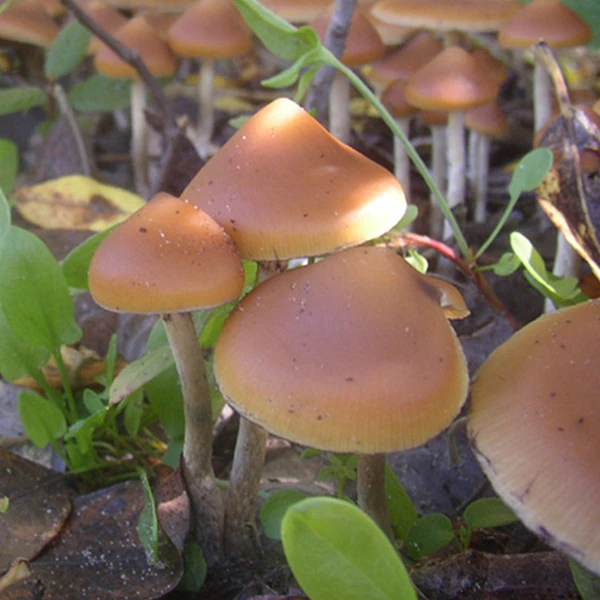
The cap is 3 to 10 cm, conic to convex, expanding and flattening but always keeping a pronounced, persistent broad central umboA raised bump in the centre of the cap.. That umbo on a wide flattened cap is the "flying saucer" profile, and the single most useful separator from the wavy-margined, umbo-less P. cyanescens.
Caramel cap, viscid and hygrophanous
Chestnut to ochre to caramel brown, smooth and viscid when moist with a separable gelatinous pellicleA thin skin over the cap that can be peeled., often pitted with dark blue-black zones where damaged. It is hygrophanousChanges colour as it loses moisture., fading to pale straw or buff as it dries.
Tall, slender, rhizomorphic stem
The stem is long and slender, 9 to 20 cm by only 3 to 6 mm, silky white ageing dingy brown, hollow at maturity. The base thickens, often curves, and carries coarse white aerial mycelium with azure tones plus dense white rhizomorphsThick cords of fungal threads, like fungal roots. that bind the wood chips together tenaciously. There is no persistent ring, only a thin evanescent cortinaA cobwebby partial veil that soon disappears. leaving at most a faint zone.
Violent blue-black bruising
All damaged tissue bruises deep blue to blue-black, fast and intense, strongest on the cap margin and stem base, with the basal mycelium itself carrying azure tones. This is among the strongest bluing of any Psilocybe and is the visible oxidation the species was named for. Gills are sinuate to adnate, close, pale brown maturing to deep purplish-brown with whitish edges.
Where it comes from
A cold coastal wood-lover, not a dung mushroom
Psilocybe azurescens is a lignicolousWood-loving: grows on wood, woodchips or buried timber. wood-lover, a saprobeFeeds on dead organic matter rather than a living host. that decomposes woody debris rather than dung. It grows caespitoseIn tight clusters from a shared base. to scattered on deciduous wood chips and buried branches, sticks and waterborne wood in sandy coastal soils, with a strong affinity for the dune grass Ammophila (marram), whose roots its dense white rhizomorphs knit together. It is not coprophilicDung-loving. and it forms no sclerotia, so its survival structure is mycelium on buried wood and grass roots, never an underground truffle. Substrate is the single most reliable thing separating it from the grassland and dung Psilocybes.
The native range is a narrow strip of the US Pacific Northwest coast centred on the mouth of the Columbia River, documented from Depoe Bay, Oregon north to Grays Harbor County, Washington, with the type from near Hammond, Oregon. It is a cold-fruiter: fruitings begin in late September and continue into late December and early January, which fits its cool coastal home. It is not a British or European wild species; the only European occurrences are feral patches attributed to escaped outdoor cultivation. Britain's genuinely native field species is P. semilanceata (the Liberty Cap), and the wood-lover establishing in southern Britain is P. cyanescens, not azurescens.
The main event
Under the microscope
This is what you actually bought the spores for. Put a print or a drop from a syringe on a slide, and here is what shows up, and how it differs from a cube.
- Ellipsoid and thick-walled. Smooth, thick-walled spores 12 to 13.5 by 6.5 to 8.0 µm (length-to-width about 1.6 to 1.9), ellipsoidOval, like a rugby ball. to subellipsoid, each with a clean apical germ poreA thin spot at one end of a spore where a new fungus can emerge..
- Purple-brown in the mass. The print is dark purplish-brown to purplish-black, the classic Psilocybe deposit. A single spore reads rich reddish-brown in KOHPotassium hydroxide, a routine mounting reagent. (purple-wine in aqueous ammonia); only a dense mass looks near-black.
- The cystidia tell. Four-spored basidiaThe club-shaped cells on the gills that grow and release the spores.; genuinely abundant fusoid-ventricose pleurocystidiaSterile cells on the gill FACE. on the gill face (about 23 to 35 by 9 to 10 µm), a sterile band of cheilocystidiaSterile cells along the gill EDGE. on the edge, and clamp connectionsSmall bridges on the fungal threads, an ID feature. readily found on the hyphae.
- Against a cube, and the look-alikes. Cubensis spores are larger and broader (commonly ~11.5 to 17 by 8 to 11 µm, often sub-hexagonal), so azurescens reads narrower and cleanly ellipsoid. P. cyanescens runs smaller (~9 to 12 by 5 to 8 µm); P. subaeruginosa overlaps so heavily that geography, not the slide, separates them.
- The legal bit, and why it's true. A dormant spore carries no psilocybin and no psilocin; that chemistry only appears later in living tissue. That is exactly why a syringe or print is a study specimen and legal to own in the UK.
How it behaves
A cold-fruiting outdoor wood-lover
Azurescens behaves nothing like a tropical cubensis, and its documented behaviour is genuinely interesting at the substrate-and-season level. We document that as ecology, the way Stamets wrote his methods down, not as a how-to.
What follows is documentary natural history, a record of how the organism behaves where it is studied and grown legally. In the UK psilocybin and psilocin are controlled and fruiting these spores would be an offence; we sell spores for microscopy, taxonomy and collecting only, and nothing below is a recipe or a set of parameters.
An outdoor wood-bed organism
Where it has been studied and grown legally, azurescens is an outdoor woody-substrate species, established on wood-chip and mulch beds rather than in indoor jars. The methods originally developed for its relative P. cyanescens were adapted to it, and it has been reported established outdoors well beyond its native range. It does not take to standard indoor cubensis approaches, and it is rated difficult by every account.
Cold-fruiting, late season
It is a cool-temperature fruiter that comes up as the weather turns, late autumn into winter, consistent with its cool coastal home. This cold tolerance is part of why it is documented as an outdoor organism in temperate climates rather than a warm indoor one.
Wood-lover paralysis: a documented, unresolved caution
Azurescens and its wood-loving cousins are associated with "wood-lover paralysis", a transient muscular weakness reported after ingestion of these species (and notably not reported for cubensis). A 2025 peer-reviewed survey (Beck and colleagues, Toxicon) gives the first formal description; the cause is unknown, the evidence argues it is not psilocybin or psilocin themselves, and community "antihistamine cures" are dismissed by the authors as resting on an unlikely theory. We flag it because it is the single most interesting lesser-known fact about the wood-lover clade, and because it underlines exactly why these are study specimens here, not food.
Sources: Stamets & Gartz 1995 (Integration); Stamets, "Psilocybin Mushrooms of the World" (1996); Beck et al. 2025 (Toxicon); and the Wikipedia and GBIF species records.
Choose your format
Print, syringe, vial or swab?
Same lab-grade genetics in every option. The difference is shelf life versus how soon you are at the scope.
Spore print
Keeps longest
Spores dropped onto sterile foil. Stored cool and dry it outlasts everything else here, so it is the one to reach for if you are building a reference collection to keep for years.
Spore syringe
Ready tonight
Spores suspended in sterile water, ready to go straight onto a slide. The quickest way to be at the microscope this evening. Comes in 3 mL and 12 mL.
Vial & swab
Compact
A sealed glass vial is a tidy middle ground; a sterile swab is the most travel-friendly little format for adding a rare species to your set.
At a glance
The spec sheet
- Species
- Psilocybe azurescens Stamets & Gartz, 1995
- Common names
- Flying Saucer Mushroom, Blue Angel, azure psilocybe
- Family
- Hymenogastraceae (historically Strophariaceae)
- Section
- Cyanescens (under molecular revision)
- Cap
- 3 to 10 cm, conic to convex, persistent broad umbo, caramel-chestnut, viscid, hygrophanous
- Stipe
- 9 to 20 cm long, 3 to 6 mm thick, silky white, hollow, rhizomorphic base
- Gills
- Sinuate to adnate, close, pale brown to deep purplish-brown, whitish edges
- Bruising
- Intense, rapid blue to blue-black on all tissues
- Spore print
- Dark purplish-brown to purplish-black
- Spores
- 12 to 13.5 × 6.5 to 8.0 µm, ellipsoid, thick-walled, apical germ pore
- Basidia
- 4-spored, clavate, ~27 to 30.5 × 6.3 to 7.2 µm
- Cystidia
- Pleurocystidia abundant 23 to 35 × 9 to 10 µm; cheilocystidia present; clamps present
- Habitat
- Coastal wood debris, sandy soils, dune grass (Ammophila); not dung, no sclerotia
- Season
- Late September to December / early January (cold-fruiting)
- Intended use
- Microscopy, taxonomy & collecting only
More from the cabinet
Other rare & exotic species
Dig deeper
Further reading
Independent, non-commercial sources, no shops, just good information.
- Species Fungorum / Index Fungorum (record 446057): the authority file, confirming "Stamets & Gartz" and the 1995 protologue in Integration.
- Psilocybe azurescens on Wikipedia: the best single overview for morphology, range, season and the potency figures.
- GBIF backbone, Psilocybe azurescens: taxonomic backbone with the Hymenogastraceae placement and occurrence records.
- Psilocybe cyanescens on Wikipedia: the key look-alike; use for the wavy-cap contrast and smaller spore range.
- Beck, Barlow, Engel & Barratt 2025, "Wood-lover paralysis", Toxicon 264:108450: the first formal scientific description of wood-lover paralysis.
- Bradshaw et al. 2022, DNA authentication and chemical analysis of Psilocybe (PMC): peer-reviewed potency work showing over fivefold specimen-to-specimen variation, the basis for hedging fixed potency claims.
Common questions
Frequently asked
Yes. Index Fungorum, GBIF, MycoBank, Encyclopedia of Life and Wikidata all give "Psilocybe azurescens Stamets & Gartz", published in 1995 in the journal Integration. The co-author is biochemist Jochen Gartz. "Stamets & Pollock (1996)" is a recurring error: Pollock is associated with other Psilocybe history, and 1996 is only the year of Stamets' popular book, not the formal description.
Because of the cap. It expands and flattens into a wide disc but keeps a pronounced central umbo, giving a profile that looks like a classic flying saucer. "Blue Angel" and "azure psilocybe" are other names you will see, all of them common names rather than taxonomy.
It is reputed to be among the most potent, and by most accounts sits at or near the top of the genus. But the famous figures are author-era numbers from limited assays and the content varies enormously between specimens. We say "one of the most potent" rather than "the most potent", and none of it applies to a dormant spore, which contains no active compounds.
No. Azurescens is a fruitbody-only wood saprobe. It overwinters as a tenacious white mycelial mat on buried wood and grass roots, not as a hardened underground sclerotium. The truffle-formers are different species (P. tampanensis, P. mexicana), so do not expect sclerotial material here.
Macroscopically, cyanescens ("Wavy Caps") is smaller with a wavy, undulating cap margin and no persistent umbo; azurescens is taller, with a non-wavy margin and a pronounced persistent umbo. Microscopically, azurescens spores are clearly larger (12 to 13.5 by 6.5 to 8.0 micrometres versus about 9 to 12 by 5 to 8 for cyanescens) and it shows consistently abundant pleurocystidia. Spore size alone overlaps, so use cap shape, stem length and habitat too.
That is the Australasian counterpart, and it is so close morphologically and molecularly that the slide barely separates them: subaeruginosa spores run slightly longer and its cystidia larger, but the overlap is heavy. In practice geography does the work (Pacific Northwest USA versus Australia and New Zealand), and a clean separation can need multi-locus DNA sequencing.
No. It is a North American native confined to a small Pacific Northwest coastal strip. European feral patches (for example near Stuttgart) are attributed to escaped outdoor cultivation, not a natural range. Britain's native field species is the Liberty Cap (P. semilanceata), and the wood-lover establishing in southern Britain is P. cyanescens. That is exactly why azurescens is a collector and microscopy curiosity here, not a foraging target.
It is a transient muscular weakness reported after ingestion of azurescens and its wood-loving relatives, and notably not reported for cubensis. A 2025 peer-reviewed survey (Beck and colleagues, Toxicon) gives the first formal description; the cause is unknown, the evidence argues it is not psilocybin or psilocin themselves, and community "antihistamine cures" are dismissed by the authors. We mention it as documented natural history. It has no bearing on handling dormant spores under a microscope.
Ask the community
Questions and answers
No questions yet. Yours could be the first.
For microscopy, taxonomy and collecting only.Sold for legal research. Not for cultivation. Spores contain no controlled substances. We trust you to be responsible.