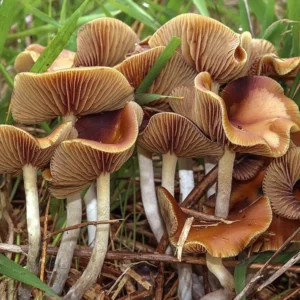
Home / Magic Mushroom Spores / Rare & Exotic Species / Psilocybe Semilanceata
Psilocybe semilanceata
The Liberty Cap
The wild British grassland icon and the conserved type species of the entire Psilocybe genus. A tiny sharp-nippled conical cap that you study, print and identify, never farm. Offered strictly as a microscopy and taxonomy reference specimen.
Choose your format
Some formats are out of stock
Want to know the moment it returns?
Sold for microscopy, taxonomy and collecting only. Not for cultivation.
filled under laminar flow
plain packaging, tracked
The short version
Psilocybe semilanceata, the Liberty Cap, is the small, sharply pointed grassland mushroom that most of Europe pictures when it hears "magic mushroom", and it is genuinely the most widely distributed potent Psilocybe in the world. It is the conserved type species of the whole genus, the mushroom behind the first medical write-up of a psychedelic in European history (the London case of 1799), and the first European mushroom in which psilocybin was chemically confirmed (Hofmann and Heim, 1963). Unlike a fleshy, dung-loving, easily-farmed cubensis, the Liberty Cap is a grassland saprobe that feeds on decaying grass roots, carries a peelable gelatinous skin over a nipple-tipped cap, and famously resists indoor cultivation. Listed here purely as a reference specimen for microscopy, taxonomy and spore-printing. A dormant spore contains no psilocybin or psilocin, and nothing on this page is a grow guide.
Straight talk
Fact vs. legend
There is a lot of folklore around this strain. Here is which bits are real, side by side.
What we actually know
- Psilocybe semilanceata is the conserved type species of the entire genus Psilocybe, fixed by vote of the Nomenclature Committee for Fungi in 2010 (on a proposal by Redhead and colleagues, 2007).
- It is a grassland saprobe that feeds on decaying grass roots; it is not coprophilic and not a wood-lover, and it does not fruit from dung even in heavily grazed pasture.
- Keay and Brown (1990) documented it invading the peripheral cortical cells of living grass roots in co-culture, with a clear preference for Agrostis and Poa over perennial ryegrass.
- It was the first European mushroom in which psilocybin was chemically confirmed, by Albert Hofmann and Roger Heim using material from Switzerland and France, reported in 1963 at roughly 0.25 percent by dry weight.
- On the slide it has cheilocystidia but no pleurocystidia and no chrysocystidia, clamp connections in all tissues, and smooth thick-walled germ-pored spores about 10.5 to 15 by 6.5 to 8.5 micrometres.
- The first medical description of psychedelic-mushroom intoxication in European history involved this species: the Brande family case in London in October 1799, written up by Everard Brande in 1800.
What the community says
- Vendor "Liberty Cap strains" or "genetics" (names like Astoria turn up) are marketing lore, not taxonomy. The species is not commercially cultivated and has no recognised cultivars; only the wild organism exists.
- It is frequently and wrongly assumed to be a dung-grower like cubensis. It merely favours dunged, grazed pasture; the dung enriches the grass, it is not the substrate.
- It is often sold as "the most potent magic mushroom in the world". By most accounts it is among the most potent and, more reliably, one of the most consistent, but P. azurescens and others reportedly reach higher peak levels, so the superlative is unsafe.
- Reported potency figures swing by roughly an order of magnitude across studies (Hofmann about 0.25 percent, Beug and Bigwood about 1.0 percent average, Gartz a span up to about 2.37 percent), and are said to vary with size, locale, season and drying. Smaller fruit bodies are reportedly highest by weight.
- The name origin is layered, not a single coinage: the shape-to-liberty-cap comparison runs from the poet Woodhouse (1803) through Coleridge and Southey's Omniana (1812), and the formal English common name is credited to Mordecai Cooke in Victorian British mycology.
- Categorical claims that it is flatly "impossible to cultivate" come mainly from forums and vendors; the citable core is the slow grass-root habitat and the absence of any reproducible indoor fruiting protocol.
The story
The little brown mushroom that named a genus
Most of the mushrooms in this category are immigrants and inventions: tropical species bred into branded lineages and grown on grain. The Liberty Cap is neither. It is a wild, native organism of British and north-European pasture, a thumbnail-sized cone on a wavy stem that has been quietly fruiting in damp autumn fields for far longer than anyone has had a name for it. And when mycologists finally had to decide what the genus Psilocybe even meant, after molecular work showed the old genus was a tangle of unrelated things, they chose this mushroom as the anchor. In 2010 it became the conserved type species of the whole group. The entire idea of "magic mushroom" taxonomy is pinned to a small grassland fungus you could mistake for a blade of grass from a few feet away.
Its documented human story begins not in a lab but in a panic. In October 1799 a man gathered field mushrooms in London's Green Park and cooked them into a breakfast for his family. Within an hour came vertigo, black spots, cold extremities and stomach cramps, and his eight-year-old son was, in the chemist's own words, attacked with fits of immoderate laughter. The apothecary Everard Brande wrote it up in 1800 as a case of poisoning by a "poisonous species of Agaric". It is now recognised as the first medical description of psychedelic-mushroom intoxication in European history, and the species was later matched to Sowerby's 1803 plate, where it was drawn under the old name Agaricus glutinosus.
The whole idea of magic-mushroom taxonomy is pinned to a small grassland fungus you could mistake for a blade of grass.
From the bonnet rouge to Albert Hofmann
The English name is its own piece of history. The cap's sharp cone echoes the Phrygian pileus, the felt cap of a freed Roman slave, revived as the bonnet rouge, the cap of liberty, during the French Revolution. The poet James Woodhouse first likened the fungus to "Freedom's cap" in 1803, Coleridge and Southey repeated the image in Omniana in 1812, and the Victorian mycologist Mordecai Cooke cemented "liberty cap" as its common name. It is one of the few mushrooms whose name comes from revolutionary politics rather than its own biology.
The scientific milestone came in 1963. Albert Hofmann, the chemist who had synthesised LSD and isolated psilocybin from a Mexican Psilocybe, turned to fruit bodies of this very British and European field mushroom, collected in Switzerland and France via Roger Heim, and confirmed psilocybin in them. It was the first time the compound had been found in any European mushroom. That a humble pasture cone tied the European countryside directly to the man who discovered LSD is exactly the kind of story a domesticated cube simply cannot tell, and it is the reason we treat this listing as a reference specimen for study, not a product to be farmed.
The signature
The wild native, not a lab strain
Almost everything sold in this category is a domesticated cubensis lineage with a marketing name. The Liberty Cap is the opposite story. It is a genuinely wild, native British and north-European grassland organism with no real cultivars, no breeder pedigree, and a silhouette no cube can imitate. That is the hook: this is the species the genus is named after, and it carries history a domesticated mushroom simply does not have.
The sharp papilla
The single most distinctive physical feature is a pointed nipple, a papillaA small nipple-like point at the top of the cap., sitting on top of a tiny conical-to-bell-shaped cap only 5 to 25 mm across. That sharp witch's-hat profile is exactly what the epithet semilanceata ("half-spear-shaped") describes. A cubensis cap is broad, fleshy and rounded with no papilla, so the outline alone tells the two apart at a glance.
A skin you can peel
The moist cap carries a thin gelatinous film, a pellicleA thin skin over the cap that can be peeled., that you can physically bend back and roll off the cap surface. Under the microscope this is an ixocutisA gelatinised cap-surface layer. up to about 90 micrometres thick. It is a tactile, photographable detail that most domesticated species pages never feature.
The conserved type species
When molecular work split the old genus Psilocybe, mycologists chose to conserve the name around the bluing hallucinogenic clade and pinned that decision to a single namesake. Redhead and colleagues (2007) proposed P. semilanceata as the conserved type, and the Nomenclature Committee for Fungi accepted it in 2010. The Liberty Cap is, quite literally, the mushroom the whole genus is defined by.
Consistency, not record strength
By most accounts the Liberty Cap is notable less for peak potency than for how consistent it reportedly is. Beug and Bigwood's Pacific Northwest assays clustered tightly and they called it one of the most constant species they measured. We make no potency claims about a product that is a dormant spore, but the documented record is one of unusual sample-to-sample steadiness rather than the single strongest species.
The species
Meet Psilocybe semilanceata
The genus name Psilocybe means roughly "smooth head" (Greek psilos, "bare", plus kybē, "head"), and this is its namesake. The epithet semilanceata is Latin for "half-spear-shaped", for the sharply conical cap; the English name "Liberty Cap" comes from the Phrygian pileus, the conical felt cap of a freed Roman slave that became the French Revolution's cap of liberty. Family placement is genuinely contested: the most-cited modern molecular answer is Hymenogastraceae, but Strophariaceae is still widely used and Index Fungorum currently files the genus under Agrocybaceae. We flag all three rather than assert one.
The cleanest microscopy split from P. cubensis is the gill face: cubensis carries pleurocystidia there, the Liberty Cap does not. In grassland the field look-alikes worth knowing are the dung-loving Protostropharia semiglobata (rounded viscid cap, no sharp nipple), the dark-spored Panaeolus and Panaeolina, rust-printed Conocybe, and the dangerous one, Inocybe geophylla (silky whitish cap, dull brown print, contains muscarine), which a purple-brown spore print rules out at once.
- Family
- Hymenogastraceae (contested: also Strophariaceae; Agrocybaceae per current Index Fungorum)
- Genus
- Psilocybe (Fr.) P. Kumm., 1871
- Species
- Psilocybe semilanceata (Fr.) P. Kumm., 1871
- Basionym
- Agaricus semilanceatus Fr.
- Genus status
- The conserved type species of Psilocybe (2010)
- Etymology
- semilanceata, "half-spear-shaped"; "Liberty Cap" from the revolutionary bonnet rouge
How you'd know it
Field marks
A tiny, sharp-tipped cone on a wavy stalk, unmistakable once you have the silhouette. These describe the mature wild organism for reference and identification.
Sharp conical cap with a papilla
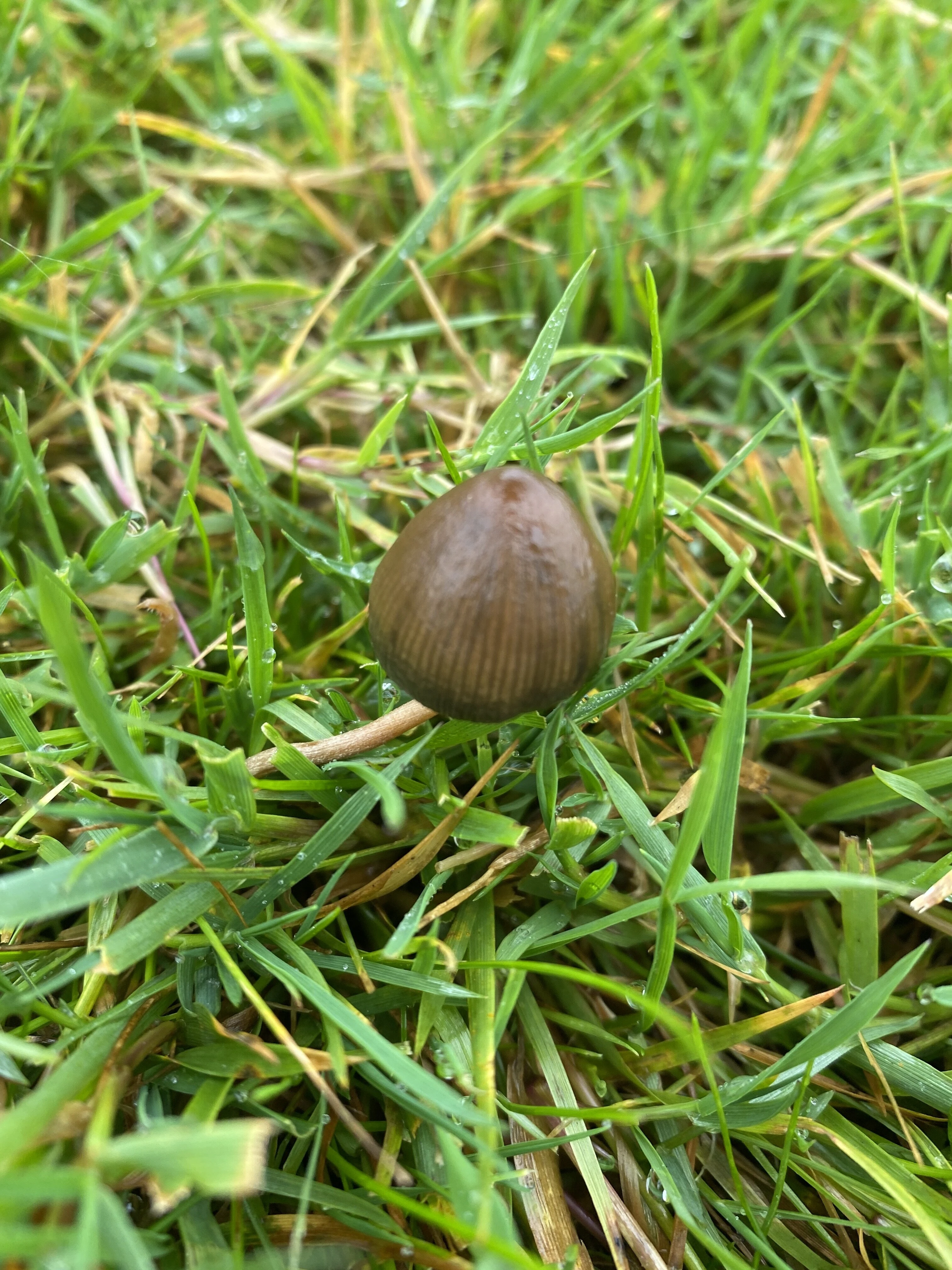
Cap 5 to 25 mm across and 6 to 22 mm tall, sharply conical to bell-shaped, almost always keeping a distinct pointed papillaA small nipple-like point at the top of the cap. at the apex even when mature. The shape barely changes with age. This tall-relative-to-wide pointed profile is the most reliable single field mark.
Hygrophanous cap with a peelable pellicle
Strongly hygrophanousChanges colour as it loses moisture.: ochre to chestnut when moist (sometimes with a greenish-blue tinge) and fading to pale yellow-brown when dry. Moist caps are sticky from a thin gelatinous pellicle which can be bent back and peeled. Translucent radial striations show the gill positions through a wet margin.
Slender, wavy, tough stem
Stem 4.5 to 14 cm long but only 1 to 3.5 mm thick, pale yellowish-brown, tough and flexible rather than brittle, and often distinctly wavy. A young cobweb-like (cortinaA cobwebby partial veil that soon disappears.) partial veil does not last, so mature specimens show no ring, at most a faint fibrillose zone.
Purple-brown gills, bluing bruise, mealy smell
15 to 27 narrowly adnexedNarrowly attached to the stem. to nearly free gills that darken from pale brown to grey then purple-brown as spores mature, with a paler edge. All parts bruise bluish where handled, and the tissue may blue with age. Odour and taste are farinaceous, like freshly ground flour.
Where it comes from
A grassland mushroom, not a dung or wood mushroom
The Liberty Cap is a saprobeA decomposer; feeds on dead organic matter., and the most accuracy-critical fact about it is what it does and does not feed on. It lives in grassland (meadows, pastures, lawns, often grazed) on rich, slightly acidic soil, and it feeds on dead and decaying grass roots, documented hosts including bent (Agrostis), annual meadow-grass (Poa annua) and perennial ryegrass. It is not mycorrhizal, so the grass-root link is nutritional, not a symbiosis. Crucially it is NOT coprophilicDung-loving. and NOT a lignicolousWood-loving. wood-lover: it does not fruit from dung the way a cubensis does, and it is not a woodchip species like P. cyanescens. It is often found in pasture fertilised with sheep or cow dung, but that is because the manure enriches the grass, not because the mushroom grows on the manure. Proximity is not substrate.
It is cool-temperate and, by most accounts, the most widely distributed psilocybin mushroom in the world, with the British Isles a genuine ecological and cultural stronghold. In the UK the classic season runs roughly September into November or early December, fruiting after the first cold, wet spells in grazed pasture. It favours old, structurally complex, nutrient-poor grassland soils that take a long time to develop, which is a large part of why it stays a wild autumn organism rather than something you encounter on a shelf.
The main event
Under the microscope
This is what you actually bought the spores for. Put a print or a drop from a syringe on a slide, and here is what shows up, and how it differs from a cube.
- Smooth ellipsoids with a germ pore. Thick-walled spores, oblong in side view and oval (ellipsoidOval, like a rugby ball.) in face view, about 10.5 to 15 by 6.5 to 8.5 µm (the Guzman reference range), each with a distinct apical germ poreA thin spot at one end of a spore where a new fungus can emerge..
- Deep purple-brown print. The deposit is a deep reddish purple-brown, the typical Psilocybe colour. That alone rules out the white-, cinnamon- and jet-black-spored grassland look-alikes (including the muscarine-containing Inocybe geophylla).
- No pleurocystidia, and that is the point. The gill edge carries flask-shaped (lageniformFlask-shaped, with a narrow neck.) long-necked cheilocystidiaSterile cells along the gill EDGE.; the gill face carries no pleurocystidiaSterile cells on the gill FACE. at all, which is itself diagnostic. Clamp connectionsSmall bridges on the fungal threads, an ID feature. appear throughout the tissue.
- Against a cube. The single cleanest discriminator is the gill face: cubensis has pleurocystidia there, semilanceata does not. Secondary tells are the narrower spores (6.5 to 8.5 µm wide versus 8 to 11.5) and the much more slender outline. The peelable cap skin you feel in the field is, microscopically, a gelatinised ixocutis up to ~90 µm thick.
- The legal bit, and why it's true. A dormant spore carries no psilocybin and no psilocin; that chemistry only appears later in living tissue. That is exactly why a syringe or print is a study specimen and legal to own in the UK.
How it behaves
The mushroom that refuses to be farmed
The Liberty Cap is famous among cultivators for one thing: it refuses to be cultivated. That refusal is not folklore, it follows directly from how the organism makes its living, and understanding why is more interesting than any recipe would be.
The following is documentary ecology, describing how the organism behaves where it is studied legally, not a grow guide. There are no parameters, recipes or quantities here. In the UK psilocybin and psilocin are controlled; spores are listed only as a dormant microscopy and taxonomy reference.
It needs a habitat, not a substrate
A cubensis is a generalist that will run through grain, dung or brown-rice and fruit readily, which is exactly why it dominates kits. The Liberty Cap is a grassland specialist tied to the cool, nutrient-poor, structurally complex root-mat of old pastures and upland meadows. That micro-habitat is slow to form and sensitive to disturbance, and it has no clean indoor equivalent. The reputation that it ranges from extremely difficult to effectively impossible to grow comes largely from vendor and forum sources, but the ecology behind it is solid: there is no documented, reproducible indoor fruiting protocol in the peer-reviewed literature.
What the science actually shows it doing
Keay and Brown (1990, Mycological Research) co-cultured the fungus with grassland plants and watched it invade the moribund cells at the periphery of grass-root cortex, with measurable host preference: it colonised Agrostis and Poa more readily than perennial ryegrass, where a polyphenol-rich layer held it to the outermost cells. That is real, peer-reviewed substrate-type behaviour, and it tells you why a grass-root saprobe is so hard to coax onto a jar of grain. Mycelium can be grown on agar; consistent fruiting is what stays undocumented.
A grassland species, so not the wood-lover risk
It is worth being precise about one ecological contrast. The toxidrome called wood-lover paralysis, formally described by Beck and colleagues (2025, Toxicon), is associated specifically with lignicolous wood-loving Psilocybe such as P. cyanescens, P. azurescens and P. subaeruginosa. Because the Liberty Cap is a grass-root saprobe and not a wood-lover, it is not among the implicated species. This is an ecological distinction, not a safety endorsement of anything; we list spores for microscopy only.
Sources: Fries / Kummer 1871; Keay & Brown 1990 (Mycological Research); Hofmann & Heim 1963; Beck et al. 2025 (Toxicon); and the Wikipedia, First Nature and Index Fungorum records.
Choose your format
Print, syringe, vial or swab?
Same lab-grade genetics in every option. The difference is shelf life versus how soon you are at the scope.
Spore print
Keeps longest
Spores dropped onto sterile foil. Stored cool and dry it outlasts everything else here, so it is the one to reach for if you are building a reference collection to keep for years.
Spore syringe
Ready tonight
Spores suspended in sterile water, ready to go straight onto a slide. The quickest way to be at the microscope this evening. Comes in 3 mL and 12 mL.
Vial & swab
Compact
A sealed glass vial is a tidy middle ground; a sterile swab is the most travel-friendly little format for adding a rare species to your set.
At a glance
The spec sheet
- Species
- Psilocybe semilanceata (Fr.) P. Kumm., 1871
- Basionym
- Agaricus semilanceatus Fr.
- Common names
- Liberty Cap, Witch's Hat
- Family
- Hymenogastraceae (contested; see above)
- Genus status
- Conserved type species of Psilocybe (2010)
- Cap
- 5 to 25 mm, conical to bell-shaped, with a sharp papilla
- Stem
- 4.5 to 14 cm long, 1 to 3.5 mm thick, slender, wavy
- Gills
- 15 to 27, narrowly adnexed to nearly free, purple-brown
- Spore print
- Deep reddish purple-brown
- Spores
- 10.5 to 15 × 6.5 to 8.5 µm, smooth, thick-walled, apical germ pore
- Cystidia
- Cheilocystidia present (lageniform); pleurocystidia absent
- Habitat
- Grassland saprobe on decaying grass roots (not dung, not wood)
- Season
- Autumn into early winter (UK approx. September to December)
- Range
- Cool-temperate worldwide; the most widely distributed potent Psilocybe
- Intended use
- Microscopy, taxonomy & collecting only
Dig deeper
Further reading
Independent, non-commercial sources, no shops, just good information.
- Psilocybe semilanceata on Wikipedia: the most complete free overview: morphology, microscopy (Guzman figures), ecology, distribution, potency assays and the Hofmann 1963 history.
- Index Fungorum (record 232492): the primary nomenclatural register: the (Fr.) P. Kumm. 1871 combination, the basionym, and the current family lineage.
- First Nature, Psilocybe semilanceata: a British-focused field profile with etymology and ID notes (and a useful counterpoint that files the genus in Strophariaceae).
- Liberty cap: how Europe's magic mushroom got its name, The Conversation: Andy Letcher's well-sourced essay on the name's revolutionary-political lineage.
- Keay & Brown 1990, colonization of grassland-flora roots: the peer-reviewed grass-root saprobe study, the hard evidence behind why it is a grassland organism.
Common questions
Frequently asked
No, and this is the single most common mistake about it. It is a grassland saprobe that feeds on decaying grass roots. It often turns up in grazed pasture that has been fertilised with sheep or cow dung, but the manure just enriches the grass; the mushroom does not fruit from the dung itself. That habit separates it cleanly from the genuinely dung-loving Protostropharia semiglobata and from cubensis.
No. It is strictly a grassland organism living on grass roots, not a woodchip or mulch species. The wood-loving Psilocybe (P. cyanescens, P. azurescens and relatives) are a separate ecological group, and the toxidrome called wood-lover paralysis described by Beck and colleagues (2025) is associated with those wood-lovers, not with this grassland species.
Because it is a habitat specialist, not a substrate generalist. It is tied to the cool, nutrient-poor, slow-developing root-mat of old pasture and feeds on grass roots, a setting with no clean indoor equivalent. Keay and Brown's 1990 work showed it invading grass-root cortex with real host preference. Mycelium can be grown on agar, but no reproducible indoor fruiting protocol exists in the literature, which is why it stays a wild autumn organism.
Look at the gill face. Cubensis has pleurocystidia there; semilanceata has none. Semilanceata's spores are also narrower (6.5 to 8.5 micrometres wide versus 8 to 11.5 in cubensis) and its outline is more slender. Both share a dark purple-brown print and an apical germ pore, so the cystidia and spore width do the work.
That is an overclaim. By most accounts it is among the more potent and, more notably, one of the most consistent in reported psilocybin level. Documented figures still swing widely between studies and are said to vary with size, locality, season and drying, and species like P. azurescens reportedly reach higher peaks. We make no potency claims about a product that is a dormant spore.
That is genuinely unsettled. The most-cited modern molecular placement is Hymenogastraceae, but Strophariaceae is still widely used and Index Fungorum currently files the genus under Agrocybaceae. We list Hymenogastraceae as the common modern answer and flag the disagreement rather than pretend it is resolved.
Not in any real sense. Unlike cubensis with its Golden Teacher, B+ and Penis Envy lineages, P. semilanceata is not commercially cultivated and has no recognised cultivars. Any vendor "strain" or "genetics" label is marketing lore. The accurate name is just the species and its authority, Psilocybe semilanceata (Fr.) P. Kumm.
Microscopy, taxonomy and spore-printing. A dormant spore contains no psilocybin or psilocin, which is the basis on which it is offered here. It is a study and reference specimen, useful for examining spore morphology, the germ pore, cheilocystidia and clamp connections, and for comparison against other Psilocybe. Nothing on this page is a cultivation guide.
Ask the community
Questions and answers
No questions yet. Yours could be the first.
For microscopy, taxonomy and collecting only.Sold for legal research. Not for cultivation. Spores contain no controlled substances. We trust you to be responsible.