
Home / Magic Mushroom Spores / Rare & Exotic Species / Psilocybe Subaeruginosa
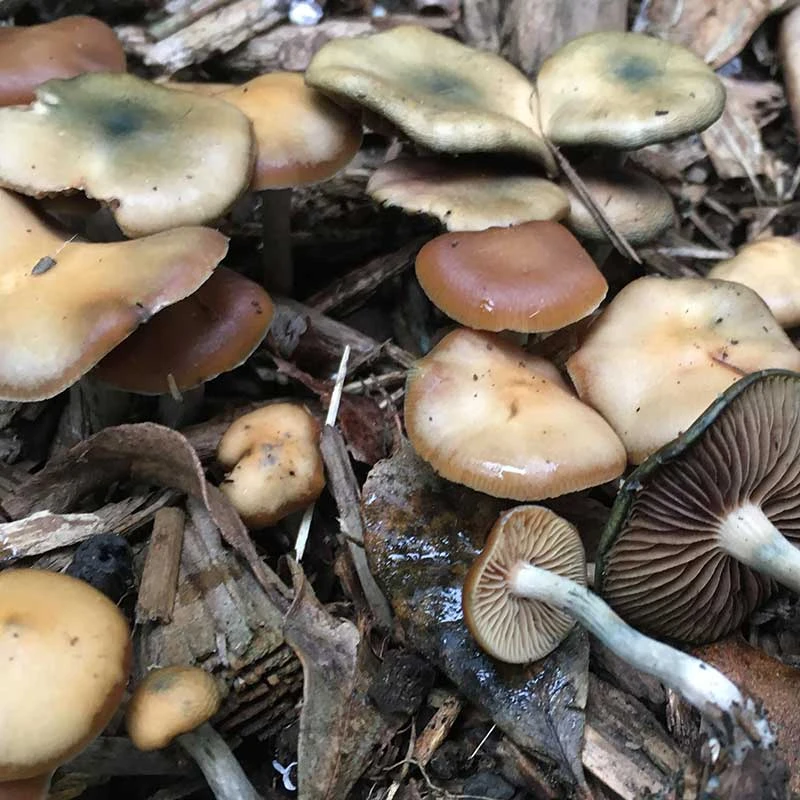
Psilocybe subaeruginosa
Gold Tops
The dominant potent wood-lover of temperate Australia and New Zealand, and the senior name of the famous subs / azzies / wavies complex. Recent genomics even suggests the Northern Hemisphere wavy caps and flying saucers may be the same organism under this older 1927 name. Sold strictly as spores for microscopy, taxonomy and collecting.
Choose your format
Some formats are out of stock
Want to know the moment it returns?
Sold for microscopy, taxonomy and collecting only. Not for cultivation.
filled under laminar flow
plain packaging, tracked
The short version
Psilocybe subaeruginosa is the flagship wood-loving Psilocybe of temperate Australia and New Zealand, fruiting on rotting wood, bark mulch and garden woodchip rather than the dung that cubensis favours. It bruises an intense blue-green, carries a peelable gelatinous skin on the cap, and drops a purple-black spore print. It is the senior member of the closely related "subs, azzies and wavies" complex (cyanescens, azurescens, allenii), so close that recent genomics argues several may be one species under the older 1927 name. Sold here strictly for microscopy, taxonomy and collecting.
Straight talk
Fact vs. legend
There is a lot of folklore around this strain. Here is which bits are real, side by side.
What we actually know
- Described by John Burton Cleland in 1927 from South Australian material; the earliest known collection dates to June 1915 in New South Wales, before it had a name.
- A wood-loving (lignicolous) saprotroph of temperate Australia and New Zealand, fruiting on rotting wood, bark and woodchip mulch, only occasionally on dung. About 95 percent of GBIF records are from those two countries.
- All parts bruise greenish-blue from psilocin oxidation; the epithet subaeruginosa literally means "somewhat verdigris", encoding that reaction.
- Spores are smooth, subellipsoid, thick-walled, around 13 to 14 micrometres long with a broad apical germ pore; the print is purple-black, and pleurocystidia are present on the gill face.
- It is the senior name (1927) of the closely related subs / azzies / wavies complex; recent genomics (McTaggart et al. 2024) reports cyanescens and azurescens as conspecific with it, with Australasia as the centre of origin.
- Wood-lover paralysis, a temporary muscle weakness associated with this group, received its first peer-reviewed description in 2025 (Beck et al., Toxicon), and the cause remains unidentified.
What the community says
- It is often marketed as "the most potent mushroom on earth" or as beating azurescens. This is vendor hyperbole, not an established analytical fact; the peer-reviewed basis only places the wood-lovers among the highest, and the headline ~1.93 percent figure is the top of a very wide, substrate-dependent range from a single older report.
- "Gold tops", "subs" and "wavies" are sometimes sold as if they were distinct strains. They are vernacular field nicknames, not taxonomic ranks or registered cultivars; "gold tops" is also loosely applied to other gold-capped Psilocybe, so the name alone is not a reliable identifier.
- Aeruginascin is widely repeated in forum and vendor lore as the cause of wood-lover paralysis. By most accounts this is an unproven hypothesis; aeruginascin is also present in cubensis, which is not associated with the effect, and the 2025 Toxicon paper leaves the cause unidentified.
- The claim that you can confidently separate subaeruginosa from cyanescens, allenii or azurescens "under the microscope" is an overclaim. Their spores and cystidia overlap so heavily that range and ITS sequencing, not the slide, are the dependable splitters.
- An old myth says these mushrooms contain strychnine that builds up in the spine. No Psilocybe contains strychnine, and the claim is debunked.
- The "chocolate-brown cystidia" Cleland and Guzman used to characterise the species are reportedly absent in later studies (Chang and Mills 1992 found them hyaline), so brown cystidia are a contested historical character rather than a settled diagnostic.
The story
The gold top that may have named the whole family
Australia's east coast met Western psychedelic culture, by most accounts, through surfers in the 1960s. After 1969 newspaper reports of people foraging cubensis, two researchers, Picker and Rickards, turned to the native species instead and in 1970 published the first chemical analysis of Psilocybe subaeruginosa, confirming it carried psilocybin. That is the documented start of its modern reputation as Australia's flagship wild psilocybin mushroom, though the fungus itself had been quietly collected since at least June 1915 and named by the physician-naturalist John Burton Cleland back in 1927.
Cleland gave it a name that does real work. Subaeruginosa means "somewhat verdigris", a nod to the blue-green bruise that floods the flesh wherever it is handled. That bruise is psilocin oxidising after damage, so in a sense the name encodes the chemistry. He never designated a type specimen, though, and the one Guzman and Watling later examined went missing from the Adelaide collections. A lectotype was eventually fixed from Belair National Park, but with no habitat data attached, and that thin paper trail is part of why the species has been argued over ever since.
One species wearing four names
Through the twentieth century, mycologists kept describing what looked like new Australian wood-lovers, then folding them back in. P. australiana and P. eucalypta, both named in 1978, are now treated as the same thing as subaeruginosa. A 1992 study went further and lumped in tasmaniana too; Guzman called that "confused", and tasmaniana was later pulled back out. The real surprise came in 2024.
Recent genomics indicates the iconic Northern Hemisphere "wavy caps" and "flying saucers" may be the very same organism as Australia's humble gold top, and the Australian name, dated 1927, would hold priority.
McTaggart and colleagues reported that P. cyanescens (the wavy caps that fruit on British and European mulch) and P. azurescens (the Pacific Northwest flying saucers) are conspecific with subaeruginosa, with Australasia as the centre of origin and the Northern Hemisphere populations reading as low-diversity offshoots carried abroad on woodchip and mulch. The synonymy is still debated, so it is fairly phrased as "the genomics indicates", not settled law. But the implication is a genuinely good story for a collector: the famous wavies a UK forager finds on a garden bed, and the legendary azzies of the Oregon coast, may simply be the temperate wood-lover that an Australian doctor put a name to nearly a century ago.
There is a darker thread in the lore too. This whole group is associated with "wood-lover paralysis", a temporary loss of muscle strength reported during a psilocybin experience and noted by Paul Stamets as far back as 1996, though the phrase itself crystallised on forums in the 2000s. It finally received its first peer-reviewed description in 2025. We mention it only as the most distinctive piece of community lore attached to the species, and as a reminder of where the edge of the science sits, because the cause is still unknown. None of it changes what we sell, which is dormant spores for the microscope.
The signature
The peelable skin, the blue bruise, and a name that may have eaten its cousins
A cubensis page cannot run any of these. Subaeruginosa is a temperate wood-lover with a few crisp tells a dung-loving cube does not share, plus a genuinely surprising taxonomic story that makes it the senior name of one of the most famous mushroom groups in the world.
A separable gelatinous pellicle
The cap is sheathed in a thin, rubbery, peelable skin. Bend a piece of a wet cap and the gelatinous film lifts away, a hallmark of the temperate wood-lover group (shared with cyanescens and the Liberty Cap) and absent on the dry, non-peeling cap of cubensis. Combined with a purple-black print (cubensis prints purple-brown) it is one of the cleanest visual separators in the genus.
A violent blue-green bruise
All parts stain greenish-blue where handled or aged, gills fastest. The epithet itself encodes this: sub- ("somewhat") plus aeruginosa ("verdigris, copper-rust"), literally "somewhat blue-green". The bluing is psilocin oxidising after tissue damage, the same reaction the names azurescens and cyanescens point at.
The senior name of subs, azzies and wavies
Recent peer-reviewed genomics (McTaggart et al. 2024) reports that the Northern Hemisphere P. cyanescens ("wavy caps") and P. azurescens ("flying saucers") are conspecific with subaeruginosa, with Australasia as the centre of origin and the Northern Hemisphere populations reading as introduced offshoots. Because Cleland's 1927 name predates them, the Australian name would hold priority. This is still debated, so we phrase it as "recent genomics indicates", not settled fact, but it is a true and lesser-known story.
The species
Meet Psilocybe subaeruginosa
It belongs to the bluing, psilocybin-bearing core of Psilocybe (Greek psilos, "bare", plus kybē, "head"). The genus was conserved on a blue-bruising type (the Liberty Cap, P. semilanceata), proposed by Redhead and colleagues and ratified at the 2011 Melbourne Botanical Congress, which is why the active, blue-bruising species kept the name Psilocybe while the non-bluers moved to Deconica, and why older texts citing Strophariaceae are pre-revision rather than simply wrong. Current databases place it in Hymenogastraceae; some references still retain Strophariaceae, a and active disagreement.
It is the senior member of its own complex. P. cyanescens (wavy caps, smaller, undulating margin, smaller spores, on European and North American woodchip) and P. azurescens (flying saucers, strongly umbonate, Pacific Northwest) sit alongside it, with P. allenii near-identical to cyanescens but non-wavy. They are so close that range and ITS sequence, not field marks, are the reliable separators. P. australiana and P. eucalypta (both 1978) are now treated as synonyms of subaeruginosa.
- Family
- Hymenogastraceae (some references retain Strophariaceae)
- Genus
- Psilocybe (Fr.) P. Kumm., 1871
- Species
- Psilocybe subaeruginosa Cleland, 1927
- Synonyms
- P. australiana and P. eucalypta (both Guzman & Watling, 1978)
- Etymology
- sub- ("somewhat") + aeruginosa ("verdigris"), for the blue-green bruise
- Type
- Lectotype from Belair National Park, South Australia (no habitat data)
How you'd know it
Field marks
A caramel, blue-bruising wood mushroom of the temperate south. These describe the mature wild organism for reference and identification.
Cap: caramel, hygrophanous, peelable
Roughly 10 to 60 mm, conical to conic-convex, often with a small umboA raised bump in the centre of the cap., honey to caramel-tan, slightly viscid. Strongly hygrophanousChanges colour as it loses moisture., shifting from dark caramel when wet to a pallid biscuit-gold on drying, which is why it earns the name "gold top". A thin gelatinous pellicleA thin skin over the cap that can be peeled. peels from the wet cap.
Gills and print
Gills adnateBroadly attached to the stem. to adnexed, moderately close, pale cream to smoky brown when young, darkening to violet-brown as the spores mature, with a paler edge. Spore print purple-black (sometimes plainer brown, and rarely brown via a pigment-inhibiting mutation). Odour and taste farinaceous (mealy or floury).
Stem and veil
Stem roughly 25 to 70 mm long and 2 to 8 mm thick, whitish and often streaked greyish-brown, finely fibrillose, mealy at the apex. A white cobwebby (cortinateA cobwebby partial veil, like a spider web.) partial veil shows in youth but soon vanishes, leaving only a faint fibrillose zone rather than a persistent ring.
Bruise and rhizomorphs
All parts stain greenish-blue to blue where handled, damaged or aged, gills fastest. The base is typically anchored by conspicuous thick white rhizomorphicThick cords of fungal threads, like fungal roots. mycelium that "runs" through the substrate, a tell of its weedy wood-loving habit. The blue bruise plus the peelable skin plus the dark print is the classic field signature.
Where it comes from
A temperate wood-lover, not a dung mushroom
It is a wood-loving (lignicolousWood-loving: grows on wood, woodchips or buried timber.) saprotrophFeeds on dead matter rather than a living host., not a dung or pasture species. Its primary substrate is woody debris: fallen wood, bark and rotting wood in native eucalypt forest and introduced pine plantations, and very commonly woodchip and bark mulch in gardens, parks, botanic gardens, trail edges and roadsides. It is often an "edge" species of sclerophyll forest, and it readily colonises urban woodchip piles, spreading via thick white rhizomorphic mycelium. Peer-reviewed work records fruitings from grass, leaf litter, moss and wood, so it fruits from material lying over buried wood too, and only occasionally from dung. It grows solitary to gregarious to clustered.
It is native and widespread across temperate Australia (Queensland south through New South Wales, Victoria, South Australia and Tasmania, plus a southwest pocket near Balingup) and New Zealand, with about 95 percent of GBIF records from those two countries. It is an autumn-into-winter fruiter in the Southern Hemisphere, typically April through July or August, triggered by a drop in temperature, rising moisture and shortening days. For a UK reader the key point is range: subaeruginosa does not occur wild as a native British species. The wood-lover a UK collector actually meets is P. cyanescens (wavy caps), and recent DNA work suggests some of that Northern Hemisphere material may trace back to Australasian stock carried on woodchip.
The main event
Under the microscope
This is what you actually bought the spores for. Put a print or a drop from a syringe on a slide, and here is what shows up, and how it differs from a cube.
- Large, smooth, subellipsoid. Thick-walled subellipsoidRoughly oval, slightly inequal-sided. spores around 13 to 14 µm long (broad range ~10 to 15.8), each with a clear broad apical germ poreA thin spot at one end of a spore where a new fungus can emerge., yellowish-brown in KOH. An old figure of 7 to 9 µm still circulates in copied descriptions and is outdated; the large-spore value is the modern consensus.
- Purple-black in the mass. The print is purple-black (sometimes plainer purple-brown). Dark print is shared genus-wide, so it is not a species diagnostic on its own.
- The cystidia. Mostly four-spored basidiaThe club-shaped cells on the gills that grow and release the spores.; abundant fusoid-ventricose cheilocystidiaSterile cells along the gill EDGE. on the edge and pleurocystidiaSterile cells on the gill FACE. present on the face. (The old "chocolate-brown cystidia" of Cleland and Guzman are reported hyaline by later workers, so colour is a contested historical character, not a diagnostic.)
- Against a cube, and the complex. Cubensis spores are clearly larger and broader (~11.5 to 17.3 by 8 to 11.5 µm); subaeruginosa spores are narrower (width ~6.6 to 7.7 µm). Both genera carry pleurocystidia, so the firm separator is spore size and the purple-black versus purple-brown print, not cystidia presence. Against cyanescens, azurescens and allenii the spores overlap so heavily that range and ITS sequence, not the slide, are the dependable splitters.
- The legal bit, and why it's true. A dormant spore carries no psilocybin and no psilocin; that chemistry only appears later in living tissue. That is exactly why a syringe or print is a study specimen and legal to own in the UK.
How it behaves
A weedy wood and mulch organism
Subaeruginosa is a lignicolous saprotroph, so its ecology is the temperate woodchip story, not the tropical dung story of a cube. The interesting part for a collector is how aggressively and weedily it colonises lignin, and how variable that makes the organism. We keep this to substrate TYPES and behaviour, with no numbers, recipes or steps.
What follows documents how the organism behaves where it is studied and grown legally, the way a mycologist writes methods down. Psilocybin and psilocin are controlled in Australia, New Zealand and the UK; we sell these spores in the UK strictly for microscopy, taxonomy and collecting, never for cultivation or consumption.
A wood and mulch organism
In the wild it works fallen wood, bark and decomposed woody debris in eucalypt forest and pine plantation, and it readily takes to woodchip and bark mulch in gardens and parks. It is described as "weedy", myceliating woodchip piles and spreading via thick white rhizomorphic cords that run through the substrate over distance. This is the opposite of a coprophilic (dung-loving) cube, and it is why the species shows up so often on human-made mulch beds.
Potency varies with substrate, lineage and age
Reported psilocybin by dry weight spans a wide range across analyses (roughly 0.06 percent up to about 1.93 percent in older reports, psilocin generally lower), and sources stress this variability is driven by substrate, habitat and growth conditions, with woodchip-bed specimens reported stronger than native-forest ones. Treat any single headline percentage as the top of a range, not a typical value, and as documented variation rather than a product claim.
A richer tryptamine profile
Besides psilocybin and psilocin, analyses report norpsilocin, baeocystin, norbaeocystin and aeruginascin, plus beta-carbolines, produced through the psilocybin gene cluster. This is documentary chemistry of the wild organism and part of what makes it interesting under study; it is not a claim about effects.
Why it is a study specimen, not a food
This wood-lover group carries a real, cautiously documented safety note: "wood-lover paralysis", a temporary muscle weakness reported during a psilocybin experience and notably not reported for cubensis. It got its first peer-reviewed description in 2025 (Beck and colleagues, Toxicon); the cause is unknown and the popular aeruginascin theory is unproven. It is one more reason these are sold as microscopy specimens, never as food.
Sources: Cleland 1927; McTaggart et al. 2024 (Fungal Systematics & Evolution); Beck et al. 2025 (Toxicon); Borovicka et al. 2012; and the Wikipedia and GBIF species records.
Choose your format
Print, syringe, vial or swab?
Same lab-grade genetics in every option. The difference is shelf life versus how soon you are at the scope.
Spore print
Keeps longest
Spores dropped onto sterile foil. Stored cool and dry it outlasts everything else here, so it is the one to reach for if you are building a reference collection to keep for years.
Spore syringe
Ready tonight
Spores suspended in sterile water, ready to go straight onto a slide. The quickest way to be at the microscope this evening. Comes in 3 mL and 12 mL.
Vial & swab
Compact
A sealed glass vial is a tidy middle ground; a sterile swab is the most travel-friendly little format for adding a rare species to your set.
At a glance
The spec sheet
- Species
- Psilocybe subaeruginosa Cleland, 1927
- Common names
- Gold tops, goldies, subs, wavies
- Family
- Hymenogastraceae (some references retain Strophariaceae)
- Complex
- subs / azzies / wavies (with cyanescens, azurescens, allenii)
- Spore print
- Purple-black (rarely brown)
- Spore size
- ~13 to 14 µm long (range ~10 to 15.8), narrow (~6.6 to 7.7 wide)
- Spore shape
- Smooth, subellipsoid, thick-walled, broad apical germ pore
- Cystidia
- Cheilocystidia 17 to 29 µm; pleurocystidia present 22 to 47 µm; fusoid-ventricose
- Bruising
- Strong greenish-blue (psilocin oxidation)
- Substrate
- Wood, bark and woodchip mulch (lignicolous); rarely dung
- Range
- Temperate Australia and New Zealand (~95 percent of records)
- Season
- Autumn into winter (Southern Hemisphere, ~April to August)
- Intended use
- Microscopy, taxonomy & collecting only
More from the cabinet
Other rare & exotic species
Dig deeper
Further reading
Independent, non-commercial sources, no shops, just good information.
- Psilocybe subaeruginosa on Wikipedia: the most complete single overview: protologue, synonymy history, microscopy figures, range and the lectotype tangle.
- GBIF species profile and occurrence data: accepted-name record plus the ~4,700 occurrence points that anchor the temperate Australia and New Zealand range.
- McTaggart et al. 2024, Fungal Systematics & Evolution 14:209-217: the peer-reviewed genomics arguing Australasia is the centre of origin and that cyanescens and azurescens are conspecific with subaeruginosa.
- Beck, Barlow, Engel & Barratt 2025, Toxicon 264:108450: the first peer-reviewed description of wood-lover paralysis; survey-based, cause still unidentified.
- Borovicka, Rockefeller & Werner 2012, "Psilocybe allenii", Czech Mycology 64(2): the reference work on how near-identical this complex is on a slide, and the standard KOH microscopy approach.
Common questions
Frequently asked
Yes, for microscopy and research. A dormant spore contains no psilocybin or psilocin, so the spores themselves are not a controlled substance in the UK. We sell them strictly for microscopy, taxonomy and collecting, never for cultivation.
Lean on spore size and print colour. Cubensis spores are bigger and broader, roughly 11.5 to 17.3 by 8 to 11.5 micrometres, with a purple-brown print; subaeruginosa spores are narrower (width around 6.6 to 7.7 micrometres), about 13 to 14 micrometres long, with a purple-black print. Both genera carry gill-face pleurocystidia, so cystidia presence is not the separator here; spore dimensions and print colour are.
Not reliably. Published work finds their spores and cystidia overlap so heavily that dimensions alone cannot tell them apart. The dependable separators are geographic range (subaeruginosa is native to temperate Australia and New Zealand) and ITS rDNA sequence, not the slide.
That is vendor hyperbole, not an established fact. Reported psilocybin spans a very wide, substrate-dependent range, and the peer literature only places the wood-lovers among the highest, often citing azurescens for the top figures. We do not sell on potency claims, and these are spores for microscopy in any case.
No. They are vernacular field nicknames, not taxonomic ranks or registered cultivars. "Gold tops" is even applied loosely to other gold-capped Australian Psilocybe, so the name alone is not a reliable identifier. For a wild wood-lover there are no legitimate strain names; any vendor "strain" branding is provenance, like a collection locality, not a registered cultivar.
It is a reported temporary muscle weakness associated with this wood-lover group after a psilocybin experience, first peer-reviewed in 2025 (Beck et al., Toxicon). The cause is unknown, and the popular aeruginascin theory is unproven. It is lore and safety context attached to the living, ingested mushroom only. It has no bearing on dormant spores used for microscopy.
No. Subaeruginosa is native to temperate Australia and New Zealand. The wood-lover a UK collector actually meets is P. cyanescens (wavy caps), well established on British woodchip and garden beds. Recent DNA work suggests some Northern Hemisphere material may trace back to Australasian stock carried on mulch, which is part of why the taxonomy is so tangled.
Both are real disagreements. The family shifted to Hymenogastraceae after the genus was conserved on a blue-bruising type in 2011, but some current references still list Strophariaceae, so older texts are pre-revision rather than wrong. For spores, an old small figure (7 to 9 micrometres) still circulates in copied descriptions and conflicts with the modern large-spore consensus around 13 to 14 micrometres; the larger value is the one to trust.
Ask the community
Questions and answers
No questions yet. Yours could be the first.
For microscopy, taxonomy and collecting only.Sold for legal research. Not for cultivation. Spores contain no controlled substances. We trust you to be responsible.