
Home / Magic Mushroom Spores / Rare & Exotic Species / Psilocybe Tampanensis
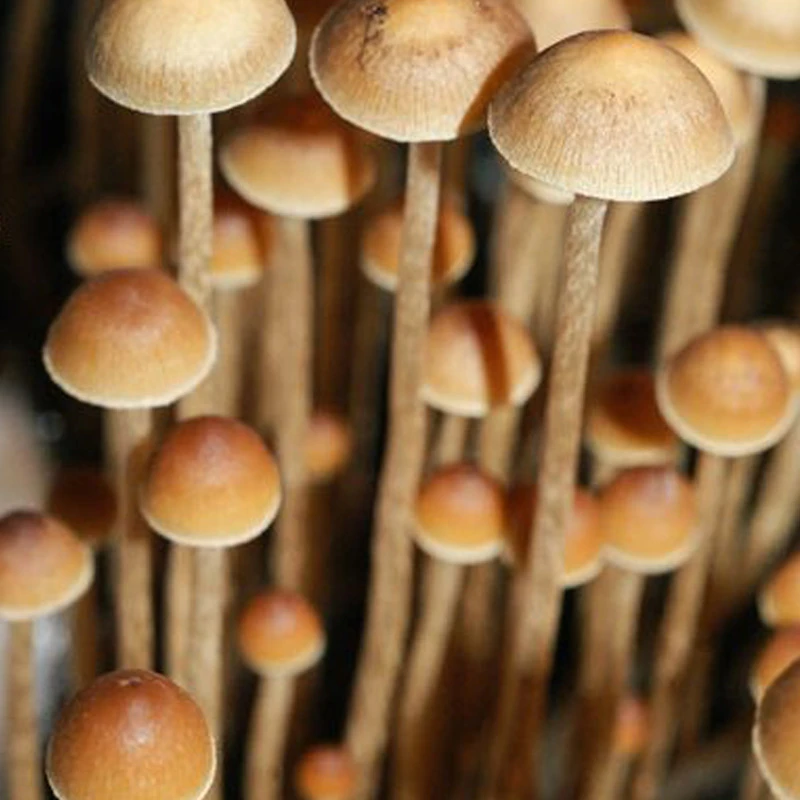
Psilocybe Tampanensis
The Philosopher's Stone
The sclerotia-forming Psilocybe behind the "Philosopher's Stone": a sandy-meadow rarity from Florida, known to science from almost a single 1977 find, with small angular spores and a purple-brown print all its own.
Choose your format
Some formats are out of stock
Want to know the moment it returns?
Sold for microscopy, taxonomy and collecting only. Not for cultivation.
filled under laminar flow
plain packaging, tracked
The short version
Psilocybe tampanensis is the famous sclerotia-forming species, the original "Philosopher's Stone." Described in 1978 from a single Tampa, Florida collection, it is genuinely rare in the wild and unlike the dung-loving cubensis: a sandy-soil grassland saprobe with small, somewhat rhombic spores and a purple-brown print. Sold here strictly for microscopy and collecting.
Straight talk
Fact vs. legend
There is a lot of folklore around this strain. Here is which bits are real, side by side.
What we actually know
- Described in 1978 by Gaston Guzman and Steven H. Pollock in the journal Mycotaxon, from a collection made the year before near Tampa, Florida.
- It is a sclerotium-forming species: alongside small ochre fruitbodies it produces hardened underground masses of mycelium, which is what made it taxonomically notable.
- By most accounts the wild organism is genuinely rare; it went essentially unrecorded for almost two decades until Guzman reported it from Pearl River County, Mississippi, in 1996.
- Unlike Psilocybe cubensis it is not dung-loving (coprophilic). It is a saprobe of sandy meadows and sandy soil in deciduous forest.
- Spores are small and somewhat rhombic, roughly 8.8 to 9.9 micrometres long, markedly smaller than a cubensis spore, with a distinct apical germ pore.
- Steven Pollock, credited with the "Philosopher's Stone" nickname, was shot dead in 1981 in a case that was never prosecuted.
What the community says
- By most accounts a single wild fruitbody was found, and essentially all cultivated lineages are said to descend from that one cloned collection. Treat the literal "only one mushroom ever" version as community shorthand.
- Paul Stamets relates that Pollock skipped a "boring" conference near Tampa to go hunting and found the lone specimen. Gary Lincoff was reportedly foraging with him, so the "found completely alone" version is an oversimplification.
- The "Philosopher's Stone" name reportedly came from Pollock himself, a nod to the alchemical stone said to transmute metal and confer enlightenment.
- It is sometimes called "the strongest" sclerotia species. There is no good evidence for that, and the community often calls it comparatively mild.
- Lurid post-murder details circulate widely but are rumour-grade and should not be treated as settled fact.
The story
A new species from a single afternoon
Almost everything romantic about Psilocybe tampanensis traces back to one man, one collection, and one striking trait. By most accounts a single, unremarkable little fruitbody was collected near Tampa, Florida in 1977 by the American physician and mycologist Steven H. Pollock, found in a sandy meadow around the time of the Second International Mycological Congress (held in Tampa from 27 August to 3 September 1977). Paul Stamets tells it as Pollock slipping away from a dull conference to go hunting; the fellow mycologist Gary Lincoff was reportedly out foraging with him, so the often-repeated "found completely alone" line flattens the story a little.
Pollock cloned the find into pure culture, and he and the Mexican Psilocybe authority Gaston Guzman formally described it in 1978 in the journal Mycotaxon, under the title "A new bluing species of Psilocybe from Florida, U.S.A." What made it notable was not the small ochre mushroom but the hardened underground bodies it readily forms: the sclerotia Pollock is said to have nicknamed the "Philosopher's Stone."
By most accounts essentially all material in circulation traces back to that one cloned collection, which is a remarkable thing to be able to say about any organism.
Rare in the wild, then a long silence
The species then went quiet. It was not reliably recorded again for almost two decades, until Guzman reportedly collected it once more in Pearl River County, Mississippi, in 1996, in a sandy-soil meadow within deciduous forest, much like the Florida type site. Pollock himself did not see any of this: he was shot dead in San Antonio in 1981, in a case that was never prosecuted and remains officially unsolved. We mention it plainly because it is part of the species' history, and we leave the louder true-crime threads where they belong, in the realm of rumour.
The signature trait
The Philosopher's Stone
This is the section a cubensis page does not need. Psilocybe tampanensis is one of a small handful of Psilocybe species that readily form sclerotiaHardened, dormant lumps of fungal tissue, a survival store the fungus can revive from later., the truffle-like bodies popularly (if inaccurately) sold as "magic truffles" and known since Pollock as the Philosopher's Stone.
What a sclerotium actually is
A sclerotium (plural sclerotia) is a hardened, compact mass of myceliumThe thread-like body of a fungus, the network a mushroom grows from.: tightly interwoven hyphaeThe microscopic threads that make up a fungus. knitted into a dense body, usually with a dark, melanin-pigmented outer rind over a paler core. It is rich in stored food reserves and very low in water, which lets it sit dormant for long stretches. It is a vegetative resting and storage organ, not a fruiting body.
Why this species makes them
The standard reading is plain survival. Sandy, fire-prone, seasonally dry grassland is an unstable place to live, and above-ground fruiting is sporadic. A buried, hardened, nutrient-loaded mass lets the fungus ride out drought, wildfire and nutrient scarcity, then resume mycelial growth when conditions improve. Many unrelated fungi solve the same problem the same way, from ergot to chaga.
Not a truffle, and not a spore
True truffles are the spore-bearing fruiting bodies of Tuber, an unrelated ascomycete genus, so "magic truffle" is a folk name rather than accurate mycology. A sclerotium produces no spores at all: under magnification you would see interwoven hyphae and pigmented rind, nothing to print. The spore is the reproductive, microscopy-worthy unit; the sclerotium is dormant storage tissue.
The famous nickname
Pollock is said to have called these hardened bodies the "Philosopher's Stone", after the alchemical stone of legend. The name stuck, and it is still how the sclerotia of this species are known in collector circles today.
When the Netherlands restricted psilocybin mushrooms in December 2008, the list covered the above-ground fruiting bodies but not the underground sclerotia. The "stone" stayed legal as a "truffle" while the mushroom did not, an accident of wording that turned a niche connoisseur item into the basis of the Dutch smart-shop truffle trade and, later, a small legal retreat industry.
The species
Meet Psilocybe tampanensis
Its closest well-known relative is Psilocybe mexicana, the other famous sclerotia-former in section Mexicanae. Tampanensis is described as intermediate in form between P. mexicana and P. caerulescens, differing from mexicana in shorter basidia and a different range, and from caerulescens in its larger spores. The old "Atlantis" / ATL line is generally treated today as tampanensis material.
- Family
- Hymenogastraceae (older books say Strophariaceae)
- Genus
- Psilocybe (Fr.) P. Kumm., 1871
- Species
- Psilocybe tampanensis Guzman & S.H. Pollock, 1978
- Section
- Mexicanae (Guzman), spores over ~8 µm
- Etymology
- tampanensis, "of Tampa", after the Florida type locality
- Type locality
- Near Tampa, Florida, USA (collected 1977)
How you'd know it
Field marks
The wild mushroom is genuinely scarce, so these notes rest on a thin set of records. They describe the mature organism for reference and identification.
Small ochre cap
Just 1 to 2.4 cm across, convex to slightly conic with a faint umboA small raised bump in the centre of the cap. when young, flattening with age. Ochraceous to straw-brown, fading as it dries (hygrophanousChanges colour as it loses moisture, a common identification clue.), smooth and a touch sticky when moist.
Slender stem, cobwebby veil
A thin stem, 2 to 6 cm long and only 1 to 2 mm thick, similar in colour to the cap. The partial veil is cortinateA cobwebby veil, like a spider web, rather than a solid ring. (cobwebby, like a Cortinarius), ephemeral, and leaves no real ring.
Adnate, darkening gills
Gills broadly attached (adnateJoined to the stem along their full width.), brown to dark purple-brown as the spores ripen, with paler edges. The colour is the maturing spore mass showing through.
Blue bruising, mealy smell
The thin whitish flesh bruises blue to bluish-green where injured, the standard Psilocybe oxidation reaction, and carries a faintly farinaceous (fresh-flour) odour.
Where it comes from
A sandy-soil rarity, not a dung-lover
Psilocybe tampanensis is a saprobeFeeds on dead organic matter rather than a living host. of sandy soil, documented from sandy meadows and sandy soil in deciduous forest. This is one of the most useful things to know about it: unlike the dung-loving (coprophilicDung-loving: grows on the droppings of grazing animals.) Psilocybe cubensis, and unlike the wood-rotting (lignicolousWood-loving: grows on wood, woodchips or buried timber.) species, this one is a quiet grassland soil dweller. It bruises blue where handled, the classic Psilocybe oxidation reaction.
It is also genuinely rare in the wild. With so few confirmed sightings (the story above has the dates), its true habitat preferences are not firmly established. On the evidence we have, its natural range is a narrow slice of the southeastern United States.
How it survives
Saved by cultivation, not the wild
One of mycology's strangest survival stories: a species recorded in the wild only about twice, yet found in collections worldwide because it persists almost entirely as cloned cultivated stock rather than through any wild population. It survives ex-situ, descended from a single Florida fruitbody kept alive in culture for decades.
What follows documents how Psilocybe tampanensis is actually grown and kept, as mycology and history. The species is legally cultivated in a number of places, the Netherlands (where its sclerotia are sold openly) and Jamaica among them; here in the UK we sell these spores strictly for microscopy and study. We include the real detail because it is genuinely fascinating and, like any careful record, worth preserving rather than quietly losing.
Survival by cloning: an ex-situ lineage
This is the heart of the story. From that lone 1977 fruitbody Pollock raised a pure culture on agar, and that culture, not any wild population, is the ancestor of essentially all Psilocybe tampanensis in existence today. The species effectively survives as a maintained genetic line, a textbook case of ex-situKept alive away from the wild, in cultures and collections rather than its natural habitat. persistence arising from research and enthusiast culture-keeping rather than any formal conservation programme. After Pollock's death in 1981 the lineage was reportedly perilously narrow, held by only a handful of people; by most accounts Stephen Peele then deposited a live culture in a European fungus library, the CBS Culture Collection in the Netherlands, expressly so the strain would not die out. Paul Stamets is widely credited with helping disseminate it through the 1980s, though accounts differ in detail.
Spore prints: the other way it persists
Living culture is not the only lifeline. The species is also kept the oldest way in mycology: as spore prints. A mature tampanensis cap drops its purple-brown spores onto foil or card, and that print is a dormant, easily-stored archive of the lineage. Kept cool, dark and dry it stays viable for study for years, and because prints are light and postable they are how the strain was passed hand to hand through the early collecting scene. Since the wild so rarely offers it up, the prints in circulation are taken from the cultivated lineage, and a well-kept print is the format most likely to outlast its owner. It is also exactly what we offer for the microscope: the same preservation method a collector reaches for to study the species.
Why sclerotia make the clone so durable
The Philosopher's Stone section above covers what sclerotia are; what matters here is what they do for survival. Because a sclerotium is a low-water, nutrient-loaded body built to lie dormant for years and revive later, a strain that readily forms them is unusually forgiving to store and bring back. That built-in dormancy is a large part of why a single 1977 clone could outlast its discoverer and still be circulating decades on.
What the growers actually worked out
Almost everything practical we know about tampanensis in cultivation comes from hobbyists rather than laboratories, and the most thorough record was kept by the Shroomery cultivator stonesun, whose comprehensive sclerotia thread is still a reference point. By his account it is a sclerotia specialist's project rather than a beginner's: he placed tampanensis as a third-tier sclerotia producer, behind Psilocybe mexicana and the galindoi / ATL#7 line. He reported that the sclerotia form early on a brown-rice-flour cake and bulk up over a span of months while the substrate is held, and he ranked the grain substrates by how freely they threw sclerotia: rye berries at the top, then rye grass seed, then wild bird seed, with brown rice flour the least productive of the set. Coaxing the rarely-seen mushroom itself to fruit was the harder trick; he found that letting the substrate dry out for a spell seemed to help, while being candid that he kept no fixed procedure and was still experimenting.
Why the record matters
Running through stonesun's work is a preservationist streak: he banked the genetics by taking spore prints rather than risk losing a strain, the same instinct that once put a culture in a fungus library. That matters, because this kind of knowledge lives almost entirely on forums like Shroomery, written by people doing the work and photographing the results. It is not in the textbooks, and if those forums ever went dark the practical record of how a species like this is grown and kept would largely vanish with them. Setting it down plainly and accurately is itself a kind of preservation, and the same reason Paul Stamets wrote his methods down rather than letting them stay folklore.
Sources: Guzmán & Pollock 1978 (Mycotaxon); Wikipedia; GBIF; the CBS/Westerdijk culture collection; and Shroomery threads by stonesun.
The main event
Under the microscope
This is what you actually bought the spores for. Put a print or a drop from a syringe on a slide, and here is what shows up, and how it differs from a cube.
- Small and a little angular. Thick-walled, smooth spores, roughly 8.8 to 9.9 µm long (about 7 to 8.8 wide), distinctly smaller than a cubensis spore. SubrhomboidRoughly diamond-shaped in outline. in face view, subellipsoidRoughly oval, like a slightly squashed egg. in side view, with a clean apical germ poreA thin spot at one end of a spore where a new fungus can emerge. and a short basal appendage.
- Pale alone, purple-brown in mass. Single spores read golden-brown (brownish-yellow in KOHPotassium hydroxide, a drop of which is used to clear and stain a sample under the microscope.); only a dense mass prints purple-brown. So a dark print but pale spores on the slide is normal optics.
- The cystidia tell. Four-spored hyaline basidiaThe tiny club-shaped cells on the gills that grow and release the spores. (~14 to 22 × 8 to 10 µm), lageniform (flask-shaped) cheilocystidiaSterile cells along the gill EDGE, often used to tell species apart. on the gill edge with thin flexuous necks, and crucially no pleurocystidiaSterile cells on the gill FACE; their absence here is itself an ID clue. and clamp connections present. Against P. cubensis, the tell is the smaller, more angular spore and the absent pleurocystidia.
- The legal bit, and why it's true. A dormant spore carries no psilocybin or psilocin at all; that chemistry only appears later in living tissue. That is exactly why the spores are legal to own and study in the UK.
Choose your format
Print, syringe, vial or swab?
Same lab-grade genetics in every option. The difference is shelf life versus how soon you are at the scope.
Spore print
Keeps longest
Spores dropped onto sterile foil. Stored cool and dry it outlasts everything else here, so it is the one to reach for if you are building a reference collection to keep for years.
Spore syringe
Ready tonight
Spores suspended in sterile water, ready to go straight onto a slide. The quickest way to be at the microscope this evening. Comes in 3 mL and 12 mL.
Vial & swab
Compact
A sealed glass vial is a tidy middle ground; a sterile swab is the most travel-friendly little format for adding a rare species to your set.
At a glance
The spec sheet
- Species
- Psilocybe tampanensis Guzman & S.H. Pollock, 1978
- Common names
- Philosopher's Stone, magic truffle (folk name for the sclerotia), Pollock, ATL7 / Atlantis
- Family
- Hymenogastraceae (older books say Strophariaceae)
- Section
- Mexicanae (Guzman)
- Spore print
- Purple-brown
- Spore size
- ~8.8 to 9.9 × 7 to 8.8 µm (smaller than cubensis)
- Spore shape
- Subrhomboid in face view, subellipsoid in side view, thick-walled, smooth, with a germ pore
- Basidia
- 4-spored, hyaline; pleurocystidia absent, clamps present
- Sclerotia
- Yes, readily forms them (the "Philosopher's Stone")
- Habitat
- Saprobic on sandy soil; not coprophilic, not lignicolous
- Range
- Southeastern USA (Florida type; 1996 Mississippi record). Rare in the wild
- Intended use
- Microscopy, taxonomy & collecting only
More from the cabinet
Other rare & exotic species
Dig deeper
Further reading
Independent, non-commercial sources, no shops, just good information.
- Psilocybe tampanensis on Wikipedia: the species overview.
- Index Fungorum (record 321959): the formal nomenclature record.
- Steven Hayden Pollock: the mycologist behind the find.
- Sclerotium: the biology of the resting body.
Common questions
Frequently asked
Largely, yes. The truffle-trade names "Atlantis" and "ATL" key, by DNA, back to Psilocybe tampanensis, so they are best read as trade labels for the same species rather than separate ones. The name "galindoi" is messier: the valid taxon P. galindoi is now folded into P. mexicana, yet much of the material actually sold as galindoi is reportedly tampanensis. When in doubt, the microscopy is the arbiter, not the label on the tub.
Yes, for microscopy and research. A dormant spore contains no psilocybin or psilocin, so the spores themselves are not a controlled substance in the UK. We sell them strictly for microscopy, taxonomy and collecting, never for cultivation.
A sclerotium is a hardened, compact mass of mycelium with a melanised outer rind and stored food reserves, a dormant survival body that lets the fungus ride out drought and fire. It is not a fruiting body and not a true truffle (true truffles are Tuber, an unrelated genus, and they make spores). "Magic truffle" is a folk name, not accurate mycology.
Mostly size and shape. A tampanensis spore is smaller (around 8.8 to 9.9 micrometres long versus roughly 11.5 to 17 for cubensis) and a little more rhombic in face view, rather than the plainer egg shape of cubensis. Both share a purple-brown print and an apical germ pore, but tampanensis lacks the pleurocystidia that cubensis has on the gill face.
By most accounts, more or less. The original description rested on essentially one Tampa collection, which Pollock cloned, and cultivated material is said to trace to that founding lineage. Treat the literal "only one mushroom ever found" as community shorthand: it was recorded again in the wild in Mississippi in 1996, so it was not lost entirely.
Cool, dark and dry. A fridge (not freezer) suits syringes and vials; a print keeps happily in a sealed bag somewhere cool. Stored well, a print stays viable for study for years.
Ask the community
Questions and answers
No questions yet. Yours could be the first.
For microscopy, taxonomy and collecting only.Sold for legal research. Not for cultivation. Spores contain no controlled substances. We trust you to be responsible.