
Home / Magic Mushroom Spores / Rare & Exotic Species / Gymnopilus Luteofolius
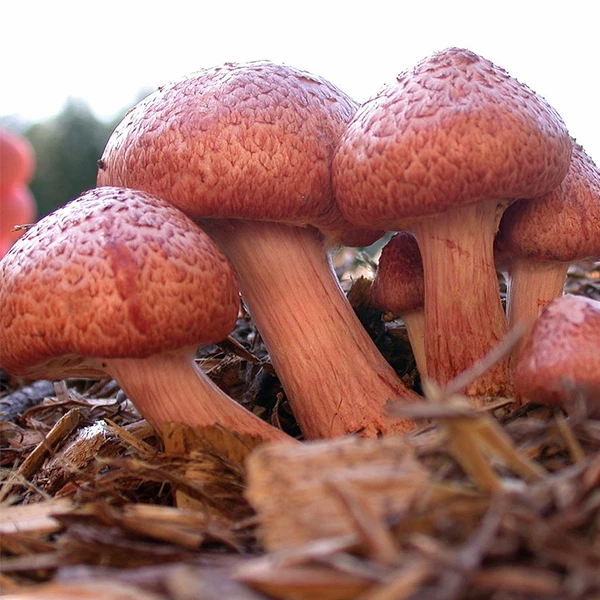
Gymnopilus luteofolius
The Rusty One
A wood-rotting rustgill that drops a bright orange-brown spore print, not the purple-brown of a Psilocybe. The single cleanest genus-level contrast you can put under a microscope. Sold for microscopy, taxonomy and collecting only.
Choose your format
Some formats are out of stock
Want to know the moment it returns?
Sold for microscopy, taxonomy and collecting only. Not for cultivation.
filled under laminar flow
plain packaging, tracked
The short version
Gymnopilus luteofolius is a different animal from the cubensis most spore pages are built around. It is not even the same genus. Where a Psilocybe drops a purple-brown print, this one drops a bright rusty orange-brown deposit, and its spores are small, warty and lack a germ pore, the opposite of cubensis's big smooth germ-pore-bearing spores. It is a clustered wood-rotter (think dead logs and woodchip, not dung or grass), with a scaly cap that ages from purplish through brick-red to yellow and a famously bitter taste. Psilocybin in the genus Gymnopilus is real but genuinely patchy, and this species was never confirmed positive in the foundational assay, so treat any activity talk as reputation, not fact. Sold strictly for microscopy and collector study.
Straight talk
Fact vs. legend
There is a lot of folklore around this strain. Here is which bits are real, side by side.
What we actually know
- Described by Charles Horton Peck in 1875 as Agaricus luteofolius; moved to Pholiota by Saccardo (1887) and to Gymnopilus by Rolf Singer (1951).
- It drops a bright rusty orange-brown spore print, the genus-diagnostic contrast against purple-brown Psilocybe and jet-black Panaeolus.
- Spores are small (about 6 to 8.5 by 4 to 4.5 micrometres), warty, dextrinoid, and lack a germ pore; cubensis spores are roughly twice as long, smooth, and germ-pore-bearing.
- It is a clustered wood-rotter on dead hardwood, conifer and woodchip, not a dung or grassland fungus; it fruits autumn into winter.
- It is overwhelmingly North American (around 2,220 GBIF records, roughly 90 percent US and Canada) with zero recorded occurrences in Great Britain.
- It tastes distinctly bitter and its edibility is recorded as unknown; it is not a food mushroom.
What the community says
- Reportedly psychoactive: psilocybin presence in this species is not confirmed by published assay. The foundational Hatfield, Valdes and Smith 1978 screen found psilocybin in G. aeruginosus, G. luteus, G. viridans and G. spectabilis but did not report it in G. luteofolius. Activity is, by most accounts, variable and collection-dependent.
- Potency figures such as 0.1 to 0.5 percent total tryptamines appear only on vendor or educational pages with no primary citation; treat them as unverified lore, and note the only hard genus numbers come from other Gymnopilus species.
- A Shroomery-cited California collection reportedly assayed negative despite looking active, which is said to illustrate real collection-to-collection variability rather than a settled negative for the species.
- The "Laughing Gym" name is borrowed from the G. junonius / spectabilis group and is a conflation when applied to luteofolius; even the old Japanese "waraitake" (laughing mushroom) folklore attaches to that group and to more than one fungus, so it cannot be cleanly mapped onto this species.
- Bluish-green spotting is sometimes read as proof of psilocybin; by most accounts it is discolouration that reads green over the red-orange tissue, not the clean handling bruise of a Psilocybe, and is not diagnostic.
- Wood-lover paralysis is sometimes attributed to Gymnopilus in popular sources; the peer-reviewed 2025 description (Beck et al.) is Psilocybe-specific and does not name Gymnopilus, and the mechanism is explicitly unknown.
The story
The rustgill that refuses to behave like a cube
If most of this shop reads like a love letter to Psilocybe cubensis, Gymnopilus luteofolius is the page that turns the lights on and shows you a different room entirely. Different genus, different print, different way of making a living. It rots wood instead of dung. It dresses in scales that shift from purple through brick-red to yellow as it ages, which is exactly why the same mushroom answers to both "purple gym" (when young) and "yellow-gilled gymnopilus" (when old). And when you lay a cap on glass overnight, it leaves a deposit the colour of rust, not the colour of a bruise.
Drop a print from this one and the deposit comes up rust, not purple. That single colour is the whole genus telling you who it is.
Charles Horton Peck named it in 1875, in the era when nearly every gilled mushroom got parked in the catch-all genus Agaricus before the splitters arrived. It spent time in Pholiota, then Rolf Singer moved it into Gymnopilus in 1951, and L.R. Hesler fixed the modern North American species concepts in his 1969 monograph. The genus name reads as "naked cap"; the species name as "yellow-gilled". Plain, descriptive, no lore.
The interesting part is the chemistry no one can promise you
Here is the hook a cubensis page never needs. Psilocybin turns up across Gymnopilus, but it is scattered and unpredictable, and there is a reason rooted in genome science. The gene cluster that makes the molecule did not descend tidily down the family tree; it jumped between unrelated genera by horizontal gene transfer (Reynolds and colleagues, 2018), landing in some lineages and not others, and genome work has even dated separate acquisitions within the genus (Bradshaw and colleagues, 2024). So you cannot read activity off the label, off the bluing, or off a relative. The foundational 1978 assay confirmed psilocybin in several Gymnopilus species and pointedly did not confirm it in this one. That uncertainty is not a disappointment; for a collector it is the whole appeal. Each find is its own question, and the answer lives on the slide, in the print colour, and in the warty, germ-pore-less spore, not in a forum thread.
The signature
A rusty fingerprint a cubensis can never leave
Most spore pages on this shop orbit one print colour: the purple-brown of Psilocybe cubensis. Gymnopilus luteofolius exists to break that habit. Drop a print from this one and the deposit comes up a bright rusty orange-brown, the genus-level fingerprint of Gymnopilus, and the fastest single tell that you are not looking at a Psilocybe or a Panaeolus. That contrast is the whole reason this species earns a slot in a collection.
Rust, not purple
The spore deposit is bright rusty to orange-brown. Set side by side with the purple-brown of a Psilocybe and the jet-black of a Panaeolus, the three genera sort themselves on print colour alone. The spores are so prolific that the rusty dust coats everything within a few inches of the cap.
Warty spores, no germ pore
Under the scope the spores are roughened (verrucoseCovered in small warts or bumps.), dextrinoidTurns reddish-brown in Melzer's reagent, a standard test stain., and crucially carry no germ pore. Psilocybe cubensis spores are smooth, thick-walled and show a prominent apical germ pore. That is a hard, unambiguous separator on a single slide.
Patchy by genome, not by accident
Psilocybin in Gymnopilus is scattered and inconsistent because the gene cluster that makes it spread by horizontal gene transferGenes passing between unrelated organisms rather than from parent to offspring. (Reynolds et al. 2018) rather than by ordinary inheritance, landing in some lineages and not others; genome work even dates separate acquisitions within the genus (Bradshaw et al. 2024). That is why you cannot assume any given Gymnopilus collection is active, and why this species is a genuinely interesting study subject rather than a predictable one.
Bitter, scaly, colour-shifting
Where a cube is smooth, golden and mild, this is scaly, ages from purple to brick-red to yellow, and tastes distinctly bitter. The two common names, "purple gym" and "yellow-gilled gymnopilus", describe the very same mushroom young versus old.
The species
Meet Gymnopilus luteofolius
The genus Gymnopilus (P. Karst., 1879) is a group of roughly 200 mostly wood-rotting, rusty-spored, often veiled agarics; the name reads as "naked cap" (Greek gymnos, "naked", plus pilos, "cap"). The epithet luteofolius is Latin for "yellow-leaved", understood as "yellow-gilled", for the pale young gills before the rusty spore load darkens them. Family placement is genuinely disputed: Wikipedia and the 2022 Frontiers review use Hymenogastraceae (the current DNA-based consensus), the Index Fungorum record for this species lists Galerinaceae, and the genus historically sat in Cortinariaceae and Strophariaceae. We flag the disagreement rather than pick one silently.
Its closest molecular sister is G. aeruginosus, the strongly blue-green-staining rustgill; the larger "Laughing Gym" group (G. junonius, long called G. spectabilis, and G. luteus) is much bigger with a clearer ring. Beware look-alikes from other genera: Tricholomopsis rutilans ("plums and custard") shares the purple-scaly-on-yellow palette and wood habitat but has a white print and no veil; Pholiota has smooth spores; and the deadly Galerina marginata has spores with a plage that Gymnopilus lacks. Taste and spot tests are explicitly unreliable for safe separation.
- Family
- Hymenogastraceae (disputed; Index Fungorum lists Galerinaceae)
- Genus
- Gymnopilus P. Karst., 1879
- Species
- Gymnopilus luteofolius (Peck) Singer, 1951
- Basionym
- Agaricus luteofolius Peck, 1875
- Synonym
- Pholiota luteofolius (Peck) Sacc., 1887
- Etymology
- luteofolius, "yellow-gilled"; genus "naked cap"
How you'd know it
Field marks
A scaly, colour-shifting wood-rotter that dusts everything in rust. These describe the mature wild organism for reference and identification.
Rusty orange-brown spore print
The headline mark. A bright rusty to orange-brown deposit, genus-diagnostic for Gymnopilus. This alone separates it from purple-brown Psilocybe and jet-black Panaeolus. The print frequently dusts the stem and anything just below the cap.
Scaly cap that ages purple to brick-red to yellow
Cap roughly 2.5 to 8 cm, convex flattening with age, covered in clustered (fasciculateIn bundles or tufts.) scales. Starts dull vinaceous-purple, fades through brick-red, finishes yellowish to brownish-pink. The colour change with age is itself a strong tell.
Yellow young gills turning rusty
Gills are close, notched to adnateBroadly attached to the stem., cream-buff to pale yellow when young (the source of "yellow-gilled"), maturing to bright orange-brown as the rusty spores ripen. A fleeting fibrillose veil leaves at most a faint zone near the stem apex, never a robust ring.
Clustered on wood, bitter, sometimes blue-green
Grows gregariously to densely clustered on dead hardwood and conifer wood and woodchip, never on dung or grass. Flesh whitish to light lavender-purple fading yellowish, taste distinctly bitter. It may stain bluish-green, especially at the stem base, but this is variable and not diagnostic.
Where it comes from
A North American wood-rotter
Gymnopilus luteofolius is a saprobic wood-rotter, a lignicolousWood-loving: grows on wood, woodchips or buried timber. decayer with no mycorrhizal tree partner. It fruits gregariously to densely clustered (in caespitoseIn tight clusters from a shared base. tufts) on dead wood: woodchip and mulch beds, downed logs and stumps of both hardwoods and conifers. This firmly woody substrate is itself a genus tell and the cleanest ecological line between it and the dung-and-grass species (cubensis is dung-loving; the Liberty Cap grows from pasture-grass roots; Panaeolus favour dung). Its habit of riding in on landscaping woodchip is how wood-loving fungi like this turn up in gardens and parks.
Its range is overwhelmingly North American, common across the eastern and western parts of the continent, with around 2,220 GBIF records (roughly 90 percent from the US and Canada) and essentially no presence in Great Britain. Fruiting season is reported by region: late summer and autumn into winter in the east, and a longer, milder September-to-March window on the West Coast. For a UK reader this is effectively an exotic; the native rustgill you would actually meet here is the Spectacular Rustgill, G. junonius.
The main event
Under the microscope
This is what you actually bought the spores for. Put a print or a drop from a syringe on a slide, and here is what shows up, and how it differs from a cube.
- Small, warty, no germ pore. Spores about 6 to 8.5 by 4 to 4.5 µm, ellipsoid, roughened (verrucoseCovered in small warts.) and dextrinoidTurns reddish-brown in Melzer's reagent., with no germ pore. That warty, pore-less surface is the opposite of a Psilocybe spore.
- Rusty in the mass. The deposit is bright rusty to orange-brown (ferruginous), the genus fingerprint. Set against purple-brown Psilocybe and jet-black Panaeolus, the print colour does the genus-level work on its own.
- The cystidia. Four-spored basidiaThe club-shaped cells on the gills that grow and release the spores.; abundant flask-shaped, often capitate cheilocystidiaSterile cells along the gill EDGE. on the gill edge; pleurocystidiaSterile cells on the gill FACE. are reported but variable (absent in some collections). Clamp connectionsSmall bridges on the fungal threads. present.
- Against a cube, three clean tells. Size (cubensis ~11.5 to 17 µm long, roughly double this), surface (cubensis smooth, this warty) and germ pore (cubensis has one, this has none). Clamps are present in both, so they support but do not separate. Against the deadly Galerina, Gymnopilus spores lack the plage that Galerina shows.
- The legal bit, and why it's true. A dormant spore carries no psilocybin and no psilocin; in this genus the active chemistry is patchy in the living tissue in any case. A spore deposit is a study specimen and legal to own in the UK.
How it lives
A wood decayer with chemistry you can't assume
Unlike the dung-and-grass psilocybin species, this is a wood decayer, and its ecology is the interesting part. Here is what is documented about how it lives, framed as behaviour types rather than method.
Documentary natural history only. We sell these spores for microscopy, taxonomy and collecting; this section describes how the organism behaves where it is studied legally, never a how-to, and there are no parameters, recipes, dosing or potency figures here.
A lignicolous saprobe
It feeds on dead wood, with no living-tree partner. In the wild and where it is studied it associates with hardwood and conifer deadwood, stumps, and woodchip or mulch. The substrate TYPE is the point: woody material, not manure or soil. That is also why it shows up uninvited on fresh landscaping mulch.
Clustered fruiting behaviour
It fruits in tufts, from a few caps to dense caespitose clusters off a shared wood base, on a moisture-driven autumn-to-winter rhythm. The clustered-on-logs habit is part of its visual signature and a documentary contrast with the scattered, solitary habit of many grassland psilocybes.
Why activity cannot be assumed
Documentary, not promotional: the psilocybin gene cluster spread through unrelated genera by horizontal gene transfer (Reynolds et al. 2018) rather than tidy inheritance, so it is present in some Gymnopilus lineages and absent from others, with separate acquisition events dated within the genus (Bradshaw et al. 2024). The upshot is that chemistry varies collection to collection, which is exactly why a careful collector treats each find as its own data point rather than assuming a fixed species trait.
Sources: Peck 1875; Singer 1951; Hesler 1969; Reynolds et al. 2018; Bradshaw et al. 2024; Hatfield, Valdes & Smith 1978; and the Wikipedia, MykoWeb and GBIF records.
Choose your format
Print, syringe, vial or swab?
Same lab-grade genetics in every option. The difference is shelf life versus how soon you are at the scope.
Spore print
Keeps longest
Spores dropped onto sterile foil, and with a rustgill that rusty deposit is a study specimen in its own right. Stored cool and dry it outlasts everything else here, so it is the one for a reference collection.
Spore syringe
Ready tonight
Spores suspended in sterile water, ready to go straight onto a slide. The quickest way to be at the microscope this evening. Comes in 3 mL and 12 mL.
Vial & swab
Compact
A sealed glass vial is a tidy middle ground; a sterile swab is the most travel-friendly little format for adding a different genus to your set.
At a glance
The spec sheet
- Species
- Gymnopilus luteofolius (Peck) Singer, 1951
- Basionym
- Agaricus luteofolius Peck, 1875
- Common names
- Yellow-gilled Gymnopilus, Purple Gym
- Family
- Hymenogastraceae (disputed; Index Fungorum lists Galerinaceae)
- Spore print
- Bright rusty orange-brown
- Spore size
- ~6 to 8.5 × 4 to 4.5 µm
- Spore surface
- Roughened / warty, dextrinoid, no germ pore
- Basidia
- 4-spored, ~24 to 28 × 6 to 7 µm
- Cheilocystidia
- Present, ventricose to lageniform, often capitate
- Clamp connections
- Present
- Habit
- Saprobic wood-rotter, clustered on deadwood and woodchip
- Range
- Common across North America; absent from Great Britain
- Taste
- Distinctly bitter (edibility unknown; not a food)
- Intended use
- Microscopy, taxonomy & collecting only
More from the cabinet
Other rare & exotic species
Dig deeper
Further reading
Independent, non-commercial sources, no shops, just good information.
- Gymnopilus luteofolius on Wikipedia: the most complete single overview: description, microscopy, distribution, and the explicit note that edibility and activity are unknown.
- Gymnopilus luteofolius, MykoWeb California Fungi: a careful macro and micro description with the rusty print, bitter taste and woodchip habitat.
- The Genus Gymnopilus, MushroomExpert (Michael Kuo): genus-level orientation, including the warty dextrinoid spores and the caution that within-genus separators are unreliable.
- Reynolds et al. 2018, Evolution Letters: horizontal transfer of the psilocybin cluster: the genome paper explaining why psilocybin is patchy across genera including Gymnopilus.
- Hatfield, Valdes & Smith 1978, Lloydia (PMID 565861): the foundational Gymnopilus psilocybin screen; note it did not report this species among the positives.
Common questions
Frequently asked
The spore print. Gymnopilus luteofolius drops a bright rusty orange-brown deposit, while Psilocybe prints purple-brown and Panaeolus prints jet-black. One overnight print on paper or glass sorts the genus immediately.
Three ways. Size (cubensis spores run about 11.5 to 17 micrometres long, this species about 6 to 8.5, roughly half). Surface (cubensis smooth, this one warty). Germ pore (cubensis has a prominent one, this species has none). Add the rust versus purple print and the call is unambiguous.
It is not confirmed. Psilocybin occurs in the genus but patchily, and the foundational 1978 screen detected it in several relatives (G. aeruginosus, G. luteus, G. viridans, G. spectabilis) but not in this species. Reports of activity are reputation-grade and, by most accounts, collection-dependent. We do not make or imply any potency claim, and these spores are sold for microscopy only.
Because the psilocybin gene cluster spread through unrelated mushroom genera by horizontal gene transfer rather than ordinary inheritance, landing in some Gymnopilus lineages and not others (with separate acquisitions dated within the genus). That is the scientific reason you cannot assume any given collection is active.
Essentially no. GBIF shows around 2,220 records worldwide, roughly 90 percent North American, and zero in Great Britain. To a UK collector it is an exotic. The native rustgill you would actually meet here is the Spectacular Rustgill, Gymnopilus junonius.
Because it genuinely is disputed. Wikipedia and the 2022 Frontiers review use Hymenogastraceae (the current DNA-based consensus), while Index Fungorum's record for this species lists Galerinaceae, and the genus historically sat in Cortinariaceae and Strophariaceae. We flag the disagreement rather than pretend it is settled.
Yes, at different ages. Young caps are scaly and purplish, fading through brick-red to yellow with maturity, and the gills go from pale yellow to rusty as spores ripen. The two common names describe one mushroom at two life stages, not two species.
Because the sources demand it. Potency numbers for this species come from vendor pages with no assay behind them, the "Laughing Gym" folklore belongs to a different group of Gymnopilus, and even wood-lover paralysis is documented for wood-loving Psilocybe, not confirmed for Gymnopilus. We separate documented fact from lore and label the lore as such.
Ask the community
Questions and answers
No questions yet. Yours could be the first.
For microscopy, taxonomy and collecting only.Sold for legal research. Not for cultivation. Spores contain no controlled substances. We trust you to be responsible.