


Psilocybe cubensis
A+ Albino.
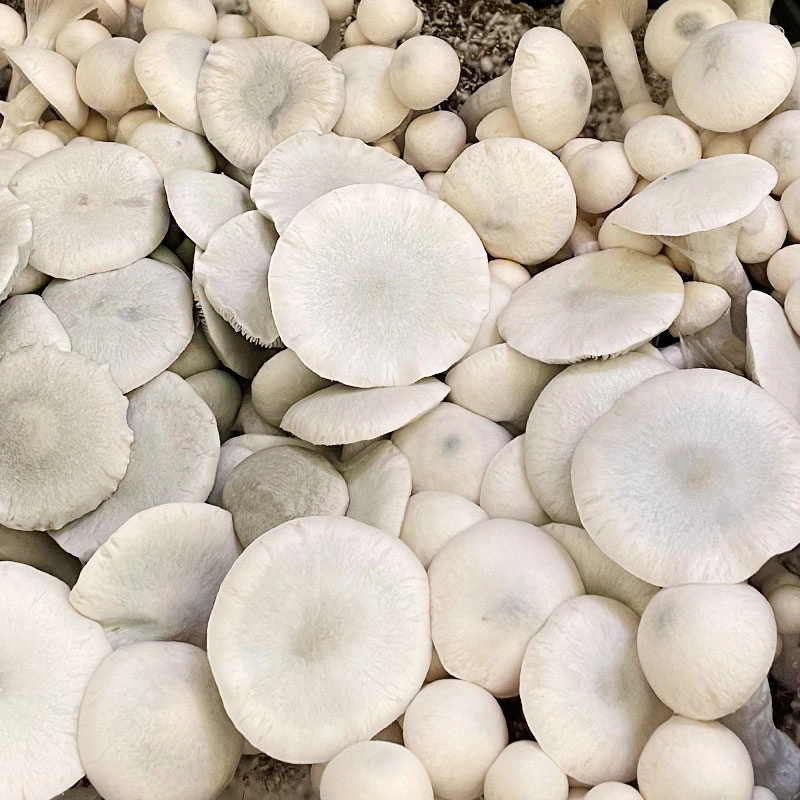
The ghost-white cube that fooled its own name: a pale, blue-bruising leucistic cube that still drops a proper dark purple print, so it studies like a classic A-strain and photographs like nothing else.
We didn't have a spare year to research every "strain" of Psilocybe cubensis, so instead we prompted Claude AI and to go reseach the web - this took an entire day and cost around £400 in token usage so we aren't deleting it. In amongst the sloppy AI copy, there are some true gems of information which are in fact real after our own research too. Make of this what you will.
What's known
Here's what's meant to be true and not.
What we actually know
- It is a plain Psilocybe cubensis, not a hybrid and not a separate species. The pale colour comes from a pigment-reducing (leucistic) trait, not from any cross.
- It is leucistic, not a true albino. The fruitbody loses most of its pigment and grows pale cream to white, but the spores stay normally coloured, so the print comes out a proper dark purple.
- Because the spores keep their pigment, it deposits a heavy, readable print just like a normally coloured cube. The pale-body, dark-print contrast is its signature.
- It is a modern hobbyist pick rather than a wild collection. No single verified creator, date or place of origin is documented, which is fair to say plainly.
- The white flesh against a dark spore deposit gives strong natural contrast on a slide and in a print. That's why collectors single it out for study.
What the community says
- The story most often told is that it is a leucistic offshoot of the A-strain (often written A+), which is itself widely attributed to the old Ralphsters Spores catalogue. Treat that parent lineage as hearsay, not proof.
- An early Albino A+ spore print is sometimes credited to a collector remembered only by the handle E-V-da-B (a credit that appears on vendor print listings). It is a tidy origin tag, but it is forum and vendor attribution rather than documented history.
- You will see it called both Albino A+ and AA+, and people argue over whether the parent was the A strain or the A+ strain. The names get used interchangeably and nobody can fully untangle them.
- It gets billed as a rare or exotic albino. In truth leucistic cubes turn up fairly regularly once a pale trait is in a strain, and this one is just a well-known, well-circulated example.
Where it came from
Albino A+ is one of those names that argues with itself the second you look closely. By most accounts it is a leucistic form of the old A-strain cubensis, which means the mushroom loses most of its body pigment and comes up pale cream to bone white, often with cold bluish tones. The giveaway is the spore print. A true albino would struggle to make pigment at all and tend to drop a faint or near-colourless print. This one drops a confident dark purple, which tells you the spores still carry their normal colour and only the flesh went pale. So the popular name is, strictly, wrong, and that little contradiction is the most interesting thing about it on a slide.
The deeper history is thin, and that is worth saying straight. The strain is reportedly a pale offshoot of the A-strain (you will also see it written A+), itself usually traced back to the old Ralphsters Spores catalogue, and an early Albino A+ print is sometimes credited to a collector known only as E-V-da-B. All of that is community and vendor attribution rather than documented record. There is no verified creator, no clean date, no place of origin. It is a modern pick that drifted out of the hobby spore trade, and the version of its story keeps the facts and the forum talk in separate boxes.
A true albino can barely make pigment and prints pale. Albino A+ prints dark purple, which is the tell that this is leucistic: the body went white, the spores never got the memo.
What to expect at the scope
Because the spores keep their colour, you get the best of both worlds for study. The pale fruitbody is a vivid bit of pigment biology to photograph, and the print behaves like any normally coloured cube: heavy, even, easy to read. Apparently the pale flesh still bruises an intense blue-green where it is handled, the same psilocin-oxidation chemistry seen across the wider Psilocybe group, so the ghost-white body and the bruise and the dark print together make it a genuinely satisfying specimen to compare against a standard A-strain or a B+.
- Psilocybe cubensis
- A Strain
- A+ Albino
- Amazonian
- APE Revert
- Australian Gold Cap
- B+
- Ban Hua Thai
- Blue Magnolia
- Blue Meanie
- Burma
- Cambodian
- Corumba Brazil
- Costa Rican
- E4K
- Ecuador
- Escondido
- Fiji
- Full Moon Party
- Golden Halo
- Golden Teacher
- Guapiles
- Gulf Coast
- Hawaiian
- Hitchhiker
- Huautla
- Jedi Mind Fuck
- Koh Samui
- Koh Samui Super Strain
- Leucistic Burma
- Leucistic Ecuador
- Lizard King
- Malabar Coast
- Mazatapec
- McKennaii
- Mexican Dutch King
- Moby Big
- Nepal Chitwan
- Nezuko
- Our Selection
- Pakalensis
- Penis Envy
- Penis Envy Uncut
- Pensacola
- Pink Buffalo
- Psylocybe Fanaticus
- Puerto Rican
- Redboy
- Rusty White
- Stargazer
- Take Mountain
- Taman Negara
- TEX PE6
- Texas Yellow Cap
- Tidal Wave
- Treasure Coast
- VZ3 (Venezuela)
- White Golden Teacher
- Yosterizii
- Z-Strain