


Psilocybe cubensis
Stargazer.
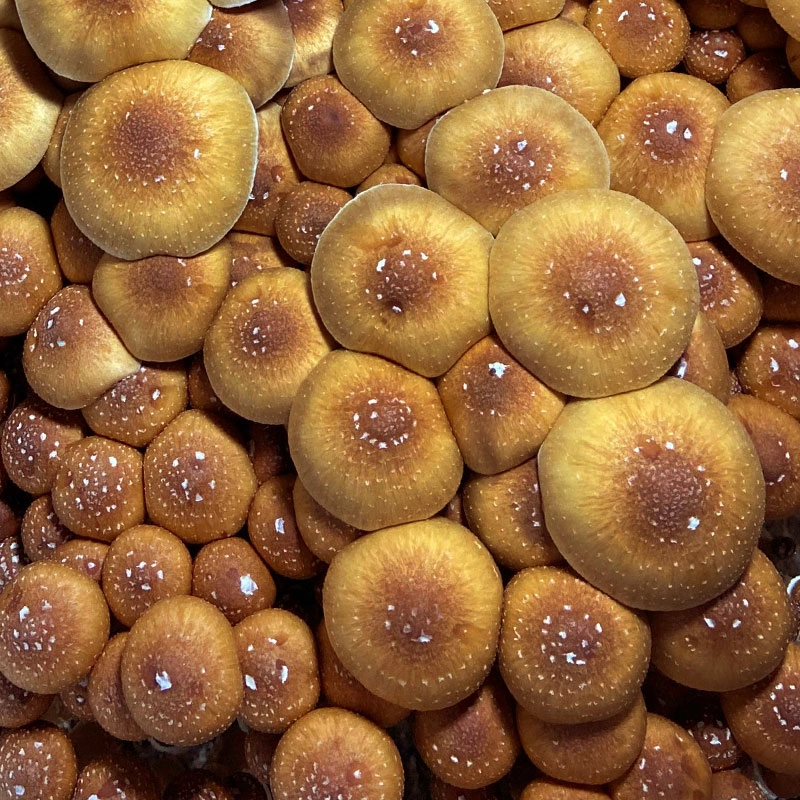
A classic-name cubensis with a great story and a shaky paper trail. Caps that tip up toward the sky as they age, and a heavy, dark purple-brown print that makes it a pleasure on the slide.

We didn't have a spare year to research every "strain" of Psilocybe cubensis, so instead we prompted Claude AI and to go reseach the web - this took an entire day and cost around £400 in token usage so we aren't deleting it. In amongst the sloppy AI copy, there are some true gems of information which are in fact real after our own research too. Make of this what you will.
What's known
Here's what's meant to be true and not.
What we actually know
- Genetically it is an ordinary Psilocybe cubensis, the same species as every other cube. No hybrid, no separate species.
- It has circulated for years as a named collector strain, often sold as both Stargazer and Inca Stargazer, which by most accounts refer to the same thing.
- It drops a heavy, dark purple-brown spore print and deposits readily, which is exactly what makes it a satisfying strain to study.
- The name is usually explained by the way the caps tend to tip slightly upward as they mature, as though gazing skyward.
What the community says
- The popular origin story says it was found near the Inca ruins at Machu Picchu in the Peruvian Andes. There is no documentation for this, and it is best treated as marketing lore.
- Vendors often claim it was used in ceremony by indigenous peoples, though the names cited (such as the Nahua) are Mesoamerican rather than Andean, which muddles the tale considerably.
- It is frequently said to appear in Stamets and Chilton's The Mushroom Cultivator. It does not. The cubensis strains named in that book were Amazonian, Ecuadorian, Matias Romero, Misantla and Palenque.
- An old forum tale even had Nostradamus using these mushrooms for scrying, which is impossible given there are no native cubensis in Europe.
- Many experienced collectors regard Stargazer as essentially a name on a label, since a cube is a cube.
Where it came from
Stargazer is one of those cubensis strains where the romance is louder than the record. The story you will hear, again and again, is that it was found high in the Peruvian Andes near the Inca ruins of Machu Picchu, and that ancient peoples used it in ceremony. It is a lovely image. It is also, as far as anyone can actually show, undocumented. Treat the whole Andean origin as community lore rather than history.
The tale tends to unravel the moment you tug on it. Some versions credit ceremonial use to the Nahua, who were a Mesoamerican people of Mexico, not Andean Peru, so the geography quietly contradicts itself. Another stubborn claim is that Stargazer is written up in Stamets and Chilton's The Mushroom Cultivator. By most accounts it simply isn't. The cubensis strains that book actually names are Amazonian, Ecuadorian, Matias Romero, Misantla and Palenque, and Stargazer is not among them.
The version is short: Stargazer is a plain Psilocybe cubensis with a great name and a backstory nobody can verify. The mushroom is real. The legend is mostly decoration.
What to expect at the scope
The most repeated and most charming explanation is the simplest one. As the fruitbodies mature, their caps reportedly tend to tip slightly upward, so a flush looks like a little crowd of faces turned toward the sky. Hence Stargazer. Whether that tilt is a genuine quirk of this strain or just something a grower noticed once and a vendor ran with, nobody can say for certain. What is not in doubt is that under the microscope it behaves like a healthy, heavy-depositing cubensis.
- Psilocybe cubensis
- A Strain
- A+ Albino
- Amazonian
- APE Revert
- Australian Gold Cap
- B+
- Ban Hua Thai
- Blue Magnolia
- Blue Meanie
- Burma
- Cambodian
- Corumba Brazil
- Costa Rican
- E4K
- Ecuador
- Escondido
- Fiji
- Full Moon Party
- Golden Halo
- Golden Teacher
- Guapiles
- Gulf Coast
- Hawaiian
- Hitchhiker
- Huautla
- Jedi Mind Fuck
- Koh Samui
- Koh Samui Super Strain
- Leucistic Burma
- Leucistic Ecuador
- Lizard King
- Malabar Coast
- Mazatapec
- McKennaii
- Mexican Dutch King
- Moby Big
- Nepal Chitwan
- Nezuko
- Our Selection
- Pakalensis
- Penis Envy
- Penis Envy Uncut
- Pensacola
- Pink Buffalo
- Psylocybe Fanaticus
- Puerto Rican
- Redboy
- Rusty White
- Stargazer
- Take Mountain
- Taman Negara
- TEX PE6
- Texas Yellow Cap
- Tidal Wave
- Treasure Coast
- VZ3 (Venezuela)
- White Golden Teacher
- Yosterizii
- Z-Strain