


Psilocybe cubensis
Taman Negara.
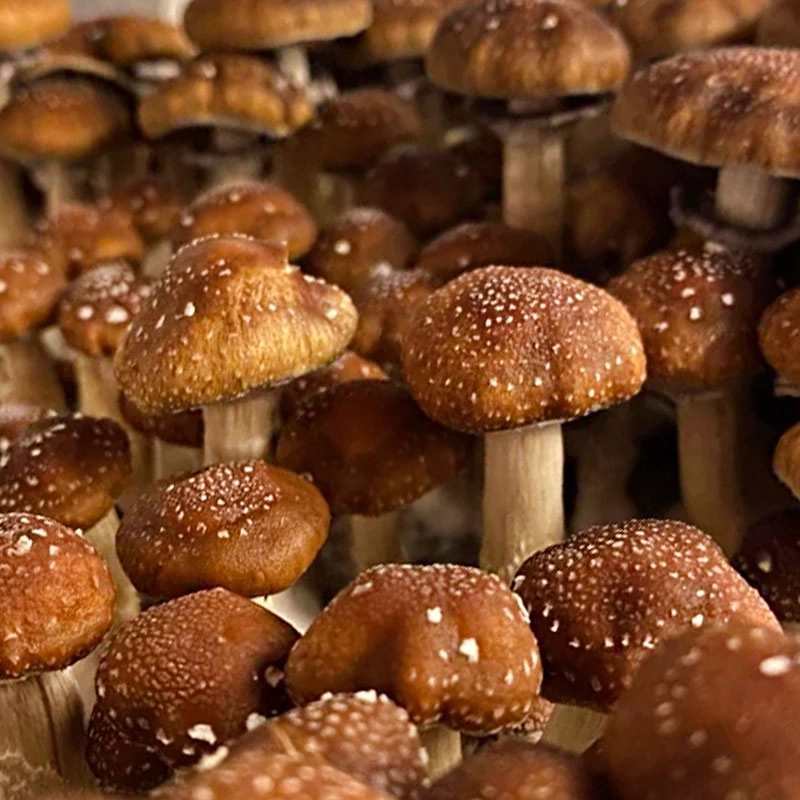
A red-capped cube from one of the oldest rainforests on the map. The story goes it was wild-collected in Malaysia's Taman Negara, and it drops a heavy, textbook-dark purple-brown print.

We didn't have a spare year to research every "strain" of Psilocybe cubensis, so instead we prompted Claude AI and to go reseach the web - this took an entire day and cost around £400 in token usage so we aren't deleting it. In amongst the sloppy AI copy, there are some true gems of information which are in fact real after our own research too. Make of this what you will.
What's known
Here's what's meant to be true and not.
What we actually know
- Genetically it is a plain Psilocybe cubensis, the same species as every other cube. The name marks a strain, not a separate mushroom.
- Its most distinctive feature is colour: caps emerge dark red to reddish-brown and ripen to golden-brown, a tone that is genuinely uncommon among cubensis strains.
- It deposits a normal, heavy dark purplish-brown spore print, with spores around 13 x 8 micrometres on four-spored basidia, so it studies like a textbook cube under the scope.
- The earliest writeups online only go back to around 2016, so by collector standards this is a fairly recent and lightly documented strain.
What the community says
- The story goes it was wild-collected in Taman Negara, a Malaysian national park said to be one of the oldest tropical rainforests on Earth at well over a hundred million years old.
- The strain surfaced through Spanish-speaking circles, with the earliest mention on the Teonanacatl forum and a wild print apparently shared by a group remembered as FreeSporeEspana (FSE).
- It is said to have reached the wider English-speaking scene around 2018 to 2019, passed to a Reddit spore trader who spread it from there.
- It is often sold as a true Malaysian wild-collected strain, but the lineage paperwork is thin enough that this is best taken as community claim rather than settled fact.
- Like most cubes it sometimes gets billed as unusually potent. A cube is a cube, and strain-to-strain strength claims are mostly overstated.
Where it came from
Taman Negara borrows its name from a Malaysian national park that is, by most accounts, one of the oldest tropical rainforests anywhere, often quoted at well over a hundred million years old. Whether or not the mushroom truly walked out of that exact rainforest, it is a wonderful piece of branding, and it is the kind of name that sticks.
The version of the history is shorter than the marketing. The earliest mentions anyone can point to only go back to around 2016, on the Spanish-language Teonanacatl forum, and the strain is said to have spread first through Spanish-speaking growers. A wild print apparently changed hands via a group remembered as FreeSporeEspana, reached a Reddit spore trader somewhere around 2018 to 2019, and travelled outward from there. None of that is documented the way a lab record would be, so take it as community lore.
The romantic claim is a wild Malaysian wild-collected strain from a primordial jungle. The provable part is a recent, lightly recorded cube with an unusually red cap. Both can be true, and only one of them is on paper.
What to expect at the scope
Where Taman Negara earns its keep is colour. Most cubes land somewhere in the golden-to-caramel range, but this one is said to open dark red to reddish-brown before ripening toward gold, a tone collectors describe as rare among cubensis strains. Early flushes reportedly throw a mix of domed and slightly pointed caps too. None of that makes it a different species, and it does not change what you see on a slide. It just gives a familiar mushroom a face worth photographing.
- Psilocybe cubensis
- A Strain
- A+ Albino
- Amazonian
- APE Revert
- Australian Gold Cap
- B+
- Ban Hua Thai
- Blue Magnolia
- Blue Meanie
- Burma
- Cambodian
- Corumba Brazil
- Costa Rican
- E4K
- Ecuador
- Escondido
- Fiji
- Full Moon Party
- Golden Halo
- Golden Teacher
- Guapiles
- Gulf Coast
- Hawaiian
- Hitchhiker
- Huautla
- Jedi Mind Fuck
- Koh Samui
- Koh Samui Super Strain
- Leucistic Burma
- Leucistic Ecuador
- Lizard King
- Malabar Coast
- Mazatapec
- McKennaii
- Mexican Dutch King
- Moby Big
- Nepal Chitwan
- Nezuko
- Our Selection
- Pakalensis
- Penis Envy
- Penis Envy Uncut
- Pensacola
- Pink Buffalo
- Psylocybe Fanaticus
- Puerto Rican
- Redboy
- Rusty White
- Stargazer
- Take Mountain
- Taman Negara
- TEX PE6
- Texas Yellow Cap
- Tidal Wave
- Treasure Coast
- VZ3 (Venezuela)
- White Golden Teacher
- Yosterizii
- Z-Strain