


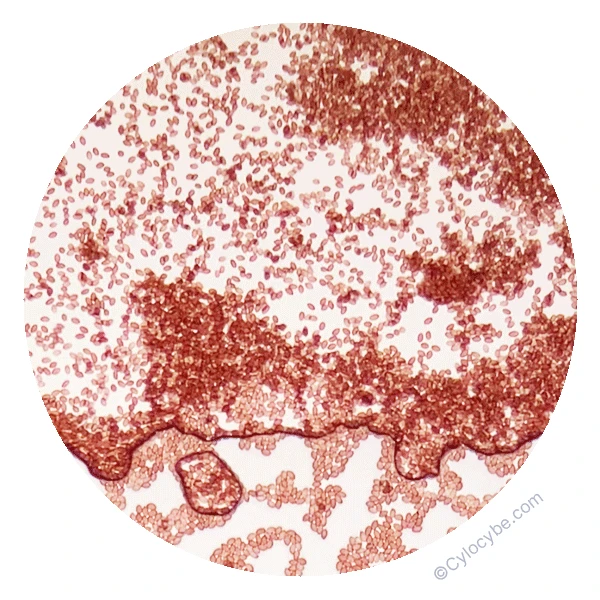
Psilocybe cubensis
Pensacola.
A Gulf Coast cube named for the Florida panhandle, with tan caps that famously turn up at the rim and sometimes split, plus a clean, dependable dark spore drop.

We didn't have a spare year to research every "strain" of Psilocybe cubensis, so instead we prompted Claude AI and to go reseach the web - this took an entire day and cost around £400 in token usage so we aren't deleting it. In amongst the sloppy AI copy, there are some true gems of information which are in fact real after our own research too. Make of this what you will.
What's known
Here's what's meant to be true and not.
What we actually know
- Genetically it is a plain Psilocybe cubensis, not a hybrid, not an albino or leucistic strain, and not a separate species.
- Its name points to Pensacola, a city on the western Florida panhandle, a region where wild cubensis does genuinely occur on dung in warm subtropical pastures.
- It drops a normal, dependable dark purple-brown spore print, the standard heavy depositor you expect from the species.
- A trait repeatedly reported for it is caps that turn upward at the rim and sometimes split open as they mature, with the gills going near-black under heavy spore drop.
What the community says
- The story goes that Pensacola began as a wild Florida collection from around its namesake city, but no collector, date or original print is documented, so the wild-origin tale is community lore rather than recorded history.
- Some sellers present it as a distinct, long-established Florida wild-collected strain, but it is just as likely a vendor name attached at some point to an ordinary Gulf Coast cube. Nobody can point to a paper trail.
- It is often described in grower circles as a fast, beginner-friendly colonizer. That is cultivation talk and tells you nothing about the spores under a microscope.
- Its strength is usually called average for the species, which is the answer for almost every cube. As the saying goes, a cube is a cube.
Where it came from
Pensacola wears its supposed home on its sleeve. The name belongs to a city on the western Florida panhandle, right on the Gulf of Mexico, and that matters because this is not an invented-sounding label slapped on a random cube. Wild Psilocybe cubensis really does live across the Gulf Coast, fruiting from cattle and horse dung in warm, humid pastures from roughly summer into autumn. So a strain collected somewhere near Pensacola is entirely plausible on the face of it.
The trouble is that plausible is as far as the evidence goes. Most accounts say the strain is said to have started as a wild Florida find, but there is no documented collector, no date, and no surviving original print to anchor that claim. It could be a genuine panhandle wild-collected strain passed quietly hand to hand, or it could be a perfectly ordinary Gulf Coast cube that picked up a geographic name somewhere along the vendor chain. Both happen constantly in this hobby, and we cannot tell you which one this is.
Treat the Pensacola backstory as community lore, not recorded history. The Florida wild population is real, but this particular strain's paper trail is not.
What to expect at the scope
For all the geographic romance, Pensacola is a plain Psilocybe cubensis. It is not an albino or leucistic strain, so the spores deposit dark in the normal way. It is not a Penis Envy type, so there is no contested McKenna-era origin myth to untangle here. What it apparently brings to the table is a look: tan caps that, the story goes, like to upturn at the margin and occasionally split as they ripen, finishing dusted purple-black from a heavy spore drop. That quirk is what most people remember it for.
- Psilocybe cubensis
- A Strain
- A+ Albino
- Amazonian
- APE Revert
- Australian Gold Cap
- B+
- Ban Hua Thai
- Blue Magnolia
- Blue Meanie
- Burma
- Cambodian
- Corumba Brazil
- Costa Rican
- E4K
- Ecuador
- Escondido
- Fiji
- Full Moon Party
- Golden Halo
- Golden Teacher
- Guapiles
- Gulf Coast
- Hawaiian
- Hitchhiker
- Huautla
- Jedi Mind Fuck
- Koh Samui
- Koh Samui Super Strain
- Leucistic Burma
- Leucistic Ecuador
- Lizard King
- Malabar Coast
- Mazatapec
- McKennaii
- Mexican Dutch King
- Moby Big
- Nepal Chitwan
- Nezuko
- Our Selection
- Pakalensis
- Penis Envy
- Penis Envy Uncut
- Pensacola
- Pink Buffalo
- Psylocybe Fanaticus
- Puerto Rican
- Redboy
- Rusty White
- Stargazer
- Take Mountain
- Taman Negara
- TEX PE6
- Texas Yellow Cap
- Tidal Wave
- Treasure Coast
- VZ3 (Venezuela)
- White Golden Teacher
- Yosterizii
- Z-Strain