


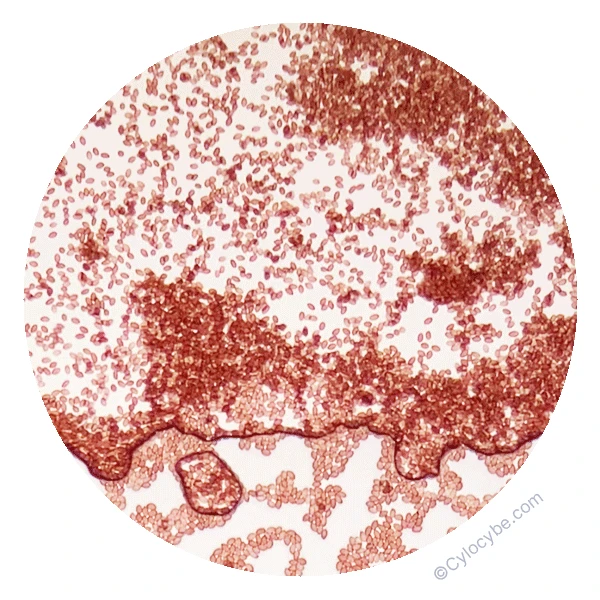
Psilocybe cubensis
Corumba Brazil.
A Pantanal wetlands cube named for the Brazilian river port of Corumba, known for the sharp little peak on its cap and a heavy, textbook purple-brown spore drop.

We didn't have a spare year to research every "strain" of Psilocybe cubensis, so instead we prompted Claude AI and to go reseach the web - this took an entire day and cost around £400 in token usage so we aren't deleting it. In amongst the sloppy AI copy, there are some true gems of information which are in fact real after our own research too. Make of this what you will.
What's known
Here's what's meant to be true and not.
What we actually know
- It is a Psilocybe cubensis strain named after Corumba, a river port in Mato Grosso do Sul, southwestern Brazil, sitting on the Paraguay River at the edge of the Pantanal wetlands.
- It is a plain cubensis, not a hybrid and not a separate species. The name marks a geographic origin, not a cross.
- It has been circulating among spore vendors since at least the early 2010s, which makes it fairly old by modern named-strain standards.
- Its most cited field mark is an acutely umbonate cap, a sharp central point that vendors and collectors repeatedly single out as the thing that sets it apart from rounder cubensis caps.
- It deposits a standard heavy, dark purplish-brown spore print, with the usual smooth subellipsoid cubensis spores on four-spored basidia.
What the community says
- It was wild-collected near Corumba in the Pantanal, but no named collector, exact date or herbarium record is on the public record, so the precise origin is community lore rather than documented history.
- It is often sold simply as Brazil or Brazilian, and vendors disagree over whether Corumba and the broader Brazil strain are the same genetics or two distinct collections from the same country. Treat the distinction as marketplace folklore.
- South American cubensis strains carry a reputation among hobbyists as exemplary genetics. That is collector enthusiasm, not a measured fact about this particular strain.
- You will see the name spelled Corumba, Curumba, Corumba Brazil and Brazil Corumba more or less interchangeably, which is a good sign the paperwork was never tight to begin with.
Where it came from
Some cubensis strains are named after a hobbyist or an inside joke. This one is named after a place, and a genuinely spectacular one. Corumba is a river port in Mato Grosso do Sul, perched on the Paraguay River right at the western gateway of the Pantanal, the largest tropical wetland on earth, a flooded plain of caimans, capybara and jabiru storks. The story goes that the original spores were wild-collected somewhere out in that dung-rich, cattle-grazed floodplain, which is exactly the warm, coprophilic habitat Psilocybe cubensis loves.
How much of that is documented? Not much. The common version is that the strain has been passed around the spore trade since the early 2010s, but there is no named collector, no precise date and no herbarium voucher you can point a sceptic at. So take the romantic Pantanal backstory as community lore rather than settled fact, and enjoy it as the good story it is.
It is named for a real place on a real river, which is more than most cube strains can say, even if the collection itself was never properly written down.
What to expect at the scope
The other wrinkle is the name. You will find this sold as Corumba, Curumba, Corumba Brazil, or plain Brazilian, and vendors do not agree on whether Corumba is its own thing or just a regional label on the broader Brazil strain. Some insist the two are distinct collections from the same country. Without genetics to settle it, that argument is unwinnable, so we will say plainly what it is: a South American cubensis, apparently from the Pantanal, with one very recognisable habit on the mushroom itself.
- Psilocybe cubensis
- A Strain
- A+ Albino
- Amazonian
- APE Revert
- Australian Gold Cap
- B+
- Ban Hua Thai
- Blue Magnolia
- Blue Meanie
- Burma
- Cambodian
- Corumba Brazil
- Costa Rican
- E4K
- Ecuador
- Escondido
- Fiji
- Full Moon Party
- Golden Halo
- Golden Teacher
- Guapiles
- Gulf Coast
- Hawaiian
- Hitchhiker
- Huautla
- Jedi Mind Fuck
- Koh Samui
- Koh Samui Super Strain
- Leucistic Burma
- Leucistic Ecuador
- Lizard King
- Malabar Coast
- Mazatapec
- McKennaii
- Mexican Dutch King
- Moby Big
- Nepal Chitwan
- Nezuko
- Our Selection
- Pakalensis
- Penis Envy
- Penis Envy Uncut
- Pensacola
- Pink Buffalo
- Psylocybe Fanaticus
- Puerto Rican
- Redboy
- Rusty White
- Stargazer
- Take Mountain
- Taman Negara
- TEX PE6
- Texas Yellow Cap
- Tidal Wave
- Treasure Coast
- VZ3 (Venezuela)
- White Golden Teacher
- Yosterizii
- Z-Strain