


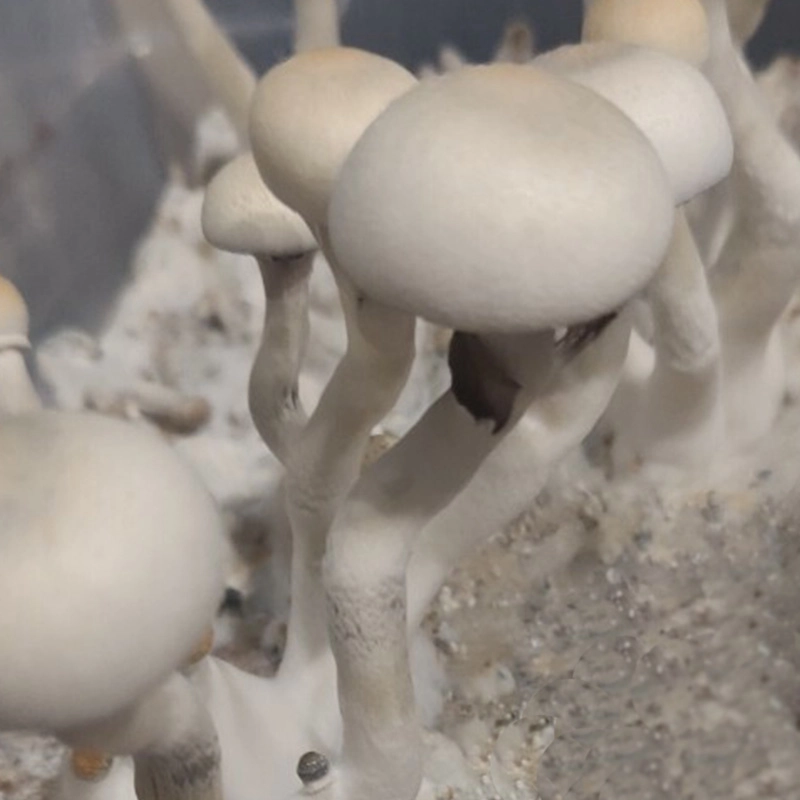
Psilocybe cubensis
Leucistic Burma.
A washed-out, almost-albino take on the old Burma line, pale alabaster caps with soft lavender tones, yet it still drops a properly purple spore print. Leucistic, not albino, and that difference is the whole point under the scope.

We didn't have a spare year to research every "strain" of Psilocybe cubensis, so instead we prompted Claude AI and to go reseach the web - this took an entire day and cost around £400 in token usage so we aren't deleting it. In amongst the sloppy AI copy, there are some true gems of information which are in fact real after our own research too. Make of this what you will.
What's known
Here's what's meant to be true and not.
What we actually know
- Its parent, plain Burma, is a Psilocybe cubensis whose backstory traces to Myanmar (the Yangon area) and to ethnomycologist John W. Allen, who is credited with spreading it through the late-1990s scene.
- Leucistic Burma is genetically still Psilocybe cubensis. It is a low-pigment selection of Burma, not a hybrid and not a separate species.
- Leucistic means reduced, washed-out pigment rather than the total pigment loss of a true albino, so the fruitbodies look pale and almost-albino while still carrying faint colour.
- Because it is leucistic and not albino, it still produces dark, purple-brown spores in mass, which is exactly how a microscopist tells the two conditions apart.
- Compared with its vigorous parent Burma, this leucistic strain is generally reported to drop a somewhat lighter spore print, though accounts vary.
What the community says
- The leucistic version is most often said to have been isolated in a lab from ordinary Burma spores and released around 2019, but the naming and exact attribution differ between sources, so treat the release story as community lore.
- Different vendors credit different people with first isolating it, which is a familiar sign of a modern strain whose real paper trail is thin.
- The parent Burma's own origin myth, a Thai student finding it in buffalo dung in a rice paddy outside Yangon before handing it to John Allen, is repeated everywhere but is best read as a good story rather than documented fact.
- Because pale and white cubes get marketed as rare and special, leucistic strains like this one attract more romance than their short, recent history really supports.
Where it came from
To understand Leucistic Burma you first have to know plain Burma, a Psilocybe cubensis with one of the better-travelled backstories in the hobby. The common version is that the trail runs to Myanmar, to a rice paddy outside Yangon, where a student is said to have collected it from buffalo dung and passed it to the ethnomycologist John W. Allen, who reportedly spread it through the online scene in the late 1990s. Allen has apparently said that a great many of the strains sold today trace back to his collecting trips through Southeast Asia. Take the romantic detail as lore, but the broad Burma lineage is real and widely documented.
The leucistic strain is a much more recent and much thinner story. It is generally described as a low-pigment selection pulled out of ordinary Burma in a lab, rather than anything collected from the wild, and it is usually dated to around 2019. Beyond that the details get fuzzy: different sellers credit different people with first isolating and naming it, which is the classic fingerprint of a modern vendor strain whose history was never really written down. We would rather say that plainly than dress it up.
The version is that this is a striking, recent selection of an old strain, and the bit collectors care about is not the backstory but the spores.
What to expect at the scope
The word does a lot of work here. Leucism is a partial washing-out of pigment, not the near-total loss you get in a true albino. So the fruitbodies come up pale and almost-albino, sometimes with a soft lavender cast as they mature, but they keep just enough colour to give the game away. The cleanest tell sits under the microscope, where a leucistic Burma still drops a dark, purple-brown spore print, while a genuine albino tends to leave little or nothing. If you are collecting it to study, that contrast between a near-white cap and a properly normally coloured print is the most interesting thing about it.
- Psilocybe cubensis
- A Strain
- A+ Albino
- Amazonian
- APE Revert
- Australian Gold Cap
- B+
- Ban Hua Thai
- Blue Magnolia
- Blue Meanie
- Burma
- Cambodian
- Corumba Brazil
- Costa Rican
- E4K
- Ecuador
- Escondido
- Fiji
- Full Moon Party
- Golden Halo
- Golden Teacher
- Guapiles
- Gulf Coast
- Hawaiian
- Hitchhiker
- Huautla
- Jedi Mind Fuck
- Koh Samui
- Koh Samui Super Strain
- Leucistic Burma
- Leucistic Ecuador
- Lizard King
- Malabar Coast
- Mazatapec
- McKennaii
- Mexican Dutch King
- Moby Big
- Nepal Chitwan
- Nezuko
- Our Selection
- Pakalensis
- Penis Envy
- Penis Envy Uncut
- Pensacola
- Pink Buffalo
- Psylocybe Fanaticus
- Puerto Rican
- Redboy
- Rusty White
- Stargazer
- Take Mountain
- Taman Negara
- TEX PE6
- Texas Yellow Cap
- Tidal Wave
- Treasure Coast
- VZ3 (Venezuela)
- White Golden Teacher
- Yosterizii
- Z-Strain