


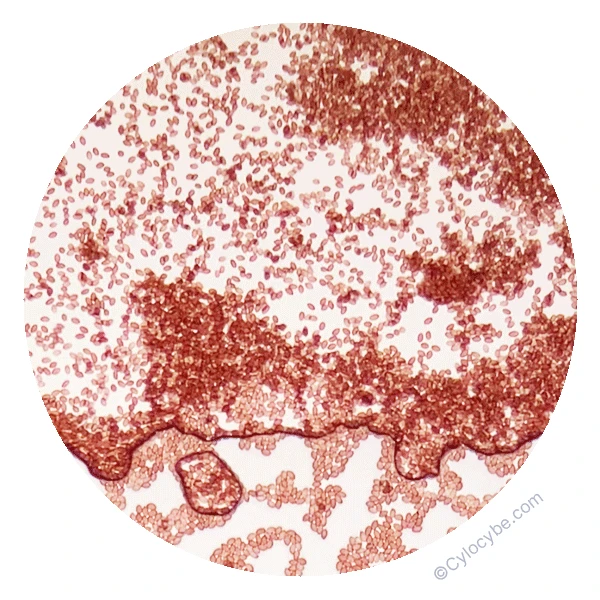
Psilocybe cubensis
Malabar Coast.
A wild-collected cube named for the tropical southwest coast of India, famous for one frustrating quirk: a stubborn veil that hangs on past maturity, so it gives up its spores grudgingly.

We didn't have a spare year to research every "strain" of Psilocybe cubensis, so instead we prompted Claude AI and to go reseach the web - this took an entire day and cost around £400 in token usage so we aren't deleting it. In amongst the sloppy AI copy, there are some true gems of information which are in fact real after our own research too. Make of this what you will.
What's known
Here's what's meant to be true and not.
What we actually know
- Genetically it is a plain Psilocybe cubensis, named for the Malabar Coast of southwest India. Not a hybrid, not a separate species.
- It is widely reported to be a wild-collected (wild-collected) strain from a hot, monsoon-soaked dung habitat rather than a hobbyist isolation.
- It is well known among collectors as a poor spore depositor: a partial veil leaves a papery ring that stays attached to cap and stem until full maturity, so prints come out light and sparse.
- Because of that, it is most often offered as a spore syringe rather than as a traditional print.
- The mature mushroom shows the usual cubensis traits, blue-green bruising and a dark purplish-brown spore colour when spores are gathered in mass.
What the community says
- The strain is often said to trace back to wild specimens collected from cattle, equine or even elephant dung along the southwest Indian coast, though the exact collector and date are not well documented.
- One vendor account credits a former Canadian spore provider, remembered only by the handle 3m, with making the original collection material available. Treat that as trade lore rather than verified history.
- A romantic claim links Malabar to Soma, the mysterious sacred drink of the ancient Indian Vedas described as a food of the gods. There is no real evidence for it, and the identity of Soma is itself unsolved.
- The name is sometimes spun as proof of an unbroken Indian psychedelic tradition. In truth the modern vendor strain is a fairly recent name with thin paper history behind it.
Where it came from
Most cubensis names come wrapped in an origin myth. Malabar Coast comes wrapped in a quirk. As far as anyone can tell, the strain traces to wild mushrooms collected on the Malabar Coast, the long, monsoon-drenched strip of southwest India that historically gave its name to a whole region of spice ports. It is the kind of hot, wet, dung-rich country where Psilocybe cubensis genuinely thrives, so a wild collection there is entirely plausible. Who actually made that collection, and when, is not something anyone has documented cleanly.
One vendor account credits a former Canadian spore supplier, remembered only by the handle 3m, with making the original specimens available. That is about as far as the paper trail goes, and it is trade lore more than verified history. The version is that Malabar is a fairly recent named strain carrying a very old-sounding name.
The backstory is not the interesting bit. The veil is: it hangs on much longer than most.
What to expect at the scope
Here is the genuinely strain-specific bit, and it is well attested. The mature mushroom carries a persistent papery ring, the leftover of the partial veil, that stays tenaciously stuck between cap and stem long after the thing has finished opening. The cap is reluctant to pull fully away from it. The practical upshot for a collector is that Malabar deposits spores poorly: prints come out light, patchy and frankly a bit annoying. That's why most sellers offer this one as a syringe. So when people warn you that Malabar is a stingy dropper, they are not knocking the strain. They are describing a real bit of its anatomy.
- Psilocybe cubensis
- A Strain
- A+ Albino
- Amazonian
- APE Revert
- Australian Gold Cap
- B+
- Ban Hua Thai
- Blue Magnolia
- Blue Meanie
- Burma
- Cambodian
- Corumba Brazil
- Costa Rican
- E4K
- Ecuador
- Escondido
- Fiji
- Full Moon Party
- Golden Halo
- Golden Teacher
- Guapiles
- Gulf Coast
- Hawaiian
- Hitchhiker
- Huautla
- Jedi Mind Fuck
- Koh Samui
- Koh Samui Super Strain
- Leucistic Burma
- Leucistic Ecuador
- Lizard King
- Malabar Coast
- Mazatapec
- McKennaii
- Mexican Dutch King
- Moby Big
- Nepal Chitwan
- Nezuko
- Our Selection
- Pakalensis
- Penis Envy
- Penis Envy Uncut
- Pensacola
- Pink Buffalo
- Psylocybe Fanaticus
- Puerto Rican
- Redboy
- Rusty White
- Stargazer
- Take Mountain
- Taman Negara
- TEX PE6
- Texas Yellow Cap
- Tidal Wave
- Treasure Coast
- VZ3 (Venezuela)
- White Golden Teacher
- Yosterizii
- Z-Strain