


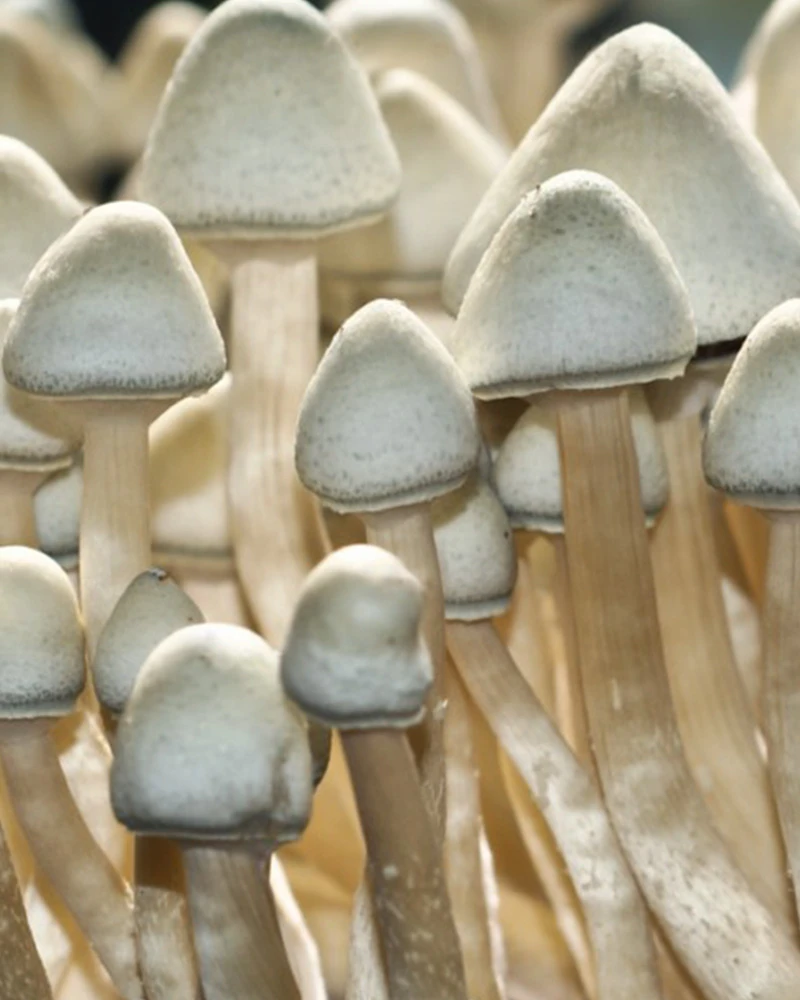
Psilocybe cubensis
Leucistic Ecuador.
A pale, frost-pretty version of a hardy Andean highland cube. White-to-cream caps with golden flecks, yet it still drops a proper dark purple-brown print, so it studies like a classic Ecuador.

We didn't have a spare year to research every "strain" of Psilocybe cubensis, so instead we prompted Claude AI and to go reseach the web - this took an entire day and cost around £400 in token usage so we aren't deleting it. In amongst the sloppy AI copy, there are some true gems of information which are in fact real after our own research too. Make of this what you will.
What's known
Here's what's meant to be true and not.
What we actually know
- Leucistic Ecuador is a plain Psilocybe cubensis, the same species as every other cube. The Ecuador name points to a highland wild-collected strain, and leucistic describes a pigment trait, not a separate species or a hybrid.
- Leucistic means a partial loss of body pigment, so caps and stems come out pale white to cream, often keeping a few golden flecks rather than going fully bare.
- Crucially it is leucistic and not albino: the spores still carry pigment, so it drops a heavy, dark purple-brown print just like a standard cube.
- The leucistic trait is recessive, which is why hobbyists keep selecting the palest specimens generation after generation to hold the look. A strain like this is maintained by selection, not found wild.
- The parent Ecuador strain is a hardy, heavy-fruiting wild-collected strain with thick stems and broad caps, traits this pale version is said to inherit.
What the community says
- The Ecuador parent strain is, by most accounts, said to have been collected around the year 2000 by a Shroomery member remembered only as BIO, near Otavalo in the northern Ecuadorian highlands at altitude. Treat the specifics as community lore rather than documented record.
- Because it apparently came from high, thin-air country, the Ecuador strain picked up a reputation as an unusually tough, resilient cube. A nice story, though hardiness claims are easy to repeat and hard to verify.
- The leucistic version itself has almost no documented backstory. Nobody seems to credit a particular person or date with isolating it, so the answer is that it is a hobbyist selection of unclear authorship.
- Vendors sometimes blur leucistic and albino together, but they are not the same thing, and calling this one albino would be wrong because its spores are clearly normally coloured.
- It is occasionally tied to old Andean ritual traditions in sales copy. Indigenous mushroom use in the region is real history, but linking it to one modern vendor isolate is a stretch.
Where it came from
Leucistic Ecuador is really two stories stacked on top of each other. The first is the Ecuador wild-collected strain underneath it, a stocky highland cube that, by most accounts, came out of the northern Ecuadorian mountains. The lore that gets repeated most often credits a collector remembered only as BIO, who is said to have printed it around the turn of the millennium somewhere near Otavalo, up where the air is thin. How much of that is documented and how much is forum folklore is genuinely hard to say, so take the names and dates as community memory rather than gospel.
The second story is the leucistic part, and here it gets easier because there is almost nothing to dress up. Leucism is a recessive pigment trait, and a pale strain like this is something a patient hobbyist selects into being by picking the whitest mushroom out of each flush, over and over, until the colour mostly drops out. Who first did that with the Ecuador strain, and when, nobody seems to record. So the fair description is a low-pigment isolation of a known wild-collected strain, of unclear authorship.
The single most useful thing to know about this one: leucistic is not albino. The body loses its colour, but the spores keep theirs.
What to expect at the scope
That distinction is the whole reason this strain is fun under a microscope. A true albino loses pigment everywhere, spores included, and gives you a faint, frustrating print. Leucistic Ecuador only loses it from the flesh, so you get the best of both: a pale, frost-white fruitbody with the odd golden fleck still showing, sitting over gills that still ripen dark and a print that lands a proper heavy purple-brown. Apparently it inherits the parent strain's generous spore drop, which means plenty of material to look at. The pale body is the novelty, but the spores are ordinary cubensis.
- Psilocybe cubensis
- A Strain
- A+ Albino
- Amazonian
- APE Revert
- Australian Gold Cap
- B+
- Ban Hua Thai
- Blue Magnolia
- Blue Meanie
- Burma
- Cambodian
- Corumba Brazil
- Costa Rican
- E4K
- Ecuador
- Escondido
- Fiji
- Full Moon Party
- Golden Halo
- Golden Teacher
- Guapiles
- Gulf Coast
- Hawaiian
- Hitchhiker
- Huautla
- Jedi Mind Fuck
- Koh Samui
- Koh Samui Super Strain
- Leucistic Burma
- Leucistic Ecuador
- Lizard King
- Malabar Coast
- Mazatapec
- McKennaii
- Mexican Dutch King
- Moby Big
- Nepal Chitwan
- Nezuko
- Our Selection
- Pakalensis
- Penis Envy
- Penis Envy Uncut
- Pensacola
- Pink Buffalo
- Psylocybe Fanaticus
- Puerto Rican
- Redboy
- Rusty White
- Stargazer
- Take Mountain
- Taman Negara
- TEX PE6
- Texas Yellow Cap
- Tidal Wave
- Treasure Coast
- VZ3 (Venezuela)
- White Golden Teacher
- Yosterizii
- Z-Strain