


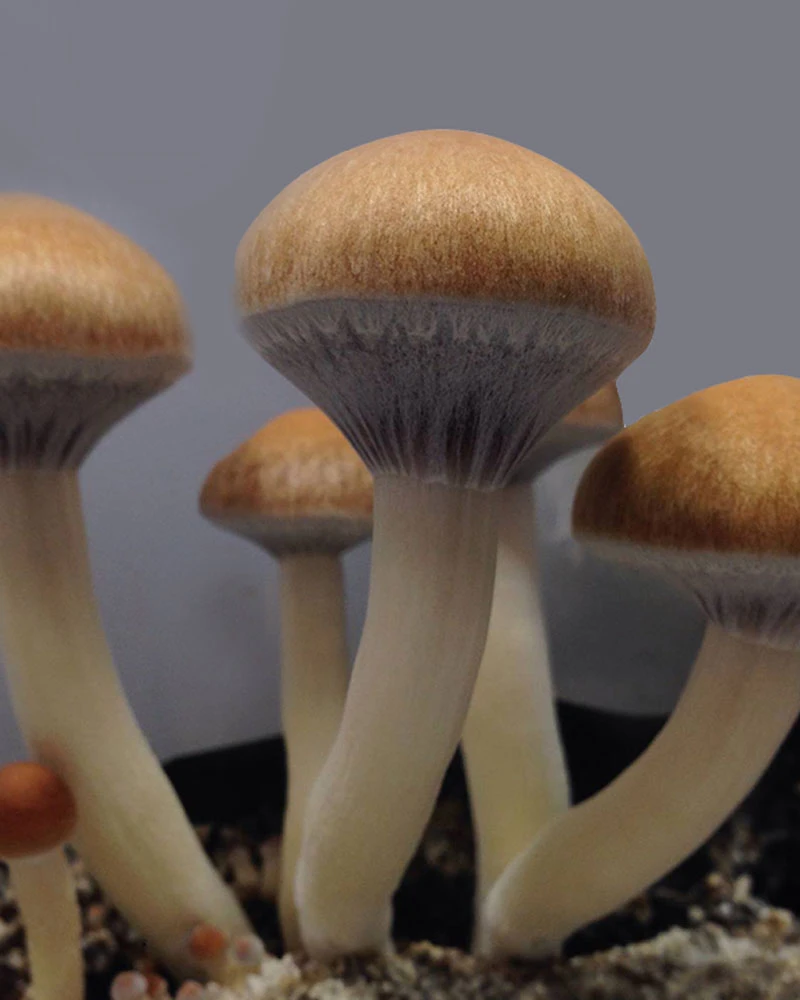
Psilocybe cubensis
Huautla.
A Mexican cube named for the Oaxacan town at the heart of mushroom history. Caramel caps, long curling stems, and a dark print that ties it to Maria Sabina's mountains.

We didn't have a spare year to research every "strain" of Psilocybe cubensis, so instead we prompted Claude AI and to go reseach the web - this took an entire day and cost around £400 in token usage so we aren't deleting it. In amongst the sloppy AI copy, there are some true gems of information which are in fact real after our own research too. Make of this what you will.
What's known
Here's what's meant to be true and not.
What we actually know
- It is a wild-collected strain, a wild geographic collection of plain Psilocybe cubensis taken from dung-enriched pastures near Huautla de Jimenez in Oaxaca, Mexico.
- It is named after the town, not after a creator. There is no documented breeder behind Huautla, which is normal for a wild-collected strain strain.
- As far as anyone can tell, it entered the online mycology scene through a Shroomery collector remembered as Club99, with the spores circulating from the late 1990s. The exact collection date is not recorded.
- It is a true Psilocybe cubensis, not a hybrid and not a separate species. A cube is a cube.
- Caps run average to small and the long stems often curl as the gills ripen, a look collectors use to recognise the strain.
- It drops a standard dark purple-brown to purple-black print, reported as an average depositor rather than a heavy one.
What the community says
- The town's fame comes from the 1955 velada in which banker R. Gordon Wasson sat with the Mazatec curandera Maria Sabina. That story is real, but the ritual mushrooms of that ceremony were other Mazatec species, not this cubensis, so the link to Sabina is geographic rather than literal.
- Vendors sometimes imply you are buying the very mushroom Maria Sabina used. Treat that as marketing romance; this is a cubensis wild-collected strain that happens to share her town's name.
- Because it comes from a high, cool mountain region, it is occasionally claimed to be a cold-hardy or high-altitude cube. The wild cubensis around the area still grows on dung in warm lowland pasture, so read altitude claims with caution.
- The Club99 attribution is community memory from old forum threads rather than firmly documented history, so even the name behind its release should be taken as lore.
Where it came from
Few strain names carry as much weight as Huautla. It points straight at Huautla de Jimenez, the mountain town in the Sierra Mazateca of Oaxaca where, in 1955, the banker R. Gordon Wasson sat through a nightlong velada with the Mazatec curandera Maria Sabina and brought the existence of psilocybin mushrooms to a Western audience. That part is history. The catch is that the mushrooms of that famous ceremony were other Mazatec ritual species, not Psilocybe cubensis, so the connection between this strain and Sabina herself is one of place, not of pedigree.
What we actually have here is a wild-collected strain, a wild collection of ordinary cubensis taken from the dung-rich cattle pastures of the same region. As far as anyone can tell, the spores reached the online hobby through a collector remembered only as Club99, and old forum threads put their first circulation somewhere in the late 1990s. The exact when and the exact who are not written down anywhere reliable, which is completely normal for a strain named after a landscape rather than a breeder.
The town is sacred, the strain is a souvenir. Huautla is a perfectly good cubensis that happens to wear one of the most famous postcodes in mushroom history.
What to expect at the scope
It is worth keeping the romance and the biology in separate jars. The history of Huautla de Jimenez is genuinely extraordinary, and the wild cubensis of that region is genuinely interesting to study. But anyone selling this as the mushroom Maria Sabina used has quietly crossed from fact into folklore. Treat the backstory as community lore, study the spores as what they plainly are, and you get the best of both: a real story and a slide.
- Psilocybe cubensis
- A Strain
- A+ Albino
- Amazonian
- APE Revert
- Australian Gold Cap
- B+
- Ban Hua Thai
- Blue Magnolia
- Blue Meanie
- Burma
- Cambodian
- Corumba Brazil
- Costa Rican
- E4K
- Ecuador
- Escondido
- Fiji
- Full Moon Party
- Golden Halo
- Golden Teacher
- Guapiles
- Gulf Coast
- Hawaiian
- Hitchhiker
- Huautla
- Jedi Mind Fuck
- Koh Samui
- Koh Samui Super Strain
- Leucistic Burma
- Leucistic Ecuador
- Lizard King
- Malabar Coast
- Mazatapec
- McKennaii
- Mexican Dutch King
- Moby Big
- Nepal Chitwan
- Nezuko
- Our Selection
- Pakalensis
- Penis Envy
- Penis Envy Uncut
- Pensacola
- Pink Buffalo
- Psylocybe Fanaticus
- Puerto Rican
- Redboy
- Rusty White
- Stargazer
- Take Mountain
- Taman Negara
- TEX PE6
- Texas Yellow Cap
- Tidal Wave
- Treasure Coast
- VZ3 (Venezuela)
- White Golden Teacher
- Yosterizii
- Z-Strain