


Psilocybe cubensis
Koh Samui.
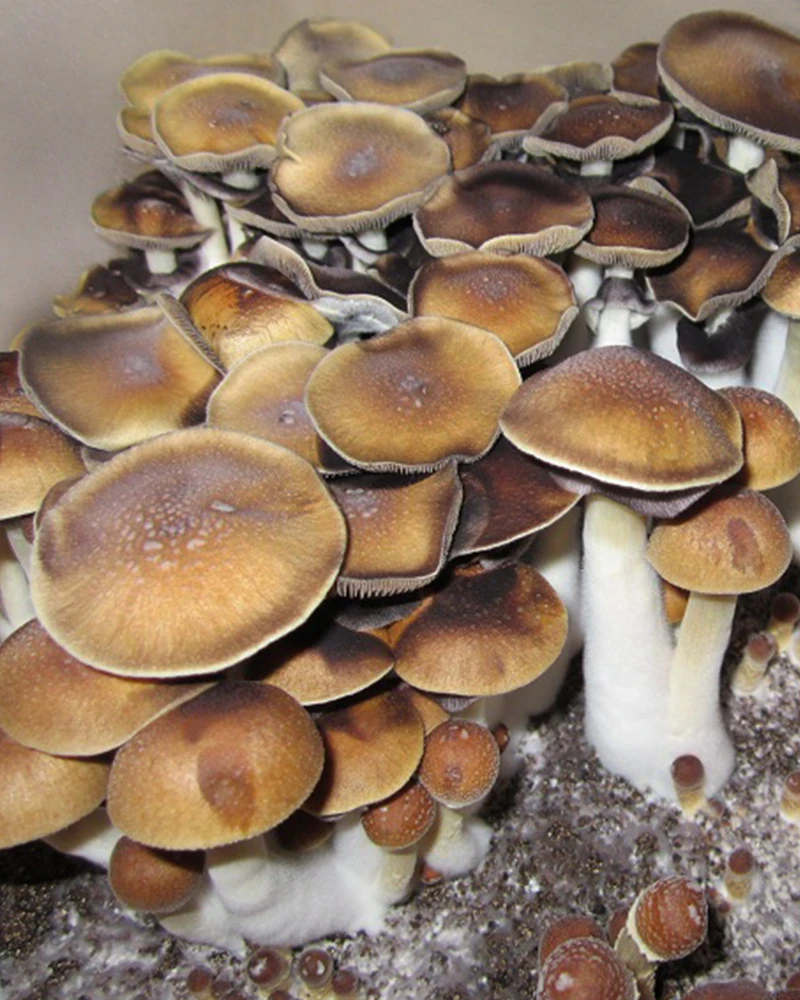
A Thai island cube tied to John Allen's field trips, famous for stumpy thick stems and broad saucer caps. A standard heavy purple-brown print and clean, textbook spores.

We didn't have a spare year to research every "strain" of Psilocybe cubensis, so instead we prompted Claude AI and to go reseach the web - this took an entire day and cost around £400 in token usage so we aren't deleting it. In amongst the sloppy AI copy, there are some true gems of information which are in fact real after our own research too. Make of this what you will.
What's known
Here's what's meant to be true and not.
What we actually know
- The name comes from Koh Samui, a tropical island in the Gulf of Thailand, where the strain is said to trace back to wild specimens collected on the island.
- It is associated with the ethnomycologist John W. Allen (Mushroom John), who collected mushroom specimens across Thailand and Southeast Asia in the late 1980s and 1990s.
- Genetically it is a plain Psilocybe cubensis, not a hybrid and not a separate species.
- It is reported to come from dung in rice-paddy plots fed by water buffalo and cattle, which fits cubensis perfectly as a coprophilic, dung-loving mushroom.
- Its field reputation is for short, thick, stocky stems and broad saucer-like caps rather than the tall lanky build of many cubes.
- It drops a standard dark purple-brown spore print and deposits readily. That's why collectors keep it on the shelf.
What the community says
- The 'Super Strain' or 'KSSS' label you often see is a vendor selection claim, said to be a larger and more vigorous pick from the original Koh Samui stock. Treat the upgrade as marketing rather than a separate documented lineage.
- Koh Samui the cubensis strain is frequently confused with Psilocybe samuiensis, a genuinely separate species from the same island. Allen co-described that species with Guzman and Bandala, but it is not this mushroom.
- Sub-names float around the hobby, from Koh Samui Classic to an albino version, and most are renamings rather than distinct documented stock.
- The exact collection date is told a few different ways, some accounts say 1989 to 1990, others just 'the nineties'. The island is solid, the calendar is fuzzy.
- It sometimes gets billed as an unusually potent Thai 'super' cube. A cube is a cube, and strain-to-strain strength claims are mostly cultivation talk, so take that one with salt.
Where it came from
Most cube names are folklore with the serial numbers filed off. Koh Samui is a nice change of pace, because there is a real place, a real collector, and a fairly clear paper trail behind it. As far as anyone can tell, the strain traces to the island of Koh Samui in the Gulf of Thailand, where the self-taught ethnomycologist John W. Allen, the man the hobby calls Mushroom John, was collecting wild specimens through the late 1980s and into the 1990s. He photographed, pressed and printed what he found, and several Thai cubensis strains that are still passed around today carry the names of the places he worked.
The substrate story is exactly what you would hope for from a cube. The mushrooms were reportedly found in rice-paddy plots fertilised by water buffalo and cattle, which is textbook habitat for a coprophilic, dung-loving species. Whether the stock circulating now is a faithful descendant of those exact prints or something that drifted over decades of hand-to-hand sharing is impossible to verify, so treat the unbroken-lineage version as community lore rather than gospel.
The island is documented, the collector is documented, but the chain from his 1990s prints to the syringe in your fridge is built on trust, not paperwork.
What to expect at the scope
Here is the trap people fall into. Allen also co-described a genuinely separate species from the same island, Psilocybe samuiensis (Guzman, Bandala and Allen, published in the early 1990s), a small reddish-brown grassland mushroom of the sandy, clay-rich soil in those rice fields. That is not this mushroom. Koh Samui the strain is a plain Psilocybe cubensis that happens to share an address with samuiensis. Same island, two different fungi. And the popular "Super Strain" badge is a vendor's selection claim, apparently a bigger, more vigorous pick from the original stock, so read it as a grade rather than a new lineage.
- Psilocybe cubensis
- A Strain
- A+ Albino
- Amazonian
- APE Revert
- Australian Gold Cap
- B+
- Ban Hua Thai
- Blue Magnolia
- Blue Meanie
- Burma
- Cambodian
- Corumba Brazil
- Costa Rican
- E4K
- Ecuador
- Escondido
- Fiji
- Full Moon Party
- Golden Halo
- Golden Teacher
- Guapiles
- Gulf Coast
- Hawaiian
- Hitchhiker
- Huautla
- Jedi Mind Fuck
- Koh Samui
- Koh Samui Super Strain
- Leucistic Burma
- Leucistic Ecuador
- Lizard King
- Malabar Coast
- Mazatapec
- McKennaii
- Mexican Dutch King
- Moby Big
- Nepal Chitwan
- Nezuko
- Our Selection
- Pakalensis
- Penis Envy
- Penis Envy Uncut
- Pensacola
- Pink Buffalo
- Psylocybe Fanaticus
- Puerto Rican
- Redboy
- Rusty White
- Stargazer
- Take Mountain
- Taman Negara
- TEX PE6
- Texas Yellow Cap
- Tidal Wave
- Treasure Coast
- VZ3 (Venezuela)
- White Golden Teacher
- Yosterizii
- Z-Strain