


Magic mushroom spores
Psilocybe cubensis.
The name
The formal record, from Index Fungorum:
Psilocybe cubensis (Earle) Singer, Sydowia 2(1-6): 37 (1948). Basionym: Stropharia cubensis Earle 1906.
Index Fungorum, record 290107
What that line means: Earle named this mushroom first, in 1906, but filed it under a different genus, Stropharia. Singer moved it into Psilocybe in 1948, and published that move in a journal called Sydowia, volume 2, page 37. Earle keeps the brackets because the first name was his. A basionym is simply the original name a later one was built on.
The genus itself:
Psilocybe (Fr.) P. Kumm., Führ. Pilzk. (Zerbst): 21 (1871).
Index Fungorum, genus record 18418
What that line means: the same idea one level up. Fries used the name first; Paul Kummer raised it to a full genus in 1871, in a German field guide printed in Zerbst. Fries in the brackets, Kummer outside them.
“Psilocybe cubensis was first described in 1906 as Stropharia cubensis by American mycologist Franklin Sumner Earle in Cuba.”
Wikipedia, Psilocybe cubensis
“The name Psilocybe is derived from the Ancient Greek roots psilos (ψιλος) and kubê (κυβη), and translates as ‘bare head’.”
Wikipedia, Psilocybe cubensis
“It belongs to the fungus family Hymenogastraceae.”
Wikipedia, Psilocybe cubensis
What a family is: the rank above genus. Older books file Psilocybe under Strophariaceae; DNA work moved it to Hymenogastraceae, so you will see both depending on how old the book is.
What it looks like
The cap:
“The cap is 1.6–8 cm, conic to convex with a central papilla when young, becoming broadly convex to plane with age, retaining a slight umbo sometimes surrounded by a ring-shaped depression. The cap surface is smooth and sticky, sometimes with white universal veil remnants attached.”
Wikipedia, Psilocybe cubensis
In plain English: the cap is roughly 1.5 to 8 cm across. Young ones are cone-shaped or domed with a small raised bump in the middle — that bump is the papilla. Older ones open out flat and usually keep it, sometimes with a shallow ring-shaped dip around it. The surface is smooth and sticky to the touch, and can carry white flecks, which are what is left of the veil that covered the mushroom when it was young.
The stem:
“The hollow white stipe is 4–15 cm high by 0.4–1.4 cm thick, becoming yellowish in age.”
Wikipedia, Psilocybe cubensis
In plain English: the stem. 40 to 150 mm tall, 4 to 14 mm thick, hollow down the middle, white to start with and yellowing as it ages.
The gills:
“The narrow grey gills are adnate to adnexed, sometimes seceding attachment, and darken to purplish-black and somewhat mottled with age.”
Wikipedia, Psilocybe cubensis
In plain English: the gills reach the stem and join it (adnate), or meet it only narrowly (adnexed), and sometimes pull away from it altogether as the cap opens out (seceding). They start grey and turn purple-black in uneven patches as the spores ripen — that patchiness is what mottled means.
And the reaction the genus is known for:
“When bruised, all parts of the mushroom stain blue.”
Wikipedia, Psilocybe cubensis
The blue is not psilocybin. It is what psilocybin becomes. Two enzymes taken from this species were described in 2020:
“We report two enzymes from Psilocybe cubensis that carry out a two-step cascade to prepare psilocybin for oxidative oligomerization that leads to blue products. The phosphatase PsiP removes the 4-O-phosphate group to yield psilocin, while PsiL oxidizes its 4-hydroxy group.”
Lenz, Wick, Braga, García-Altares, Lackner, Hertweck, Gressler & Hoffmeister, Angew. Chem. Int. Ed. 59(4): 1450–1454 (2020) · PubMed 31725937 · doi:10.1002/anie.201910175
In plain English: break the mushroom and two enzymes go to work in sequence. The first, PsiP, snips the phosphate group off psilocybin, which leaves psilocin. The second, PsiL, then oxidises that psilocin. The oxidised pieces link up with each other into short chains, and those chains are the blue you can see.
“MS and IR spectroscopy indicated the formation of a heterogeneous mixture of preferentially psilocyl 3- to 13-mers and suggest multiple oligomerization routes, depending on oxidative power and substrate concentration. The results also imply that phosphate ester of psilocybin serves a reversible protective function.”
Lenz et al. (2020) · PubMed 31725937
In plain English: the blue is not one compound but a mixture — chains of roughly three to thirteen linked units, in varying proportions depending on how much oxygen and how much starting material there is. That is why the colour varies from a faint blue-green to a deep ink stain. The last sentence is the neat part: the phosphate group that PsiP removes acts as a cap that keeps psilocybin stable while the mushroom is intact. Damage the mushroom and the cap comes off, which is why bruising is what triggers the colour.
Under the microscope
“The spores are 11.5–17.3 x 8–11.5 µm, sub-ellipsoid, basidia 4-spored but sometimes 2- or 3-, pleurocystidia and cheilocystidia present.”
Wikipedia, Psilocybe cubensis
In plain English: a µm is a micrometre, a thousandth of a millimetre, so the spores are about 12 to 17 thousandths of a millimetre long. Sub-ellipsoid means slightly oval. Basidia are the cells on the gills that make the spores, normally four at a time. Pleurocystidia and cheilocystidia are sterile cells that sit on the face and the edge of the gill; they make no spores, and which ones a mushroom has helps tell species apart under the scope.
Where it grows
“Psilocybe cubensis is found on cow (and occasionally horse) dung, sugar cane mulch or rich pasture soil.”
Wikipedia, Psilocybe cubensis
“Psilocybe cubensis is a pan-tropical species, occurring in the Gulf Coast states and southeastern United States, Mexico, in the Central American countries of Belize, Costa Rica, Panamá, El Salvador and Guatemala, the Caribbean countries Cuba, the Dominican Republic, Puerto Rico, Guadalupe, Martinique, and Trinidad, in the South American countries of Argentina, Bolivia, Brazil, Colombia, French Guiana, Paraguay, Uruguay and Peru, Southeast Asia, including Thailand, Vietnam, Cambodia and Malaysia, India, Australia, Fiji, and possibly Nepal and Hawaii.”
Wikipedia, Psilocybe cubensis
Where it came from
A paper published in Proceedings of the Royal Society B in March 2026 named the species' closest wild relative, Psilocybe ochraceocentrata, from grassland in South Africa and Zimbabwe. The two last shared an ancestor around 1.5 million years ago — far earlier than the long-held assumption that P. cubensis reached the Americas with cattle in the 1500s.
“Discovery of the closest free-living relative of the domesticated ‘magic mushroom’ Psilocybe cubensis in Africa”. Proc. R. Soc. B 293(2066): 20252270.
Bradshaw, Sharp, Van Der Merwe, Tremble & Dentinger, 11 March 2026 · doi:10.1098/rspb.2025.2270 · registry record
Psilocybin
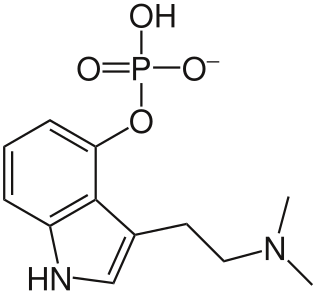
“Psilocybin… is a naturally occurring tryptamine alkaloid and investigational drug found in more than 200 species of mushrooms, with hallucinogenic and serotonergic effects.”
Wikipedia, Psilocybin
In plain English: an alkaloid is a nitrogen-containing compound made by a plant or fungus. Tryptamine describes its chemical skeleton, which is the same one serotonin is built on. Serotonergic means it acts on the body's serotonin receptors. Investigational drug means it is going through formal medical trials.
“Psilocybin itself is biologically inactive but quickly converted by the body to psilocin.” “Psilocybin is transformed into psilocin by dephosphorylation mediated via phosphatase enzymes.”
Wikipedia, Psilocybin
In plain English: psilocybin does nothing on its own. Enzymes called phosphatases strip a phosphate group off it — that is dephosphorylation — and what is left behind is psilocin, which is the active compound.
“In 1958, the Swiss chemist Albert Hofmann isolated psilocybin and psilocin from the mushroom Psilocybe mexicana.”
Wikipedia, Psilocybin
The law in the UK
“Fresh mushrooms had previously been widely available, even in shops.”
Wikipedia, Legal status of psilocybin mushrooms
“Section 21 of the Drugs Act 2005 made fresh psychedelic mushrooms (‘fungi containing psilocybin’) a Class A drug.” “From 18 July 2005 both fresh and ‘prepared’ (that is, dried, cooked or made into a tea) psilocybin mushrooms became illegal.”
Wikipedia, Legal status of psilocybin mushrooms
In plain English: before that date fresh mushrooms sat in a gap in the law and were sold openly, including in shops. Section 21 of the Drugs Act 2005 closed the gap. Since 18 July 2005 fresh and dried both count as Class A, the most serious category under the Misuse of Drugs Act 1971.
Why spores are different
“Mushroom spores, which do not contain psilocybin, are not regulated.”
Wikipedia, Legal status of psilocybin mushrooms
In plain English: the law controls psilocybin and psilocin. A spore contains neither, so it is not a controlled substance. That is the basis on which spores can be sold and studied here, and it is why growing is a different matter entirely.
Everything we sell is sold for microscopy, research and collecting.
- Psilocybe cubensis
- A Strain
- A+ Albino
- Amazonian
- APE Revert
- Australian Gold Cap
- B+
- Ban Hua Thai
- Blue Magnolia
- Blue Meanie
- Burma
- Cambodian
- Corumba Brazil
- Costa Rican
- E4K
- Ecuador
- Escondido
- Fiji
- Full Moon Party
- Golden Halo
- Golden Teacher
- Guapiles
- Gulf Coast
- Hawaiian
- Hitchhiker
- Huautla
- Jedi Mind Fuck
- Koh Samui
- Koh Samui Super Strain
- Leucistic Burma
- Leucistic Ecuador
- Lizard King
- Malabar Coast
- Mazatapec
- McKennaii
- Mexican Dutch King
- Moby Big
- Nepal Chitwan
- Nezuko
- Our Selection
- Pakalensis
- Penis Envy
- Penis Envy Uncut
- Pensacola
- Pink Buffalo
- Psylocybe Fanaticus
- Puerto Rican
- Redboy
- Rusty White
- Stargazer
- Take Mountain
- Taman Negara
- TEX PE6
- Texas Yellow Cap
- Tidal Wave
- Treasure Coast
- VZ3 (Venezuela)
- White Golden Teacher
- Yosterizii
- Z-Strain